
A million-dollar chiropractic practice sounds like a major milestone.
And it is.
But here’s the question most practice owners don’t ask soon enough:
What does the practice have to look like behind the scenes to produce $1 million consistently?
Because there’s a big difference between hitting seven figures once and building a seven-figure business.
One can happen through long hours, an overloaded schedule, aggressive marketing, and an owner who carries nearly everything.
The other is built on systems.
It has a team that knows what to do.
Marketing produces new opportunities consistently.
Patients receive an excellent experience.
Numbers are measured.
Associates are developed intentionally.
Leadership responsibilities don’t all land on one person.
And growth doesn’t automatically mean the owner has to work more.
If your goal is to build a seven-figure chiropractic practice, don’t start by asking:
“How do I see more patients?”
Start by asking:
“What kind of practice could successfully handle seven figures?”
That’s what we’re going to build.
What Does a 7-Figure Chiropractic Practice Actually Require?
Let’s start with the obvious.
A seven-figure practice generates at least $1 million in annual revenue, or an average of roughly $83,333 per month.
But revenue is only one measurement.
Imagine two chiropractors.
Doctor A collects $1 million but works constantly, handles most new patients personally, manages the team, makes every important decision, and can’t take a week off without worrying about the office.
Doctor B also collects $1 million but has documented systems, trained leaders, predictable marketing, strong patient retention, productive associates, clear financial controls, and a team capable of operating without constant supervision.
Same revenue.
Completely different businesses.
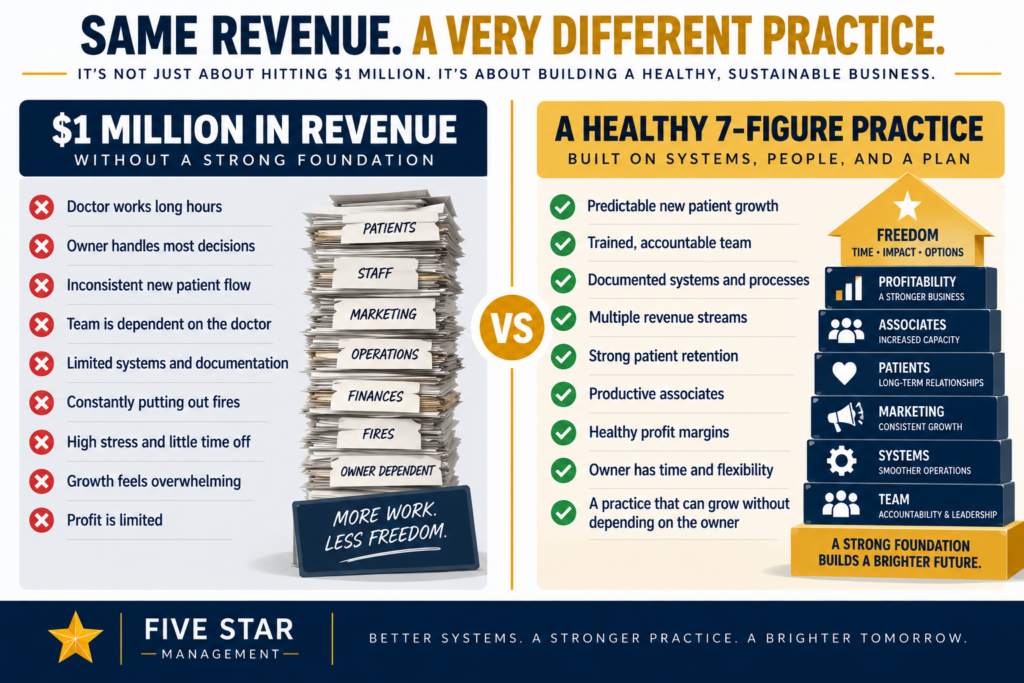
That’s why your goal shouldn’t simply be to reach seven figures.
It should be to build a healthy seven-figure practice.
And that requires several growth engines working together.
1. Know Your Numbers Before You Chase the Number
If your only financial goal is:
“We want to hit $1 million.”
You don’t have much of a plan yet.
Break the goal down.
If you want $1 million in annual collections, that’s approximately:
$83,333 per month
$19,231 per week
From there, work backward based on your actual practice.
How many patient visits does that require?
How many new patients?
What is your average case value?
What’s your conversion rate?
What’s your retention?
How much capacity does your schedule have?
What are your overhead and payroll requirements?
How much profit should the practice generate?
Now $1 million isn’t an abstract goal.
It’s a mathematical outcome tied to measurable activity.
Build a Seven-Figure Scoreboard
At minimum, monitor:
- New patients
- Patient visits
- Collections
- Conversion
- Retention
- Referrals
- Marketing sources
- Associate production
- Payroll
- Overhead
- Profitability
You don’t need to stare at a spreadsheet all day.
But you do need to know whether the practice is moving toward the goal before the bank account tells you.
2. Build Capacity Before You Need It
One of the biggest mistakes growing chiropractors make is waiting until the practice is overwhelmed before changing anything.
Then suddenly:
The schedule is packed.
Patients are waiting.
The team is stressed.
The doctor is rushing.
Phones are ringing unanswered.
New patients are difficult to fit in.
And everyone says:
“We’re too busy.”
That’s not necessarily a sign that you’ve reached your growth ceiling.
It may mean you’ve reached your current system’s ceiling.
Before adding more patients, evaluate your capacity.
Look at:
Scheduling. Are appointment types organized intelligently?
Patient flow. Where are people waiting unnecessarily?
Team responsibilities. Is the doctor doing work someone else could perform?
Facility. Are you using your physical space effectively?
Technology. Are repetitive administrative tasks automated?
Clinical systems. Can the practice maintain quality at greater volume?
The goal isn’t to cram more people into the same chaotic system.
Improve the system so the practice can handle growth without sacrificing the patient experience.
3. Stop Being the Answer to Every Question
This is one of the hardest transitions for growing practice owners.
In the beginning, being involved in everything works.
You hire your first employee.
They ask a question.
You answer it.
Something goes wrong.
You fix it.
A patient has a concern.
You handle it.
Marketing needs attention.
You do it.
That can work at $300,000.
It becomes increasingly difficult at $500,000.
And by the time you’re trying to build a healthy seven-figure organization, the owner cannot remain the central operating system for the entire business.
You need written systems.
Every recurring responsibility should eventually answer:
What needs to happen?
Who owns it?
How is it done?
How is success measured?
Who can perform it if the primary person isn’t available?
If the answer to every problem is still “Ask Doc,” your business has an invisible growth ceiling.
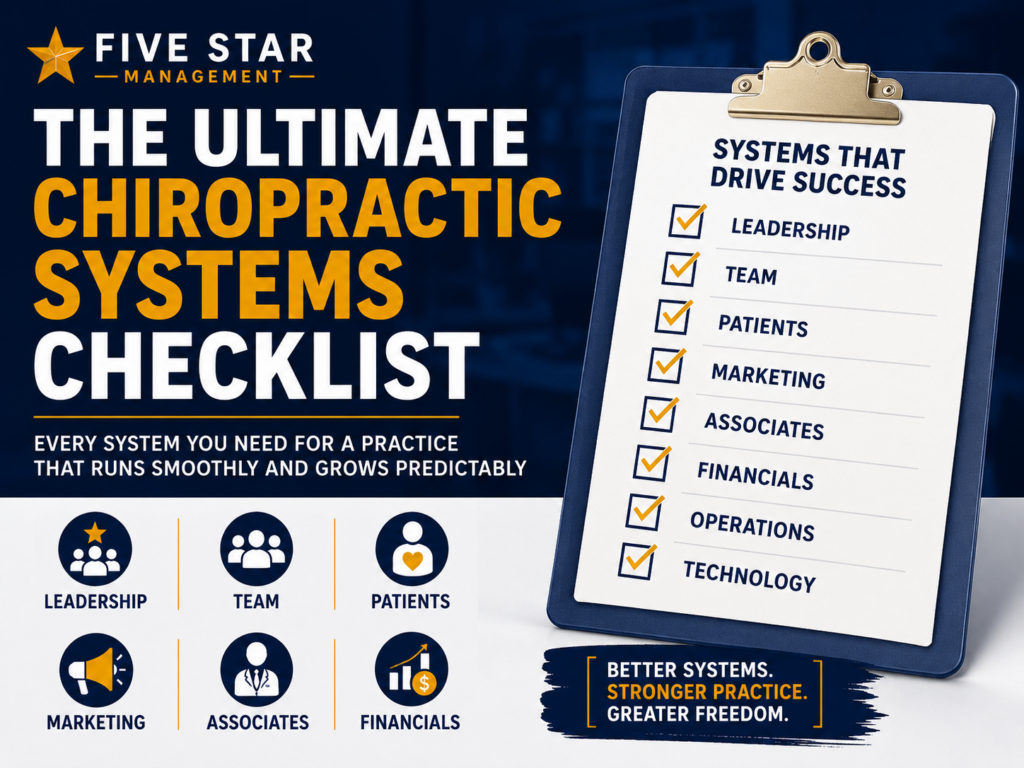
For a deeper audit of the systems your practice needs, read The Ultimate Chiropractic Systems Checklist.
4. Build a Team That Can Carry More Responsibility
Seven-figure practices aren’t built by one person.
At some point, your team has to become more than a group of people completing tasks.
They need to become people who can own outcomes.
That requires clarity.
Every team member should understand:
- Why their position exists
- What they’re responsible for
- What excellent performance looks like
- Which numbers they’re accountable for
- Which decisions they can make
- When something should be escalated
- How their role contributes to the practice’s goals
Then leadership has to inspect performance.
Not micromanage every action.
Inspect outcomes.
There’s an important difference.
Micromanagement says:
“I need to control everything you do.”
Accountability says:
“We agreed on the outcome. Let’s look at the results.”
As the practice grows, that distinction becomes critical.
Your goal is to create a team that becomes more capable as the practice becomes more complex.
5. Create Predictable New Patient Growth
You can’t build a seven-figure practice on random bursts of marketing.
Run an ad.
Get busy.
Stop marketing.
Schedule slows.
Panic.
Start marketing again.
That’s not a marketing system.
That’s a roller coaster.
At Five Star Management, we teach chiropractors to think about marketing as a Six-Pack:
Three Internal Marketing Strategies
These help you generate growth from relationships already connected to your practice.
That may include:
- Patient referrals
- Reactivation
- Patient education and internal campaigns
Three External Marketing Strategies
These help introduce your practice to people who don’t already know you.
That can include:
- Community outreach
- Digital marketing
- Strategic external campaigns
The exact mix can vary.
The principle doesn’t.
Marketing should be consistent, diversified, and measurable.
If one channel slows down, your entire new patient pipeline shouldn’t disappear.
For the full framework, read The Marketing “Six-Pack” That Builds a Full Practice.
6. Get Serious About Community Outreach
Digital marketing matters.
So does becoming known in your community.
A strong community outreach system puts your practice in front of local businesses, organizations, events, and groups where relationships can develop.
But outreach can’t simply be:
“We should do more events.”
Someone needs to own it.
At Five Star, one model we teach is the Community Outreach Assistant, or COA.
Rather than asking the doctor to personally organize every outreach opportunity, a trained COA can focus on developing relationships, coordinating events, tracking activity, following up, and helping create a consistent stream of new patient opportunities.
That makes community outreach a system, not another item on the doctor’s to-do list.
For practices that want help creating a more structured new patient generation system, New Patient Academy is designed around this process.
7. Retention Is a Growth Strategy
Here’s some uncomfortable math.
You can dramatically improve your marketing and still struggle to grow if patients are constantly disappearing out the back door.
That’s why seven-figure growth isn’t only about acquisition.
It’s also about retention.
Patients need to understand:
Why they’re there.
What you’re recommending.
How they’re progressing.
What comes next.
And that communication can’t happen only at the report of findings.
Education should continue throughout the patient journey.
Your practice should have systems for:
- Patient education
- Progress examinations
- Missed visits
- Dropout prevention
- Reactivation
- Referrals
- Patient concerns
- Long-term recommendations
The better your practice becomes at maintaining strong patient relationships, the less pressure there is to constantly replace lost visits with new patients.
Growth gets easier when you stop rebuilding your practice every month.
8. Protect the Patient Experience as You Grow
Growth has a nasty habit of exposing weak systems.
When you’re seeing 80 visits a week, a small inefficiency might be annoying.
At 300 visits, it becomes chaos.
That’s why you have to protect the patient experience while increasing volume.
Pay attention to the little things.
Are phones answered professionally?
Are patients greeted?
Does the schedule run on time?
Does everyone receive consistent information?
Are handoffs smooth?
Are financial conversations clear?
Are problems handled quickly?
Does the patient feel known?
You don’t want to reach seven figures by creating an office patients no longer enjoy visiting.
Scale the experience, not just the volume.
9. Develop Leaders Before You Desperately Need Them
At some point, a seven-figure practice needs more leadership capacity.
The owner can’t remain responsible for every:
Team question.
Schedule problem.
Patient issue.
Training decision.
Marketing decision.
Hiring decision.
Performance conversation.
Eventually, other people need to lead.
That doesn’t mean handing someone a manager title and hoping for the best.
Leadership has to be developed.
Teach people how to:
- Communicate expectations
- Inspect results
- Coach performance
- Solve problems
- Run meetings
- Make decisions
- Handle accountability
- Protect culture
This is one of the reasons Five Star developed the Clinic Directors Empowerment Program (CDEP).
CDEP helps practice owners build successful Win-Win Associate practices while developing the systems and leadership required to hire, onboard, train, launch, and lead associates successfully.
The bigger your organization becomes, the more valuable capable leaders become.
10. Add an Associate for the Right Reason
Eventually, many chiropractors pursuing seven figures encounter a simple limitation:
There are only so many patients one doctor can personally serve.
That’s when an associate can become a powerful growth strategy.
But there’s a dangerous assumption:
“I’ll hire another chiropractor, give them some patients, and we’ll grow.”
That’s not an associate strategy.
An associate needs a system.
Before hiring, determine:
Why are we adding this doctor?
Where will their new patients come from?
How will they be compensated?
How will they be trained?
What will their first 90 days look like?
Which statistics will they own?
How will we coach them?
What does success look like after one year?
A successful associate should eventually create capacity, production, and leverage.
An unsuccessful associate can create expense, frustration, and more work for the owner.
That’s why we teach the Win-Win Associate model.
The relationship needs to work for the associate, the practice, the team, and the owner.
For the training side specifically, read The Step-by-Step Associate Training System.
11. Don’t Confuse Revenue With Profit
This deserves its own section.
Because the headline says seven figures, it’s easy to become obsessed with revenue.
But $1 million in collections with terrible margins isn’t the goal.
Every stage of growth brings expenses.
More employees.
More marketing.
More space.
More technology.
Associate compensation.
Management.
Equipment.
Training.
If expenses rise as quickly as collections, you can build a larger practice without building a stronger business.
Track profitability as carefully as you track growth.
Ask:
What does it cost us to produce this revenue?
Is payroll healthy relative to collections?
Is our marketing profitable?
Is our associate profitable?
Are we getting a return from new expenses?
Are collections increasing faster than unnecessary overhead?
Revenue creates bragging rights.
Profit creates options.
And options are what eventually create freedom.
12. Build Culture on Purpose
As your team grows, culture becomes more important, not less.
When you have three people, the owner can influence nearly every interaction.
When you have ten, fifteen, or twenty people, culture begins multiplying through the team.
New employees learn what is acceptable by watching everyone else.
That’s why your standards have to be clear.
What does your team believe?
How do you treat patients?
How do you communicate?
How do you handle mistakes?
How do you respond when someone needs help?
What happens when nobody is watching?
Culture is the collection of those answers.
And if you don’t build it intentionally, one will still develop.
You just may not like the one you get.
For more on this, listen to How to Build a Strong Chiropractic Practice Culture That Keeps Great Team Members.
13. Create a Practice That Can Grow Without Consuming You
This is where the definition of success starts changing.
At first, the question is:
“How can I grow?”
Eventually, it needs to become:
“How can the organization grow?”
That’s different.
The second question forces you to build:
Systems.
People.
Leaders.
Associates.
Scoreboards.
Accountability.
Financial controls.
Marketing engines.
Training.
Culture.
Because if every additional $100,000 in revenue requires substantially more of the owner’s time and energy, you’re not really scaling.
You’re expanding your workload.
A healthy seven-figure practice should gradually become less dependent on the owner’s constant involvement, not more.
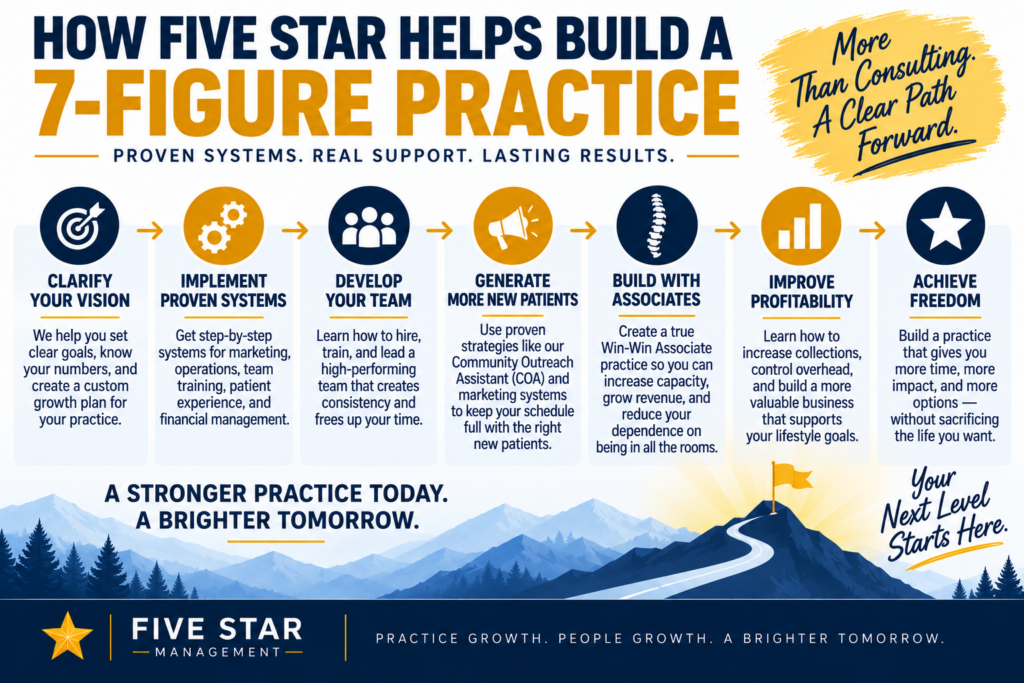
The 7-Figure Chiropractic Practice Framework
When you put everything together, seven-figure growth can be viewed through seven major areas.
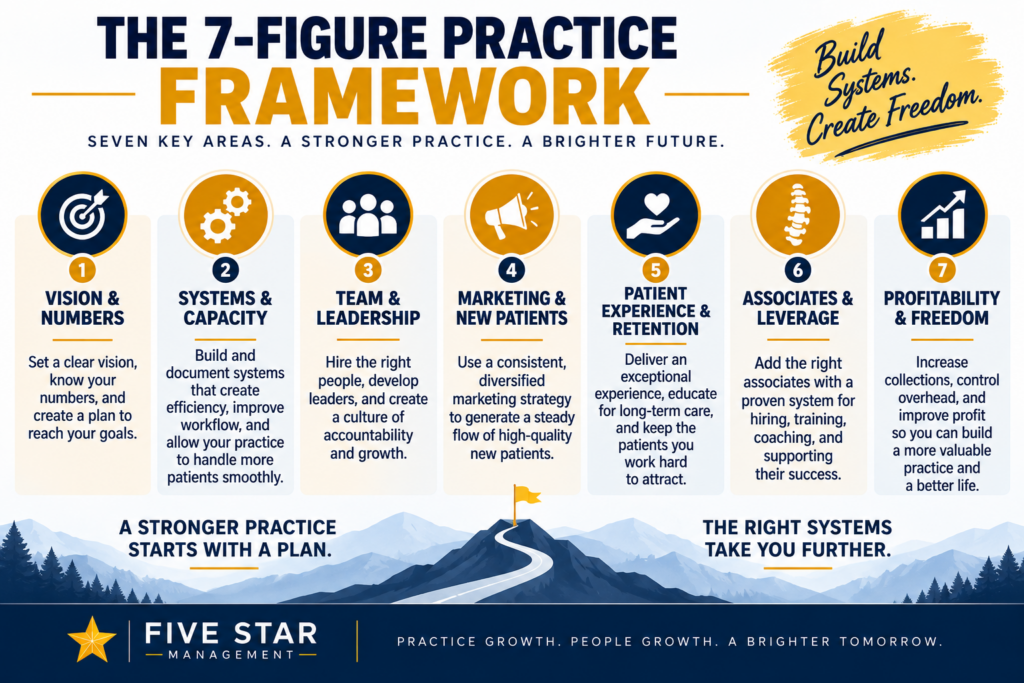
These seven areas work together. Strengthening only one may create short-term growth, but building a stronger practice requires all seven to develop together.
Here’s what each area looks like in practice:
1. Vision & Numbers
Know where you’re going and what numbers must be true to get there.
2. Systems & Capacity
Build an operation capable of handling greater volume.
3. Team & Leadership
Develop people who can own responsibilities and results.
4. Marketing & New Patients
Create consistent, diversified patient acquisition.
5. Patient Experience & Retention
Keep the relationships you’re working so hard to create.
6. Associates & Leverage
Increase clinical and organizational capacity without making the owner the permanent bottleneck.
7. Profitability & Freedom
Make sure growth produces a stronger business and a better life.
Notice something?
There isn’t one magical marketing campaign on that list.
Seven figures is usually the result of multiple business systems getting stronger at the same time.
What Should You Fix First?
Reading a list like this can make a practice owner want to rebuild everything Monday morning.
Don’t.
Instead, ask yourself:
What is currently preventing us from reaching the next level?
Every practice has constraints. The key is identifying the one that’s limiting your growth right now rather than trying to fix everything at once.

Maybe you don’t have enough new patients.
That’s a marketing problem.
Maybe you have plenty of new patients but can’t retain them.
That’s a patient communication or retention problem.
Maybe the schedule is overflowing.
That’s a capacity problem.
Maybe your team can’t handle additional volume.
That’s a training or leadership problem.
Maybe you’re personally at maximum capacity.
That’s a delegation, systems, or associate problem.
Maybe collections are increasing but profit isn’t.
That’s a financial management problem.
Fix the constraint that’s limiting growth now.
Then find the next one.
That’s how sustainable growth happens.
How Five Star Helps Chiropractors Build 7-Figure Practices
At Five Star Management, the objective isn’t simply to help a chiropractor collect a bigger number.
It’s to help build a better business behind the number.
That means helping practice owners strengthen the systems that support growth:
Marketing that consistently generates opportunities.
Team systems that create accountability.
Training that develops capable people.
Leadership that doesn’t depend entirely on the owner.
Associate systems designed to create Win-Win relationships.
Statistics that make performance visible.
Financial systems that protect profitability.
Practice systems that make growth repeatable.
Because the ultimate goal isn’t:
“I built a million-dollar practice.”
It’s:
“I built a successful practice that can continue growing without requiring everything from me.”
If you’re working toward seven figures, or you’ve already reached it but the practice still feels too dependent on you, schedule a complimentary strategy session with a Five Star coach.
We’ll help you identify the systems and strategies that could make the biggest difference in your next stage of growth.
Final Thoughts
You don’t build a seven-figure chiropractic practice by simply deciding to work harder.
You build it by creating a business capable of producing seven-figure results.
Know your numbers.
Increase capacity.
Document your systems.
Build your team.
Develop leaders.
Market consistently.
Protect retention.
Add associates intentionally.
Watch profitability.
Strengthen culture.
And gradually remove yourself as the answer to every question.
The million-dollar mark is exciting.
But the number isn’t the most important thing you build along the way.
The real achievement is building the practice capable of producing it again and again.