
Let me ask you a question.
If someone called your chiropractic practice today and wanted to become a new patient, how quickly could you get them on the schedule?
Today?
Tomorrow?
Next week?
Or would your front desk tell them you’re completely booked and they’ll have to wait?
Now, I know what some chiropractors are thinking.
“George, isn’t having a waiting list a good problem to have?”
Well, yes.
And no.
A full schedule can be a wonderful thing. It means people want what you’re offering. Your patients value your care. Your practice has demand.
But here’s where I want you to think a little differently.
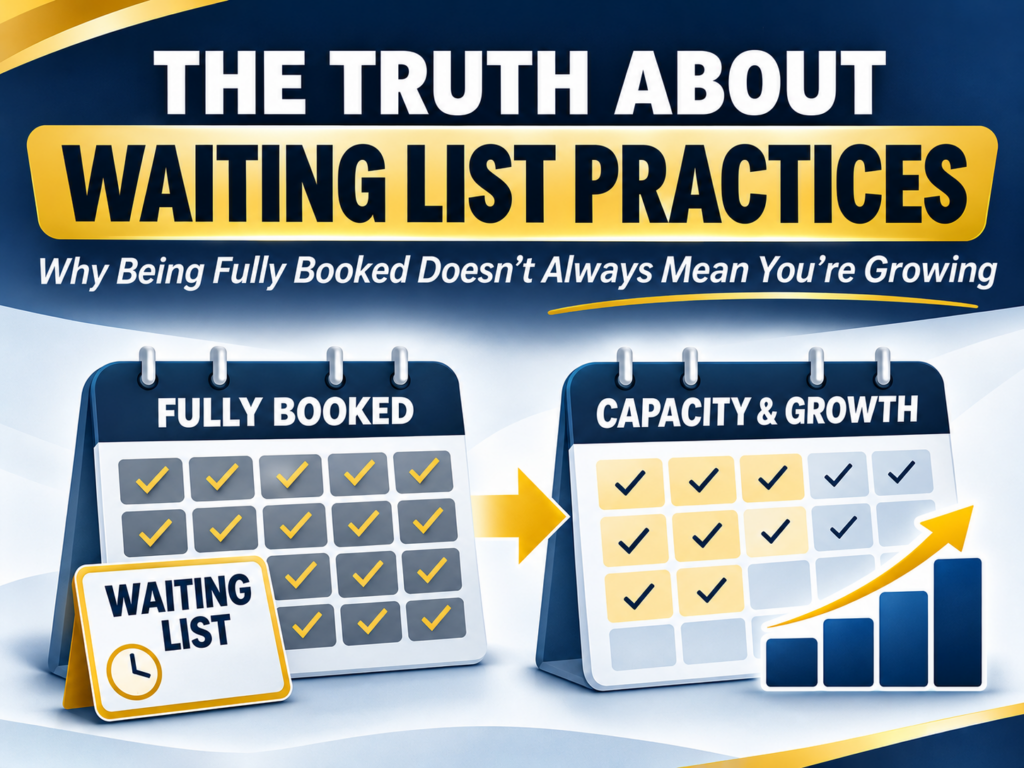
Being in demand and being prepared to handle that demand are two very different things.
I’ve seen practices celebrate being booked weeks in advance while overlooking the opportunities they’re losing every single day.
New patients can’t get appointments.
Existing patients struggle to schedule their recommended visits.
The team is overwhelmed.
The doctor is exhausted.
And everyone assumes the practice must be doing incredibly well because the schedule is full.
But is it?
Or have you simply reached the limit of your current operating system?
That’s what we’re going to talk about.
Because the goal isn’t to build a practice where everyone has to wait.
The goal is to build a practice that can serve more people without sacrificing quality, profitability, or the owner’s freedom.
The Waiting List Illusion: Busy Doesn’t Always Mean Successful
Let’s start with something important.
A waiting list tells you that demand may be exceeding your available appointment capacity.
That’s useful information.
But it doesn’t tell you whether your practice is operating efficiently.
It doesn’t tell you whether your patients are receiving timely care.
It doesn’t tell you whether your team is performing effectively.
And it certainly doesn’t tell you whether your business is profitable.
Think about two chiropractic practices.
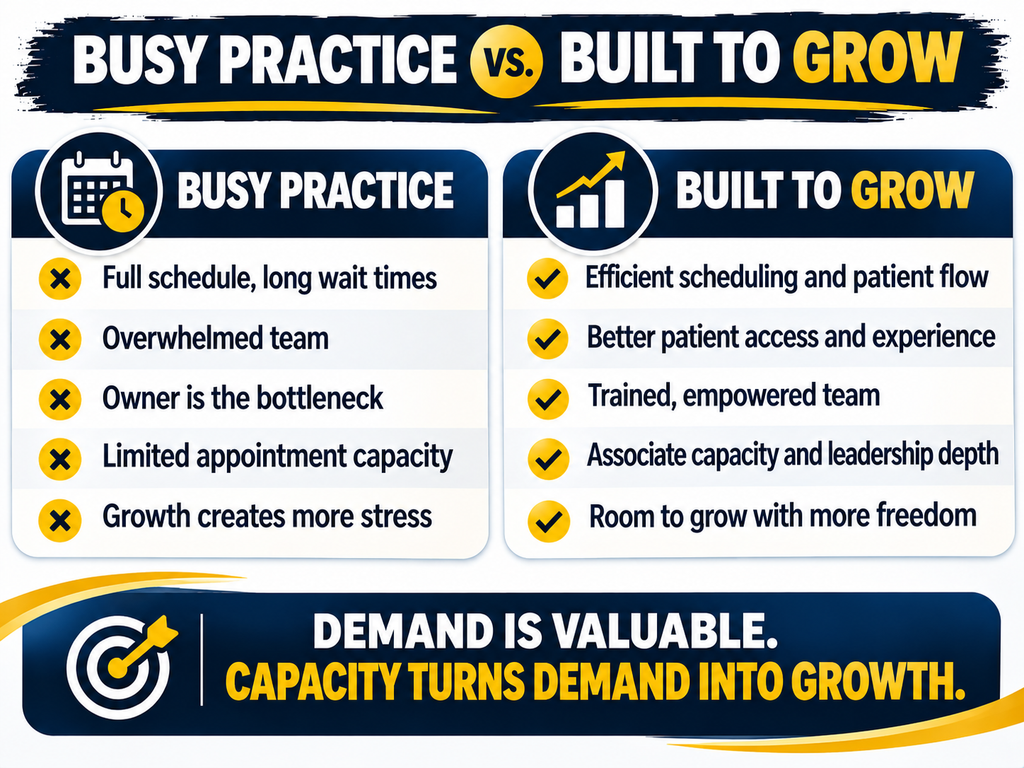
Practice A has a full schedule, a two-week waiting list, and one doctor working as many hours as possible.
The team is constantly trying to squeeze people into appointments.
Patients are frustrated because they can’t get convenient times.
The owner hasn’t taken a real vacation in years.
Practice B also has strong patient demand.
But the practice has organized scheduling systems, trained team members, clear appointment availability, and enough clinical capacity to serve patients appropriately.
Patients can get scheduled within a reasonable timeframe.
The team knows what to do.
The doctors aren’t constantly overwhelmed.
And the business has room to grow.
Which practice would you rather own?
Both may look busy from the outside.
But only one has built the capacity to turn demand into sustainable growth.
A waiting list is a signal. It isn’t a business strategy.
1. Your Waiting List Might Be Revealing a Capacity Problem
One of the first things I want practice owners to understand is that every chiropractic practice has a capacity.
There are only so many hours in the day.
Only so many appointments your doctors can appropriately handle.
Only so many patients your team can serve effectively.
And only so much work your current systems can support.
Eventually, if demand continues to increase, you reach a ceiling.
The mistake is assuming that ceiling is permanent.
It may simply be the limit of your current staffing, scheduling, and operating structure.
How to Recognize a Capacity Bottleneck
Ask yourself:
- Are new patients regularly waiting longer than your practice’s access goals?
- Are patients having difficulty scheduling recommended follow-up visits?
- Are certain appointment times consistently overbooked while others remain open?
- Are your doctors regularly running behind?
- Is your front desk constantly rearranging the schedule?
- Are employees skipping breaks or working overtime to keep up?
- Are you turning away patients because you don’t have enough appointment availability?
If several of these are happening, you may have a capacity problem.
But before you assume you need another doctor, we need to look at something else.
Your scheduling system.
2. Sometimes You Don’t Need More Hours. You Need Better Scheduling.
Here’s something I’ve learned from working with chiropractic practices.
Two offices can have the same number of doctors, the same operating hours, and similar patient demand.
Yet one practice runs smoothly while the other feels overwhelmed.
Why?
Often, the difference is scheduling.
One practice has a system.
The other has a calendar.
And those are not the same thing.
A calendar tells you when appointments are booked.
A scheduling system helps you manage the types of appointments, clinical resources, patient flow, and available capacity throughout the day.
Look at Your Actual Appointment Patterns
Before you add more hours or hire another employee, examine how your current schedule is being used.
Are you booking too many time-intensive appointments into the same period?
Are certain hours consistently overloaded?
Are appointment types allocated appropriate amounts of time?
Are there gaps in the schedule that could be used more effectively?
Does your front desk understand how to schedule for efficient patient flow?
For example, let’s say your practice has openings throughout the afternoon, but everyone wants an appointment before work or after 5 p.m.
Your practice may have available capacity overall, but not at the times patients need it.
That’s a different problem from being completely full.
And it requires a different solution.
Action Step: Perform a Scheduling Audit
Review your schedule from the previous four weeks.
Look for:
- Appointment demand by day and time.
- Actual appointment utilization.
- New patient appointment availability.
- Cancellations and missed appointments.
- Doctor and team bottlenecks.
- Opportunities to improve patient flow.
Don’t just look at how full the calendar appears.
Look at how effectively the schedule is functioning.
Because sometimes the fastest way to improve patient access isn’t adding more hours.
It’s using the hours you already have more effectively.

3. A Waiting List Can Quietly Cost You New Patients
Let’s talk about what happens when someone calls your practice for the first time.
They may be experiencing discomfort.
They may have been referred by a friend.
They may have been researching chiropractic care for weeks.
They finally decide to take action.
They call your office.
And your front desk says:
“We’re completely booked. The earliest appointment we have is three weeks from now.”
What happens next?
Some people will wait.
Others won’t.
They may call another chiropractor.
They may decide to postpone care.
They may lose interest.
Or they may simply forget about scheduling altogether.
The important point is that a full schedule doesn’t necessarily mean you’re capturing all the demand your marketing and reputation are creating.
And if you’re investing time and money into attracting new patients, this deserves attention.
Measure Your New Patient Access
I want you to start tracking something simple.
How long does a prospective new patient typically have to wait for an available appointment?
Not just your next opening on the calendar.
The next appropriate opening that works for the patient and your clinical scheduling requirements.
Track:
- Average time from inquiry to first available appointment.
- Average time from inquiry to scheduled appointment.
- Number of prospective patients who decline because of scheduling delays.
- Number of inquiries that never become appointments.
- Number of patients requesting earlier appointments.
These statistics help you determine whether limited appointment availability is affecting growth.
And here’s an important distinction.
If people are calling but not scheduling, you may not have a marketing problem.
You may have an access problem.
That’s why our article, If You’re Not Getting New Patients, Read This, emphasizes examining the entire new patient process rather than assuming every growth challenge requires more marketing.

4. Your Existing Patients Shouldn’t Have to Compete for Care
Now let’s look at the other side of the waiting list.
Your existing patients.
A practice can become so focused on bringing in new patients that it forgets to protect appointment availability for people already receiving care.
That’s a mistake.
Patients need access to clinically appropriate appointments.
They need clear communication.
They need scheduling options that reasonably support their care plans.
And they need to feel that the practice is organized enough to take care of them.
If every appointment requires a scheduling negotiation, your systems may be working against the patient experience.
Build Scheduling Around Patient Needs
Look at the types of appointments your practice provides.
New patient examinations.
Regular visits.
Re-examinations.
Longer clinical appointments.
Special scheduling requirements.
Each has different time and resource needs.
A well-designed schedule accounts for those differences.
It also gives your team a consistent process for handling appointment requests, cancellations, and changes.
That doesn’t mean every patient gets their preferred time.
It means your team has a thoughtful, organized approach to managing availability.
A great patient experience doesn’t end when someone becomes a patient. It continues every time they interact with your practice.
For more on this, see our article, How to Build Lifetime Patients: The Chiropractic Retention Strategy That Creates Long-Term Growth.
5. Don’t Confuse Doctor Productivity With Doctor Exhaustion
Here’s another situation I see.
A chiropractor tells me:
“George, I’m seeing as many patients as I possibly can. I can’t work any harder.”
And I believe them.
They’re arriving early.
Working through lunch.
Staying late.
Handling clinical responsibilities.
Answering staff questions between patients.
And taking work home.
But then we look at their practice.
They’re spending time on tasks that could be handled by trained team members.
They’re constantly interrupted by operational questions.
They’re dealing with preventable scheduling problems.
And they’re performing responsibilities that have nothing to do with delivering chiropractic care.
So I ask:
“How much of your day is actually spent doing the work that only you can do?”
That’s an important question.
Because when a doctor is overloaded, the answer isn’t always to increase their workload.
Sometimes it’s to remove unnecessary responsibilities.
Protect the Doctor’s Clinical Time
Identify tasks that require the chiropractor’s clinical judgment, expertise, or oversight.
Then identify routine operational tasks that qualified, trained team members can appropriately handle.
Examples may include:
- Appointment confirmations.
- Routine scheduling communication.
- Administrative follow-up.
- Preparing nonclinical paperwork.
- Managing office workflow.
- Tracking daily statistics.
- Coordinating team responsibilities.
The doctor remains responsible for clinical decisions and appropriate supervision.
But they shouldn’t have to personally manage every administrative detail.
When your team handles its responsibilities effectively, the doctor can focus more attention on patient care.
And that may help improve the practice’s overall capacity without simply adding more work to the doctor’s day.
6. Your Waiting List Might Be Telling You It’s Time for an Associate
Now we’re getting into one of my favorite subjects.
Associate doctors.
Because when a practice has strong demand but limited doctor capacity, bringing in another chiropractor may create a tremendous opportunity.
But I want to be very clear about something.
Hiring an associate is not automatically the solution to a waiting list.
If your systems are disorganized, adding another doctor may simply create a larger disorganized practice.
More appointments.
More scheduling complexity.
More employees.
More questions.
And more responsibilities for the owner.
That’s not the outcome we want.
The goal is to build the right structure before adding capacity.
How to Know Whether You’re Ready for an Associate
Ask yourself:
Is patient demand consistently exceeding our clinical capacity?
One unusually busy month isn’t necessarily enough to justify a long-term hiring decision.
Look for sustained demand.
Do we have enough financial visibility to evaluate the investment?
You need to understand your overhead, collections, compensation structure, and projected associate contribution.
Can we support the associate’s development?
A new doctor needs more than a treatment room and a schedule.
They need training, leadership, clear expectations, and a path toward success.
Do we have a consistent new patient system?
A waiting list may provide an initial opportunity, but long-term associate success requires continued patient demand.
Can our team support another doctor?
Scheduling, patient communication, clinical support, and operational systems must be ready for additional capacity.
If you can answer those questions confidently, an associate may be worth exploring.
The Win-Win Associate Approach
At Five Star Management, our Win-Win Associates Program focuses on building associate relationships that create opportunities for both the practice owner and the associate doctor.
The owner gains the ability to expand clinical capacity and develop a stronger business.
The associate gains an opportunity to build a successful chiropractic career within an established practice.
And patients benefit from a practice with the resources to serve them effectively.
But that outcome requires planning.
It requires the right compensation structure.
It requires training.
It requires performance expectations.
And it requires leadership.
That’s why we teach chiropractors to approach associate development as a business system, not simply a hiring decision.
If you’re considering adding another doctor, our article The Truth About Hiring Your First Chiropractic Associate is a helpful place to start.

7. A Waiting List Can Hide an Unprofitable Business
Let’s talk about another misconception.
“If I’m fully booked, I must be making good money.”
Not necessarily.
A full schedule tells you that appointments are being used.
It doesn’t tell you whether those appointments are generating sufficient revenue to support the business.
You can have a packed practice and still struggle financially.
High overhead.
Poor collections.
Inefficient staffing.
Unclear financial reporting.
Excessive overtime.
Low margins.
These problems don’t disappear because the schedule is full.
In some cases, additional volume makes them worse.
Look Beyond the Appointment Book
I want you to understand the financial performance of your practice.
At a minimum, review:
| Metric | What It Helps You Understand |
| Collections | How much revenue the practice actually receives |
| Operating expenses | What it costs to run the business |
| Profitability | Whether growth is producing financial value |
| Doctor productivity | How clinical capacity is being used |
| Appointment utilization | How much available capacity is being filled |
| New patient volume | Whether new demand is entering the practice |
| Patient retention | Whether patients continue appropriate care |
| Associate contribution | How additional doctors affect practice performance |
These numbers tell a much more complete story than the number of appointments on your calendar.
For example, if collections increase by 10% but operating expenses increase by 20%, you may be getting busier without becoming more profitable.
That’s not sustainable growth.
The goal isn’t to see the maximum number of patients at any cost. It’s to build a practice that provides excellent care and operates as a financially healthy business.
8. The Hidden Cost of Saying “We’re Not Accepting New Patients”
I want to challenge another idea.
Sometimes practices stop accepting new patients because they’re completely overwhelmed.
And in certain situations, temporarily limiting new patient appointments may be necessary to protect safe, appropriate care.
But I don’t want you to treat that situation as a permanent badge of honor.
Because when you close your doors to new patients, you’re also limiting your opportunity to serve your community.
Think about the patients who were referred by someone who trusts you.
Think about the families looking for a chiropractor.
Think about the people who have heard great things about your practice.
If your answer is consistently, “Sorry, we’re full,” those people may never become your patients.
And eventually, demand can change.
Patients move.
Schedules change.
Care episodes end.
Life happens.
A practice that stops developing new patient systems entirely may find itself in a difficult position later.
Build Capacity Before You Need It
Instead of waiting until your schedule becomes unmanageable, monitor capacity regularly.
Know how many appropriate appointments you can provide.
Know where demand is increasing.
Know which appointment times are becoming difficult to access.
Know whether your staffing and systems can support additional volume.
Then plan ahead.
That may mean improving scheduling.
Developing team members.
Expanding clinical hours when appropriate.
Or preparing to add another doctor.
The important thing is that you’re making those decisions intentionally.
Not reacting after the practice becomes overwhelmed.
9. What a Healthy Waiting List Actually Looks Like
Now, I don’t want you walking away from this article thinking every waiting list is a problem.
It isn’t.
Sometimes demand temporarily exceeds availability.
Sometimes patients request a specific doctor or time.
Sometimes cancellations create opportunities to move people into earlier appointments.
And sometimes a practice is appropriately limiting appointments because of clinical capacity or staffing considerations.
A waiting list can be a useful operational tool.
The question is how you’re managing it.
A Well-Managed Waiting List Should Have a System
Your team should know:
- Why the patient is waiting.
- What type of appointment they need.
- Whether they have any scheduling flexibility.
- Whether an earlier appointment becomes available.
- Who is responsible for contacting them.
- How and when the practice will follow up.
- When a clinical concern requires appropriate triage rather than routine scheduling.
Patients shouldn’t be left wondering whether anyone remembers them.
Your team shouldn’t be relying on sticky notes or memory.
And your practice shouldn’t be treating the waiting list as proof that nothing needs to improve.
A healthy waiting list is managed. An unhealthy waiting list manages you.
10. The Four Questions Every Waiting List Practice Should Ask
If your practice is regularly booked out, I want you to sit down with your leadership team and answer four questions.
Question 1: Is Our Schedule Actually Efficient?
Look at how appointments are distributed.
Review appointment types.
Identify unused capacity.
Examine cancellations and missed appointments.
Determine whether your scheduling system supports appropriate patient flow.
Don’t assume a full-looking calendar means every available resource is being used effectively.
Question 2: Are We Losing Patients Because of Limited Access?
Track prospective patients who can’t find a suitable appointment.
Review how long people wait.
Look at missed scheduling opportunities.
Determine whether your current availability is creating barriers to care.
If people are consistently unable to schedule, you need to know.
Question 3: Is Our Team Operating at Its Full Potential?
Are responsibilities clearly defined?
Are employees properly trained?
Can the front desk handle routine scheduling situations independently?
Are administrative tasks being delegated appropriately?
Is the doctor constantly interrupted?
Sometimes capacity improves when your people become more capable.
Question 4: Have We Outgrown Our Current Business Model?
This is the big one.
If your scheduling is efficient, your team is well-trained, and patient demand still exceeds your available capacity, you may have outgrown your current structure.
That could mean it’s time to explore:
- Additional clinical hours.
- Expanded staffing.
- Associate development.
- Better use of existing space.
- Additional treatment capacity.
- Long-term expansion planning.
Not every practice needs another location.
Not every practice needs another associate immediately.
But every growing practice needs a plan for what happens when its current capacity is no longer enough.
11. The Waiting List Practice Action Plan
Let’s make this practical.
If you’re running a chiropractic practice with limited appointment availability, here’s what I want you to do over the next 30 days.
Week 1: Measure the Problem
Track your actual scheduling demand.
Review the next available appointment for each major appointment type.
Identify where patients are waiting.
Record new patient inquiries that can’t be scheduled.
Review cancellations, missed appointments, and unused time.
Your goal is to understand the problem before making changes.
Week 2: Improve the Scheduling System
Meet with your front desk and leadership team.
Review scheduling procedures.
Clarify how appointment types are managed.
Identify avoidable gaps and bottlenecks.
Establish a consistent process for managing cancellations and waiting list requests.
Make sure clinical scheduling decisions remain aligned with patient needs.
Week 3: Strengthen Team Performance
Identify routine tasks that are unnecessarily consuming the doctor’s time.
Clarify responsibilities.
Train employees on updated procedures.
Practice difficult scheduling conversations.
Establish accountability for follow-up and appointment management.
The objective is to make your current team more effective.
Week 4: Evaluate Expansion Opportunities
Now review your results.
Has appointment access improved?
Are patients getting scheduled more efficiently?
Is the doctor spending less time on administrative interruptions?
Are there still consistent capacity constraints?
If so, begin evaluating whether additional staffing, clinical hours, or associate development makes financial and operational sense.
Don’t rush into a major investment.
Build a plan supported by your numbers.
Measure first. Improve the system second. Expand when the evidence supports it.

How We Help Chiropractors Build Practices That Can Handle Growth
At Five Star Management, we believe chiropractic practice growth should create more opportunity.
More opportunities to serve patients.
More opportunities for associate doctors.
More opportunities for team members to develop.
And more freedom for the practice owner.
But growth without systems can create exactly the opposite result.
That’s why our coaching and training focus on helping chiropractic practice owners build the leadership, operational systems, and business structure needed to support sustainable growth.
Our approach includes education, frameworks, tools, and accountability around:
- Chiropractic scheduling and patient flow.
- Practice capacity and operational efficiency.
- Team training and leadership.
- Associate hiring and development.
- The Win-Win Associates model.
- Financial performance and profitability.
- New patient growth systems.
- Long-term practice expansion.
We don’t believe the answer is simply telling doctors to work harder.
We believe the answer is helping them build stronger practices.
Practices with capable teams.
Predictable systems.
Appropriate clinical capacity.
And a business model that can grow beyond the owner’s personal limitations.
Ready to Build a Practice That Can Grow Beyond You?
If your practice is fully booked, your team is overwhelmed, or you’re wondering whether it’s time to add an associate, let’s talk.
A complimentary strategy session with a Five Star coach can help you evaluate your current practice structure, identify operational bottlenecks, and explore opportunities for more sustainable growth.
Book Your Complimentary Strategy Session.
Final Thoughts: Don’t Celebrate the Bottleneck
Here’s what I want you to remember.
A waiting list can be a sign that you’ve built something people value.
That’s worth recognizing.
But it can also be a warning that your practice has reached the limits of its current systems.
Don’t confuse being fully booked with being fully optimized.
Don’t confuse exhaustion with productivity.
Don’t confuse high demand with profitability.
And don’t assume that turning away patients is the ultimate definition of success.
The real opportunity is to build a practice that can handle demand effectively.
A practice that provides excellent care.
A practice that develops capable people.
A practice that can expand its capacity when appropriate.
And a practice that gives the owner more opportunity rather than more stress.
Because the goal isn’t to build a chiropractic practice with the longest waiting list.
The goal is to build a chiropractic practice that’s capable of serving the people who want your help.
That’s the truth about waiting list practices.