
For many chiropractors, hiring an associate sounds like the ultimate solution.
More freedom.
More growth.
More patients served.
Less stress.
At least… in theory.
But in reality?
Most associate relationships fail.
Not because the associate was lazy.
Not because the clinic owner was “bad at leadership.”
And not because chiropractic associateships can’t work.
They fail because most clinics are operating from an outdated model that creates tension from the very beginning.
One side feels overworked and underpaid.
The other feels unsupported and frustrated by low production.
And eventually, what started with excitement turns into disappointment.
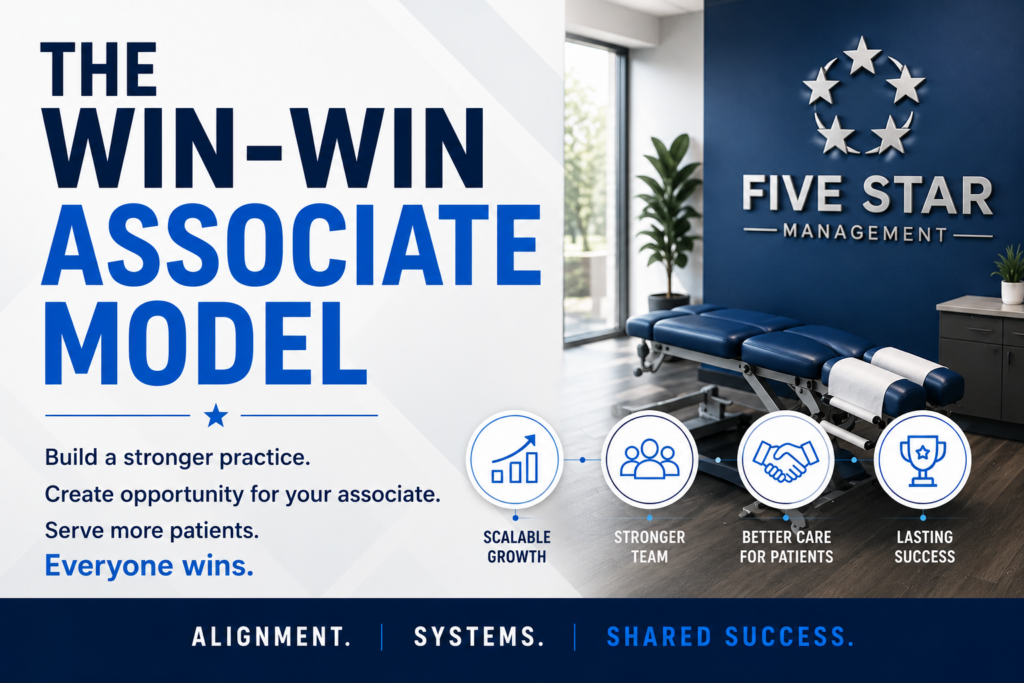
That’s exactly why we created the Win-Win Associate Model, a system designed to help chiropractors build profitable, scalable practices while creating genuine opportunity for associates at the same time.
Instead of creating competition inside the clinic…
…it creates alignment.
Here’s how it works.
Why Most Chiropractic Associateships Fail
Before we explain the Win-Win model, it’s important to understand why traditional associate structures break down.
Because most clinics unknowingly create systems that almost guarantee conflict.
The Traditional Associate Model Is Often Built on Misalignment
In many practices, the associate is hired with vague expectations like:
- “Help grow the clinic”
- “See patients”
- “Take some pressure off me”
But there’s rarely:
- A defined growth plan
- A clear compensation structure
- A documented system for success
- A long-term vision both sides understand
So what happens?
The owner expects the associate to produce immediately.
The associate expects mentorship, support, and opportunity.
And both sides slowly become frustrated.
The Biggest Mistake Clinic Owners Make
Most chiropractors hire associates too late—and with the wrong expectations.
Usually, the owner is already overwhelmed:
- Overbooked schedule
- Team stress
- Administrative overload
- Burnout creeping in
So they hire an associate hoping the associate will “fix the chaos.”
But associates don’t fix broken systems.
They amplify them.
If your clinic lacks:
- Clear procedures
- Marketing systems
- Staff structure
- Communication systems
…adding another doctor usually increases complexity instead of reducing it.
That’s why the Win-Win Associate Model starts with systems first.
Building a successful associate-driven clinic requires more than motivation—it requires consistent systems, accountability, and leadership development.
That’s one reason many chiropractors turn to ongoing chiropractic coaching and implementation support before scaling with associates.
What Is the Win-Win Associate Model?
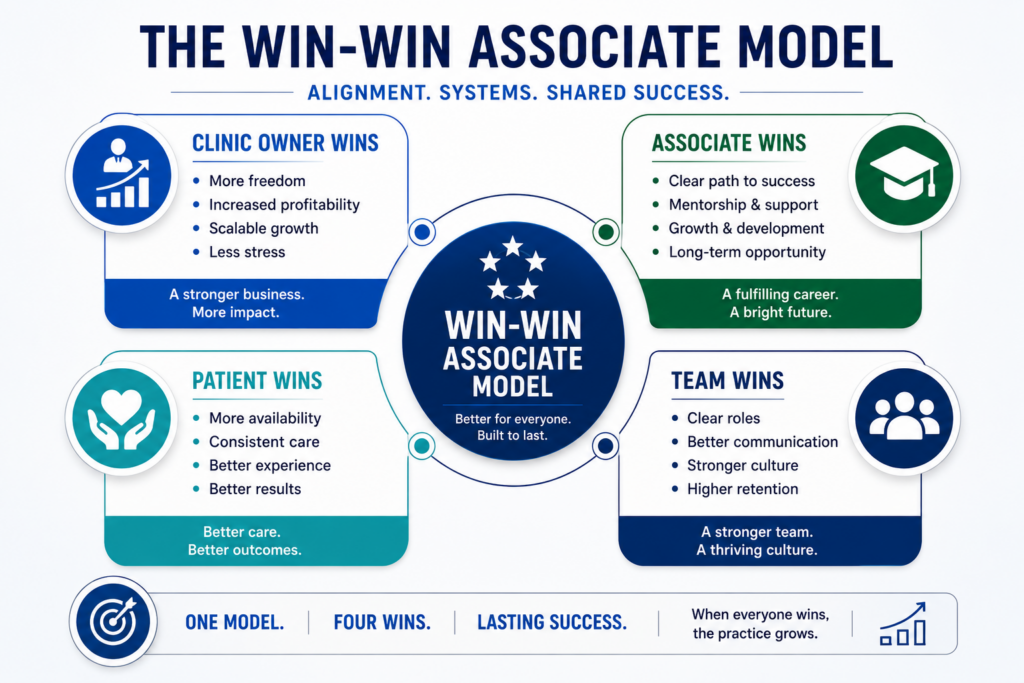
The Win-Win Associate Model is a structured approach to building associate-driven chiropractic practices where:
✅ The clinic owner grows profitably
✅ The associate has a clear path to success
✅ Patients receive better consistency and care
✅ The business becomes scalable without burnout
Instead of creating dependency on one doctor…
…the clinic becomes system-driven.
That’s the key distinction.
The Core Philosophy Behind the Win-Win Model
In our experience, successful associateships are not built around control.
They’re built around:
- Clarity
- Systems
- Leadership
- Shared success
The goal is not to create an employee who simply “covers shifts.”
The goal is to create:
- A confident doctor
- A productive leader
- A growth-focused team member
- A long-term asset to the practice
When done correctly, the associate becomes part of a bigger vision—not just a temporary solution.
In fact, I recently joined a podcast conversation about the Win-Win Associate model where I break down this philosophy in greater detail and explain what it really takes to build a successful associate-driven clinic.
Why Associates Often Underperform
Here’s a hard truth:
Most associates are not failing because they lack talent.
They’re failing because they were never given a clear framework to succeed.
Many associates enter clinics where:
- Expectations are unclear
- Training is inconsistent
- Systems change constantly
- Communication is reactive
- Success metrics are vague
Imagine trying to succeed in an environment where nobody clearly defines what winning looks like.
That’s what many associates experience.
The Win-Win model fixes this by creating structure from day one.
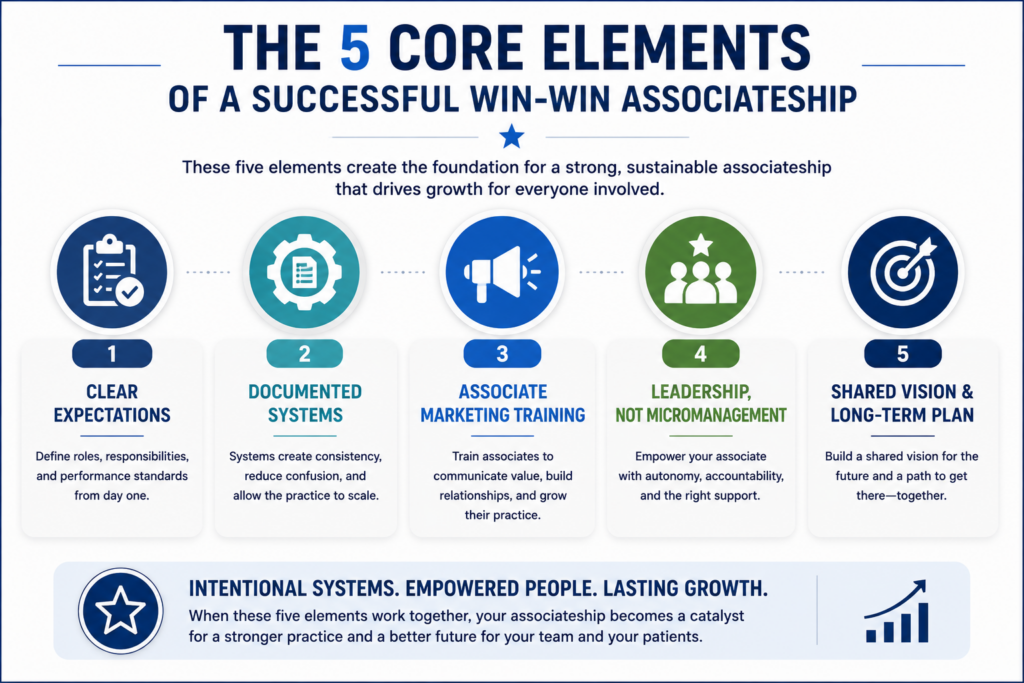
The 5 Core Elements of a Successful Win-Win Associateship
1. Clear Expectations
This sounds simple, but it’s where most clinics fail.
Every associate should clearly understand:
- Their responsibilities
- Performance expectations
- Communication standards
- Growth opportunities
- Compensation structure
Ambiguity creates stress.
Clarity creates confidence.
That’s why Five Star Management emphasizes detailed systems, role clarity, and measurable expectations from the beginning.
2. Documented Systems
A personality-driven clinic struggles to scale.
A systems-driven clinic creates consistency.
This includes:
- New patient procedures
- Report of findings processes
- Patient communication standards
- Re-exam procedures
- Marketing systems
- Staff workflows
When systems are documented:
- Associates ramp up faster
- Patients get consistent experiences
- Team communication improves
- Growth becomes predictable
Without systems, every day becomes improvisation.
And improvisation doesn’t scale.
3. Associate Marketing Training
One of the biggest misconceptions in chiropractic is this:
“If we hire an associate, the patients will just show up.”
They won’t.
Associates need to know how to:
- Build relationships
- Communicate value
- Market confidently
- Connect with the community
- Convert opportunities into patients
But many clinics never train associates in these areas.
Then they wonder why production stays low.
The Win-Win model includes intentional associate development—not just clinical responsibilities.
4. Leadership Instead of Micromanagement
Many clinic owners accidentally create dependency.
They oversee every detail.
Correct every decision.
Step in constantly.
And while this may feel helpful…
…it prevents the associate from developing ownership.
The Win-Win model encourages leadership instead:
- Coaching
- Accountability
- Feedback
- Mentorship
- Growth conversations
This builds stronger doctors and stronger clinics.
5. Shared Vision and Opportunity
Associates stay longer when they see a future.
If the relationship feels purely transactional, turnover increases dramatically.
But when associates feel:
- Supported
- Valued
- Developed
- Included in growth
…they become invested.
This creates what I call a true “win-win.”
The clinic grows.
The associate grows.
Everyone benefits.
The Hidden Benefit Most Chiropractors Miss
Most clinic owners think hiring an associate is about reducing workload.
But the real power is much bigger than that.
A successful associate model creates:
- Scalability
- Business stability
- Increased valuation
- Better patient retention
- More freedom for the owner
Without associates, many clinics become completely dependent on one person.
That creates a ceiling.
And eventually, exhaustion.
I’ve seen talented chiropractors burn themselves out trying to scale without the right structure in place.
The Win-Win model helps chiropractors build practices that can grow beyond the limitations of a single doctor.
What a Healthy Associate-Driven Practice Looks Like
When this system is implemented correctly, you start to see major changes:
The Team Becomes More Stable
Clear systems reduce confusion and stress.
Patients Experience Greater Consistency
Processes become standardized instead of personality-dependent.
Growth Feels Sustainable
The clinic no longer depends on one person doing everything.
The Owner Gains Freedom
Instead of being trapped inside the business, the owner can focus on leadership and long-term growth.
The Transition Most Chiropractors Need to Make
The biggest transformation isn’t operational.
It’s mental.
Most chiropractors were trained to think:
“If I want it done right, I have to do it myself.”
But scalable clinics require a different mindset:
“If I build the right systems, other people can succeed too.”
That shift changes everything.
Because once systems replace chaos, growth becomes far more predictable.
Is the Win-Win Associate Model Right for Every Clinic?
Not necessarily.
If a clinic:
- Has no systems
- Lacks leadership
- Avoids accountability
- Operates reactively
…adding an associate may create more stress, not less.
That’s why preparation matters.
Before hiring an associate, clinic owners should evaluate:
- Team structure
- Procedures
- Marketing systems
- Patient flow
- Financial readiness
- Leadership capacity
The strongest associateships are built intentionally—not emotionally.
Before hiring an associate, it’s critical to evaluate whether your clinic has the systems, structure, and leadership capacity to support sustainable growth.
One of the fastest ways to identify potential gaps is through this free chiropractic practice assessment.
Final Thoughts: The Future of Chiropractic Growth
The chiropractic profession is changing.
The clinics that thrive over the next decade will not simply be the clinics with the best adjusting skills.
They’ll be the clinics with:
- Better systems
- Better leadership
- Better scalability
- Better team development
And that’s exactly what the Win-Win Associate Model is designed to create.
Not just more doctors inside a clinic…
…but healthier businesses, healthier teams, and healthier lives for the people leading them.
Ready to Build a Win-Win Associateship?
At Five Star Management, helping chiropractors build successful associate-driven practices is one of our specialties.
Through the Win-Win Associates System, we help clinic owners:
- Hire the right associates
- Build scalable systems
- Increase profitability
- Develop leadership structures
- Create long-term sustainable growth
If you’re thinking about hiring an associate—or struggling to make your current associateship work—we’d love to help.
👉 Schedule a complimentary strategy session with our team and learn how to build a true Win-Win practice model that benefits everyone involved.
Or, if you’d prefer to learn the Win-Win Associate system in a live setting, join us at an upcoming seminar where we teach these growth and leadership systems in greater depth.