
Let me ask you something.
How many times have you explained the same thing to the same employee?
Once?
Twice?
Ten times?
Maybe you’ve lost count.
You tell your front desk how to handle a scheduling situation.
You explain how to follow up with a patient.
You remind someone to complete a daily responsibility.
And then, a few days later, the same problem happens again.
Now you’re frustrated.
Your employee is frustrated.
And you’re wondering why nobody seems to remember what you’ve told them.
Well, here’s something I want you to consider.
What if the problem isn’t your people? What if the problem is your training system?
I’ve worked with chiropractors for decades, and one of the most common challenges I see is practice owners expecting consistent performance without providing consistent training.
They hire good people.
They explain the job.
They demonstrate a few tasks.
And then they expect everything to run smoothly.
But that’s not how you build a great team.
A great team needs more than good intentions.
It needs structure.
It needs standards.
It needs training.
And it needs accountability.
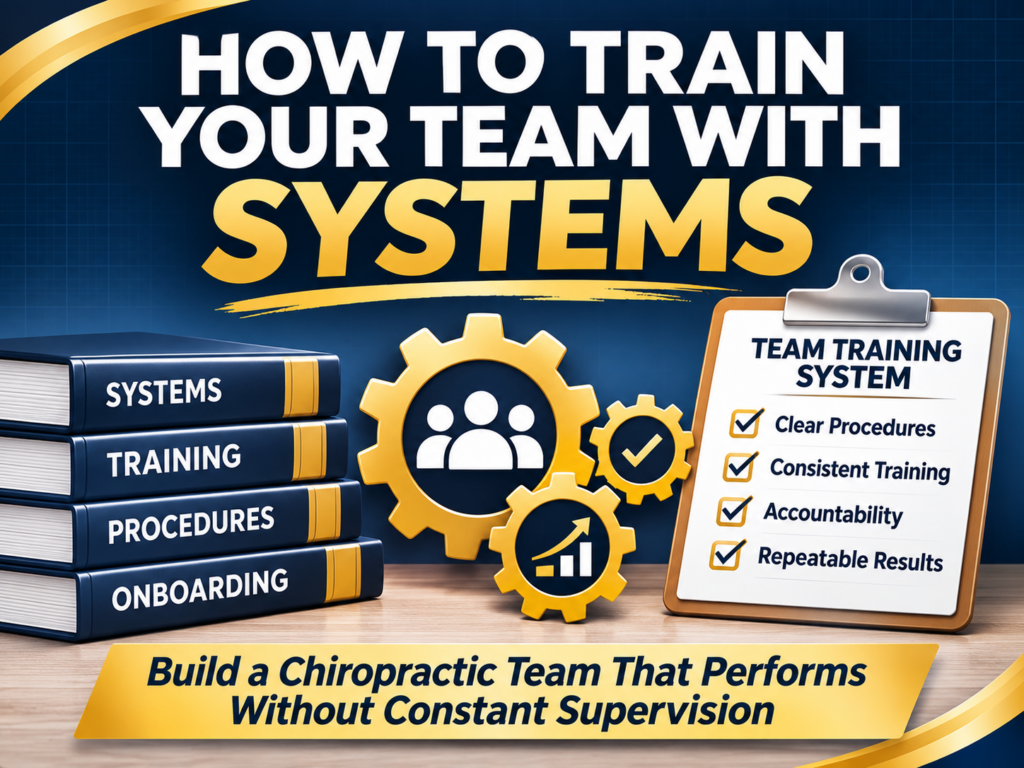
If you want consistent results from your team, you need a consistent system for producing those results.
Let’s talk about how to build one.
Why Most Chiropractic Team Training Doesn’t Work
Most chiropractic practice owners don’t intentionally create poor training programs.
They’re simply busy.
They have patients to see.
Schedules to manage.
Employees to supervise.
And a business to run.
So when they hire someone new, training often becomes something that happens between everything else.
A little instruction here.
A quick demonstration there.
Maybe the new employee shadows someone for a few days.
Then they’re expected to know the job.
And when mistakes happen, the doctor assumes the employee wasn’t paying attention.
But think about it.
Was the training actually complete?
Was there a written procedure?
Did the employee demonstrate that they understood the task?
Was their performance evaluated?
Did anyone confirm that they could perform the job independently?
Or did everyone simply assume they were ready?
Assumption is one of the biggest enemies of effective team training.
If you haven’t confirmed that someone can perform a task correctly, you don’t actually know whether they’re trained.
You only know they’ve been exposed to the information.
And exposure isn’t mastery.
1. Stop Training People From Memory
Here’s the first mistake I want you to eliminate.
Training employees based on whatever someone happens to remember.
Let’s say you hire a new chiropractic assistant.
On Monday, your office manager explains how to schedule a new patient.
On Tuesday, another employee shows them how to handle cancellations.
On Wednesday, the doctor explains how they prefer things done.
And on Thursday, the new employee receives different instructions from someone else.
Now imagine how confusing that becomes.
Everybody has their own way of doing things.
Nobody knows which procedure is correct.
And the new employee is trying to piece together a job from four different explanations.
That’s not training.
That’s confusion.
Build a Written System for Every Important Responsibility
Start by identifying the recurring responsibilities in your practice.
For example:
Front Desk Systems
- Answering incoming calls
- Scheduling new patients
- Confirming appointments
- Handling cancellations and missed appointments
- Patient check-in and check-out
- Administrative follow-up
Patient Experience Systems
- New patient onboarding
- First-visit communication
- Patient education
- Re-examination scheduling
- Patient retention procedures
- Reactivation processes
Team Operations
- Opening and closing procedures
- Daily statistics
- Internal communication
- Department responsibilities
- Meeting preparation
- Reporting and accountability
Each important responsibility should have a documented procedure that explains how the task should be completed.
It doesn’t have to be complicated.
In fact, simpler is usually better.
The goal is to create a standard that employees can understand, follow, and reference.
For a broader look at the systems every chiropractic practice should have, read our Ultimate Chiropractic Systems Checklist.
2. Create a Training System That Can Be Repeated
Now that you’ve documented the procedures, the next step is turning them into a repeatable training process.
This is where many practices fall short.
They have a manual.
They have written instructions.
They may even have training videos.
But nobody follows a consistent process for teaching the material.
So one employee receives excellent training.
Another receives partial training.
And a third learns through trial and error.
That’s not duplication.
That’s inconsistency.
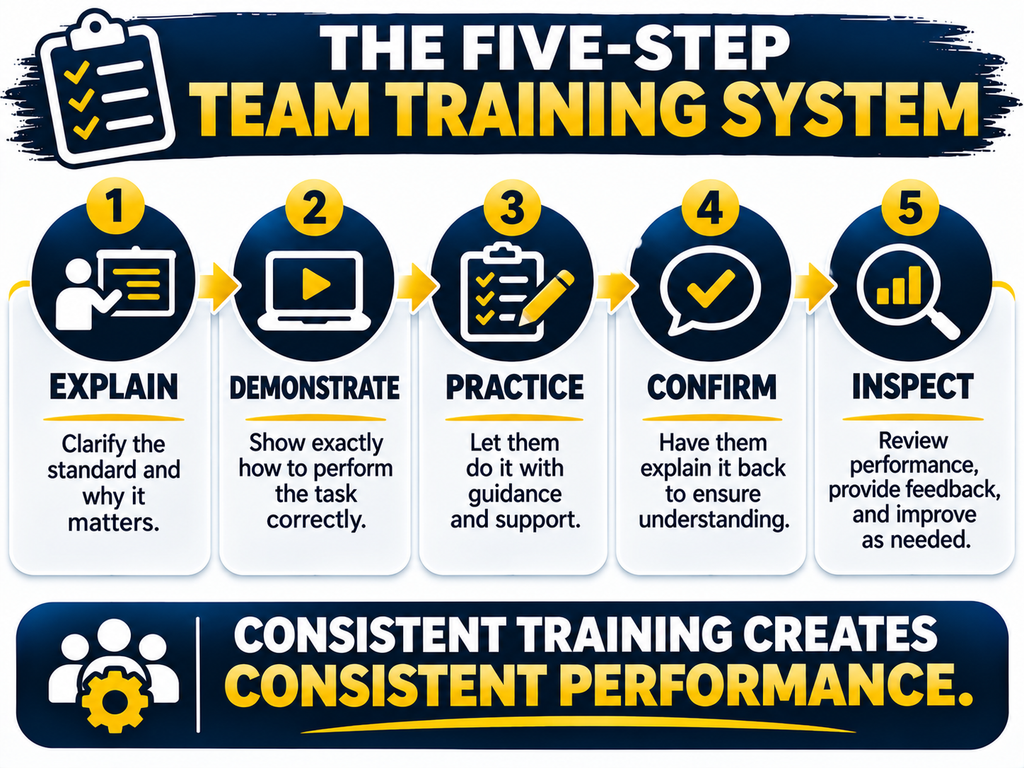
The Five-Step Team Training System
Here’s a practical approach you can use for almost any routine operational responsibility.
Step 1: Explain the Standard
Start by explaining what the employee is responsible for and what successful performance looks like.
Don’t just tell them what to do.
Explain why it matters.
For example, when training a front desk employee to confirm appointments, explain how the procedure supports patient communication, scheduling efficiency, and continuity of care.
People perform better when they understand the purpose behind their responsibilities.
Step 2: Demonstrate the Procedure
Show the employee exactly how the task should be performed.
Use the written procedure.
Walk through each step.
Explain common mistakes.
Show them what correct execution looks like.
Step 3: Have Them Practice
Now let the employee perform the task.
This may involve role-playing, supervised practice, or demonstrating the procedure in an appropriate real-world situation.
Don’t assume understanding because someone nodded their head.
Let them show you.
Step 4: Confirm Their Knowledge
Ask the employee to explain the procedure back to you.
Can they describe each step?
Do they understand when the procedure applies?
Can they identify what to do when something unexpected happens?
If they struggle to explain it, they probably need more training.
Step 5: Inspect and Improve
Once the employee begins performing the responsibility independently, monitor their execution.
Are they following the system?
Are they producing the expected result?
Where do they need additional coaching?
Correct mistakes early.
Then repeat the process until performance becomes consistent.
Explain it. Demonstrate it. Practice it. Confirm it. Inspect it.
That’s how you turn information into dependable performance.
3. Give Every Position a Clear Job Description
One of the fastest ways to create confusion in a chiropractic practice is to have employees who don’t know exactly what they’re responsible for.
They know their job title.
But they don’t know their outcomes.
Your front desk employee may understand that they’re supposed to answer phones and schedule appointments.
But do they understand what successful scheduling performance looks like?
Does your office manager know which statistics they’re responsible for reviewing?
Does your chiropractic assistant understand the standards for patient communication and workflow?
Does your associate doctor understand the practice’s operational expectations and clinical responsibilities?
These questions matter.
Because you can’t hold someone accountable for expectations that were never clearly established.
What Every Job Description Should Include
A useful job description should identify:
- Position purpose: Why the role exists.
- Primary responsibilities: The tasks the employee owns.
- Performance standards: What successful execution looks like.
- Required systems: The procedures the employee must follow.
- Reporting structure: Who provides direction and oversight.
- Training requirements: What the employee must learn and demonstrate.
For example, instead of simply writing:
“Responsible for scheduling patients.”
You might establish:
“Responsible for scheduling patients according to the practice’s approved scheduling procedures, accurately documenting appointments, communicating scheduling instructions, and completing assigned follow-up responsibilities.”
Now the expectation is much clearer.
The employee knows what they’re responsible for.
The manager knows what to inspect.
And the practice has a standard for evaluating performance.
4. Train for Results, Not Just Task Completion
Here’s something I want you to think about.
An employee can complete a task without producing the intended result.
They can make phone calls without successfully contacting patients.
They can send appointment reminders without following the complete confirmation procedure.
They can attend meetings without implementing anything discussed.
They can check boxes all day and still fail to contribute to the outcomes the practice needs.
That’s why training should connect activities to results.
Teach Employees to Understand Their Statistics
Let’s say your front desk team is responsible for managing new patient inquiries.
Don’t measure performance only by whether they answered the phone.
Look at the entire process.
How many inquiries came in?
How many were contacted?
How many scheduled appointments?
How many arrived?
Where were opportunities lost?
Now you’re looking at the effectiveness of the system.
The same principle applies to other responsibilities.
| Responsibility | What to Review |
| Appointment confirmations | Completion of the procedure and attendance patterns |
| New patient scheduling | Inquiries, appointments scheduled, and patient arrival |
| Patient follow-up | Follow-up completion and scheduling outcomes |
| Reactivation | Outreach activity and resulting appointments |
| Daily statistics | Accuracy and timely reporting |
| Team training | Demonstrated competency and consistent execution |
The purpose isn’t to turn every employee into a statistic.
It’s to give your team objective feedback.
When employees understand how their responsibilities contribute to the practice’s success, they can make better decisions and identify opportunities for improvement.
Don’t just train people to stay busy. Train them to produce meaningful results.
5. Build a Training Checklist for Every Role
One of the simplest tools you can introduce into your practice is a position-specific training checklist.
Why?
Because it eliminates guesswork.
The employee knows what they need to learn.
The trainer knows what they need to teach.
And the manager knows what has been completed.
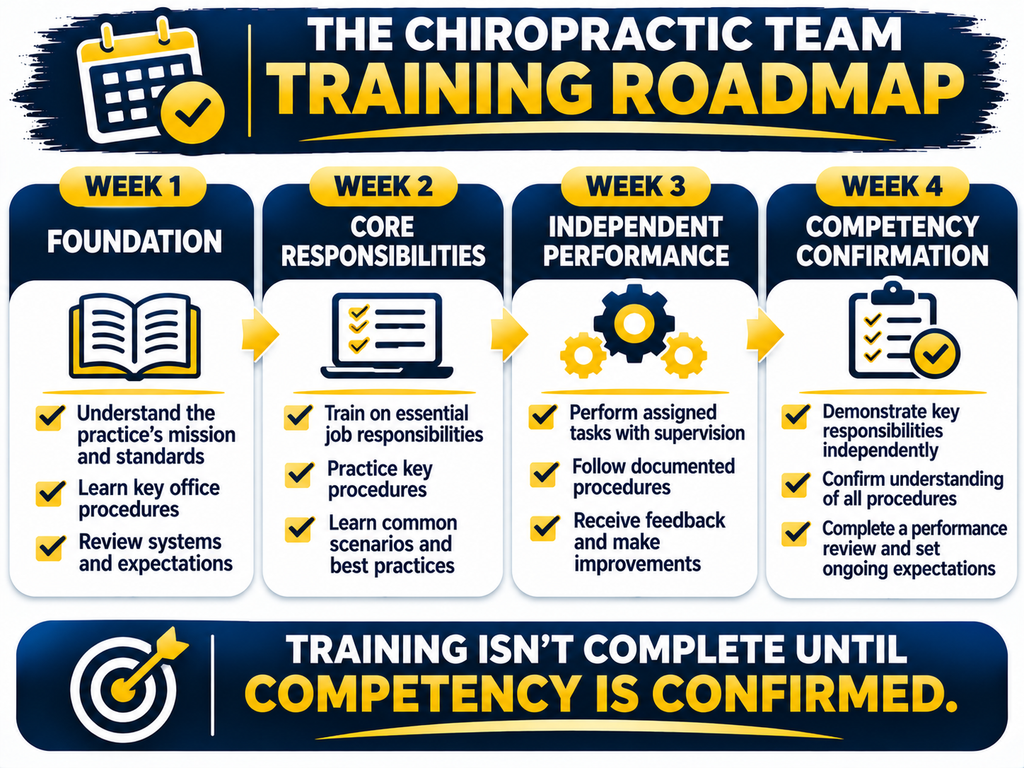
Example: Front Desk Training Checklist
Week 1: Foundation
- Understand the practice’s mission and patient experience standards.
- Learn basic office procedures.
- Review the scheduling system.
- Practice answering incoming calls.
- Understand privacy and confidentiality requirements.
Week 2: Core Responsibilities
- Demonstrate new patient scheduling.
- Practice appointment confirmations.
- Learn cancellation and missed appointment procedures.
- Understand patient check-in and check-out.
- Practice common patient communication scenarios.
Week 3: Independent Performance
- Perform assigned tasks with appropriate supervision.
- Demonstrate accuracy in scheduling.
- Follow documented procedures.
- Identify situations requiring escalation.
- Receive feedback and correction.
Week 4: Competency Confirmation
- Demonstrate essential responsibilities independently.
- Explain key procedures without assistance.
- Complete a performance review.
- Identify areas requiring continued development.
- Establish ongoing performance expectations.
This is an example, not a universal timeline. Some responsibilities require more training, and others may be learned more quickly.
The important thing is that completion is based on demonstrated competency, not simply time spent in training.
A checklist tells you what was covered. A competency check tells you what was learned.
6. Make Accountability Part of the Training System
Now let’s talk about something that makes many practice owners uncomfortable.
Accountability.
They want a great team.
They want consistent performance.
They want employees to take ownership.
But they don’t want to inspect the work.
They don’t want to have difficult conversations.
And they don’t want to correct mistakes.
Here’s the problem.
Training without accountability eventually becomes optional.
Employees start developing their own shortcuts.
Procedures become inconsistent.
Standards gradually decline.
And the doctor ends up frustrated because the systems aren’t being followed.
Accountability Isn’t Micromanagement
There’s a difference between checking whether a system is working and standing over someone’s shoulder all day.
Micromanagement focuses on controlling every action.
Accountability focuses on clear expectations, measurable performance, and appropriate follow-through.
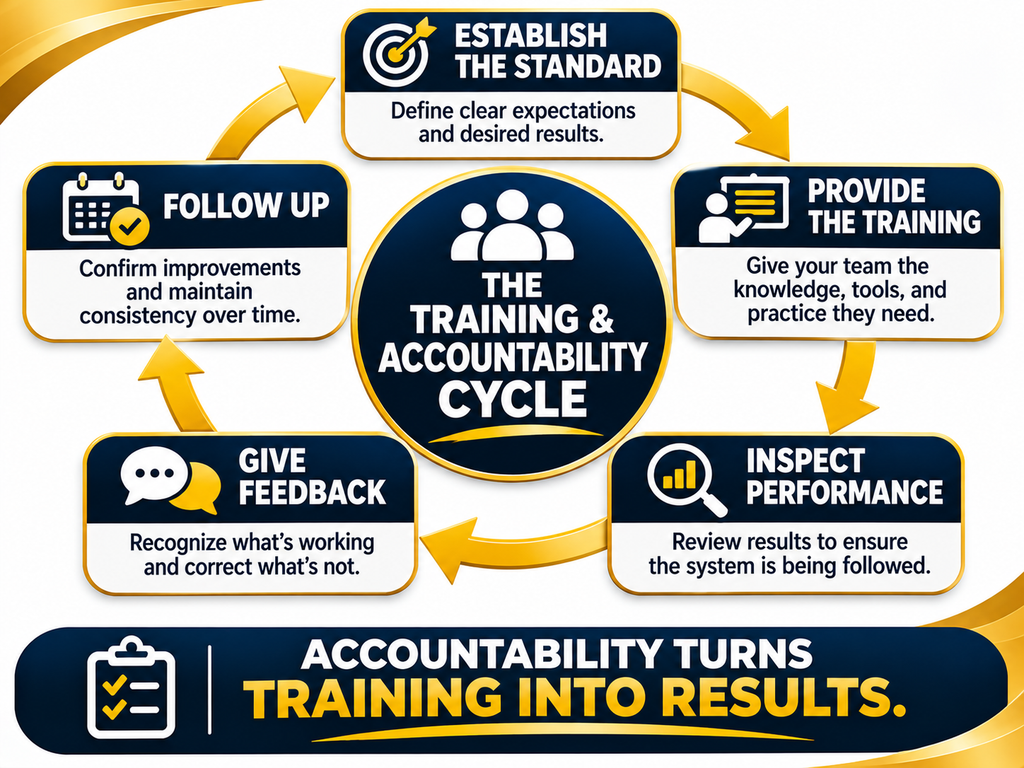
Here’s a simple process.
Establish the Standard
Make sure the employee understands what’s expected.
Provide the Training
Give them the knowledge, resources, and practice they need.
Inspect Performance
Review whether the system is being followed.
Provide Feedback
Recognize good performance and correct problems.
Follow Up
Confirm that improvements have been implemented.
This creates a culture where employees understand that standards matter.
And when standards are consistent, your team becomes more dependable.
Our article The Secret to Building a High-Performance Team explores how clear expectations, leadership, and accountability work together to strengthen chiropractic teams.
7. Use Daily Huddles to Reinforce Training
One of the biggest mistakes chiropractors make is treating training as something that happens only when someone gets hired.
They train the employee.
Check the box.
And move on.
But training shouldn’t stop after onboarding.
Your practice changes.
Your team develops.
New challenges appear.
And even experienced employees need reinforcement.
That’s where daily huddles become valuable.
Turn Your Morning Meeting Into a Training Opportunity
Your daily huddle doesn’t need to be long.
But it should help your team prepare for the day.
Review the schedule.
Identify important appointments.
Clarify responsibilities.
Discuss potential problems.
And reinforce one important standard.
For example:
Monday: Review the new patient phone procedure.
Tuesday: Reinforce appointment confirmations.
Wednesday: Practice a patient communication scenario.
Thursday: Review missed appointment follow-up.
Friday: Recognize a team member who demonstrated excellent execution.
Now you’re reinforcing your systems throughout the week.
And because the training happens in small, consistent pieces, it becomes part of your practice’s operating rhythm.
Great teams aren’t trained once. They’re developed continuously.
8. Stop Letting Your Best Employee Become Your Only Training System
Here’s a situation I see frequently.
A practice has an outstanding office manager.
She’s been there for years.
She knows everything.
She understands the schedule.
She handles difficult situations.
She knows how the doctor likes things done.
And whenever someone new gets hired, the doctor says:
“Just have her train them.”
Now, having an experienced employee participate in training can be extremely valuable.
But there’s a problem when the entire training program exists inside one person’s head.
What happens when that employee takes a vacation?
What happens when they leave?
What happens when they forget to explain something?
What happens when their personal habits don’t match the practice’s documented standards?
Your training system becomes dependent on one individual.
And that’s a dangerous position for any business.
Turn Employee Knowledge Into Practice Knowledge
Work with your strongest team members to document the procedures they perform well.
Ask them to explain their processes.
Record appropriate demonstrations.
Create checklists.
Develop role-playing scenarios.
Identify common mistakes.
Then organize those resources into a training library.
Now your best employee isn’t the training system.
They’re helping you build the training system.
And that system can support future employees long after the original trainer moves into another role.
The goal is to build a practice that can duplicate excellence, not one that depends on a few exceptional people.
9. Use Training to Develop Future Leaders
As your chiropractic practice grows, you need more than employees who can complete tasks.
You need people who can lead.
People who can train others.
People who can manage responsibilities.
People who can solve operational problems.
And people who can help maintain your practice’s standards.
But leadership doesn’t automatically develop because someone has been employed for five years.
It requires intentional training.
Start Developing Leadership Skills Early
Identify employees who consistently demonstrate:
- Strong performance.
- Reliability.
- Clear communication.
- Initiative.
- Willingness to learn.
- Good judgment.
- Ability to help others improve.
Then begin expanding their responsibilities appropriately.
Have them help train new employees.
Let them lead a portion of a team meeting.
Teach them how to review performance statistics.
Give them opportunities to solve routine operational problems.
Provide coaching and feedback.
Over time, they can develop the skills needed to support the practice at a higher level.
This is especially important when you’re preparing to add associate doctors, expand departments, or grow into multiple locations.
Through our Clinic Directors Empowerment Program (CDEP), we teach leadership and management systems designed to help chiropractic practice owners develop stronger teams and more capable leaders.
Because the more your team can successfully handle, the less your practice depends on the owner for every decision.
10. The Real Test: Can Your Team Perform Without Constant Supervision?
Here’s the question I want you to ask yourself.
If you stopped reminding your employees what to do tomorrow, what would happen?
Would they follow the procedures?
Would they know their responsibilities?
Would they complete their tasks?
Would they communicate effectively?
Would they know when to ask for help?
Or would everything start falling apart?
Your answer tells you something about the strength of your training systems.
Now, I’m not suggesting you eliminate supervision.
Every practice needs appropriate management, clinical oversight, and accountability.
But routine responsibilities shouldn’t require constant reminders.
A properly trained team should know what’s expected and have the ability to perform those responsibilities consistently.
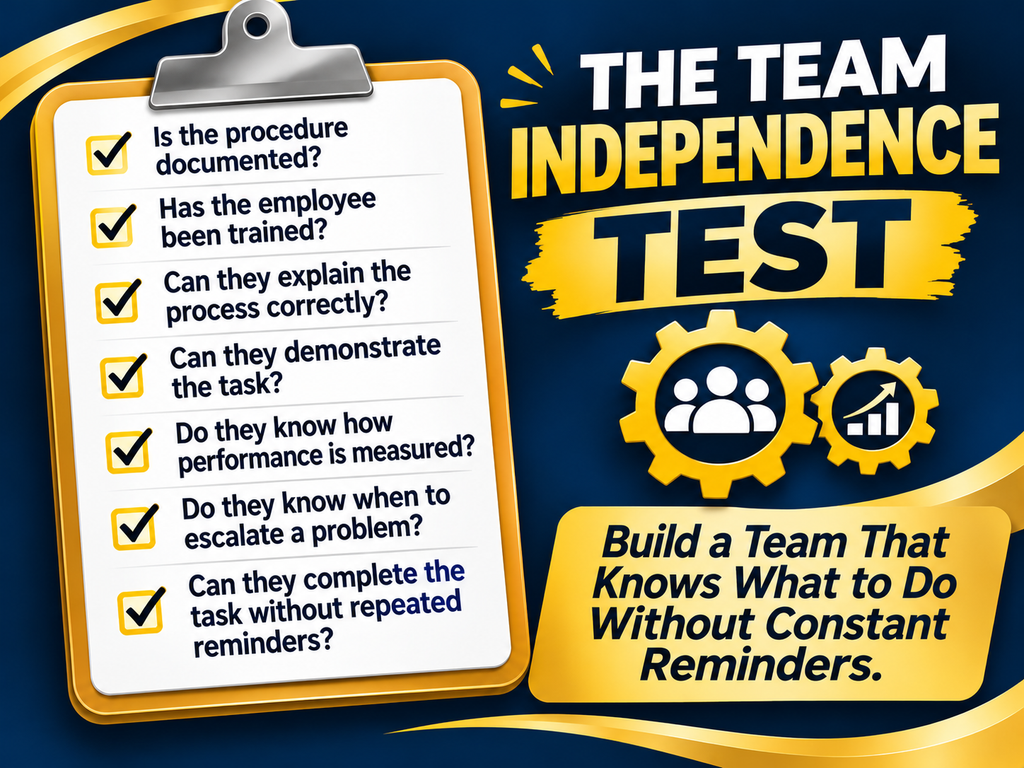
The Team Independence Test
Choose one important operational responsibility.
Then ask:
- Is the procedure documented?
- Has the employee been trained?
- Can they explain the process correctly?
- Can they demonstrate the task?
- Do they know how performance is measured?
- Do they know when to escalate a problem?
- Can they complete the task without repeated reminders?
If the answer is no to several of these questions, you’ve identified a training opportunity.
And that’s where improvement begins.
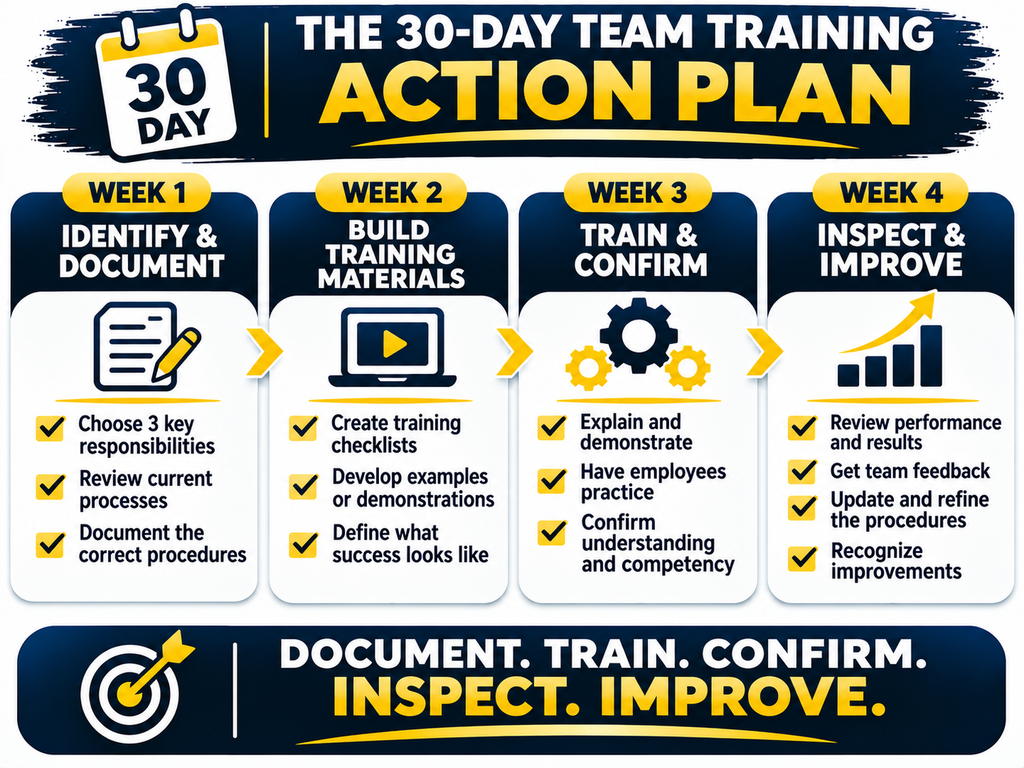
11. Your 30-Day Chiropractic Team Training Action Plan
I don’t want you to finish reading this article and simply agree that training is important.
I want you to put something into action.
So here’s a practical 30-day plan.
Week 1: Identify and Document
Choose three recurring responsibilities that create confusion or require frequent reminders.
Review how they’re currently performed.
Identify inconsistencies.
Document the correct procedures.
Clarify who’s responsible.
Week 2: Build the Training Materials
Create a simple training checklist for each procedure.
Develop examples or demonstrations.
Identify common mistakes.
Define what successful performance looks like.
Choose who will provide the training.
Week 3: Train and Confirm
Explain the procedures.
Demonstrate each step.
Have employees practice.
Ask them to explain the procedures back to you.
Observe their performance.
Correct mistakes and repeat as needed.
Week 4: Inspect and Improve
Review whether the systems are being followed.
Look at relevant performance statistics.
Ask employees where they still need clarification.
Update procedures where necessary.
Recognize improvements.
Then choose the next systems to strengthen.
You don’t need to rebuild your entire training program in one month.
You need to begin creating a repeatable process.
Document. Train. Confirm. Inspect. Improve.
Do that consistently, and your practice will begin developing a much stronger foundation.
How We Help Chiropractors Build High-Performance Teams
At Five Star Management, we believe a chiropractic practice should be built around strong systems and capable people.
Not constant reminders.
Not guesswork.
And not the owner’s ability to personally manage every detail.
That’s why our coaching and training programs focus on helping chiropractic practice owners strengthen their teams through:
- Documented operating systems.
- Clear roles and responsibilities.
- Structured employee onboarding.
- Training and competency development.
- Performance statistics.
- Accountability systems.
- Leadership development.
- Associate training.
- Practice management education.
We provide the frameworks, tools, training, and accountability to help practice owners implement these systems within their own businesses.
The objective is simple.
Build a team that understands the standards.
Build a team that knows how to perform.
Build a team that takes ownership.
And build a practice that can operate effectively without the doctor constantly solving every routine problem.
Ready to Build a Team That Runs on Systems?
If you’re tired of repeating instructions, correcting the same mistakes, or feeling like your practice can’t function without you, it may be time to strengthen your training systems.
Schedule a complimentary strategy session with a Five Star coach to discuss your current team challenges and identify opportunities to improve training, accountability, and leadership.
Book Your Complimentary Strategy Session.
Final Thoughts: Don’t Just Train People. Build a Training System.
Here’s what I want you to remember.
Great employees are valuable.
But great employees without great systems will eventually struggle.
They’ll receive inconsistent instructions.
They’ll develop different habits.
They’ll make preventable mistakes.
And they’ll depend on the owner for answers that should already exist.
The solution isn’t simply telling people to work harder.
It’s giving them the structure they need to succeed.
Written procedures.
Clear responsibilities.
Consistent training.
Demonstrated competency.
And ongoing accountability.
Because when you build a system for training your people, you’re doing more than improving employee performance.
You’re building a practice that can grow.
A practice that can develop future leaders.
A practice that can duplicate successful processes.
And a practice that doesn’t depend on the owner for every routine decision.
Don’t just train your team to do the job.
Build systems that teach your team how to do the job correctly, consistently, and independently.
That’s how you create a high-performance chiropractic team.