
Every chiropractor wants a full practice.
But too many practice owners approach marketing like a slot machine.
They try something.
Wait.
Hope it works.
If it doesn’t, they move on to something else.
A Facebook ad one month. A community event the next. A referral promotion when the schedule gets slow. Maybe a few social posts when someone remembers.
Then they wonder why new patient numbers are unpredictable.
The problem isn’t always that you’re doing the wrong marketing.
The problem may be that you don’t have a marketing system at all.
Years ago, Dr. Noel Lloyd developed a simple framework for solving this problem: the Chiropractic Marketing Six-Pack.
The idea is simple:
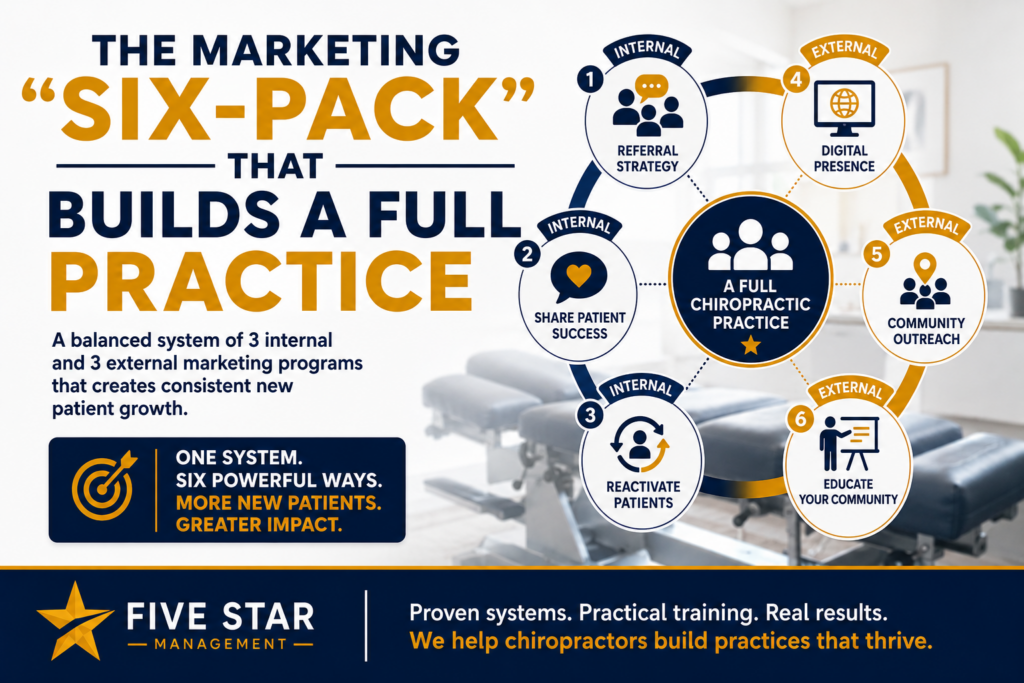
Three internal marketing programs. Three external marketing programs. All working consistently to create new patient opportunities.
Instead of depending on one source of new patients, you build multiple ways for the right people to discover your practice.
And that can completely change the growth trajectory of a chiropractic clinic.
Why One Marketing Strategy Isn’t Enough
Imagine your entire new patient pipeline depends on one source.
Maybe it’s Google.
Maybe it’s Meta ads.
Maybe it’s referrals.
Maybe it’s screenings.
Everything is great when that source is producing.
But what happens when it slows down?
Your new patient numbers fall with it.
That’s why a strong chiropractic marketing strategy needs diversification.
Dr. Lloyd recommends dedicating three to seven hours every week to marketing and dividing that effort between three internal and three external programs.
That distinction matters.
Internal marketing helps you uncover opportunities already inside your practice.
External marketing takes your chiropractic message outside your four walls.
Together, they create a much stronger new patient engine.

What Is the Chiropractic Marketing Six-Pack?
The Marketing Six-Pack isn’t six random marketing ideas.
It’s a structure.
INTERNAL MARKETING
Program #1
A consistent patient referral strategy
Program #2
A system for sharing patient success and building enthusiasm
Program #3
A patient reactivation program
EXTERNAL MARKETING
Program #4
A consistent digital presence
Program #5
A community outreach strategy
Program #6
An educational marketing strategy
The exact tactics can evolve.
The principle doesn’t.
Don’t ask one marketing channel to carry your entire practice.
Build multiple systems that work together.
Internal Marketing #1: Create a Patient Referral Strategy
Happy patients can become one of the greatest growth assets in a chiropractic practice.
But there’s a difference between hoping patients refer and intentionally creating a referral culture.
Dr. Lloyd’s original Six-Pack strategy begins by establishing a new patient goal with the team.
Make the goal achievable.
Get everyone involved.
Talk about the patients who have mentioned friends, coworkers, spouses, or family members who may need help.
Then create an appropriate opportunity to continue that conversation.
The important part isn’t turning every patient interaction into a sales pitch.
It’s building a team that recognizes opportunities to help more people.
When referrals are treated as an occasional happy accident, results are unpredictable.
When your team understands the goal and knows how to recognize referral opportunities, internal marketing becomes something the entire practice participates in.
Internal Marketing #2: Let Great Patient Experiences Create Momentum
One of the most powerful marketing assets in your practice may already be walking through your doors every day:
Patients who are excited about their progress.
In his original Six-Pack, Dr. Lloyd recommends intentionally allowing patients to share their positive experiences with team members at the front desk.
Why?
Because stories create energy.
Your team hears firsthand that the work they’re doing matters.
Other patients see enthusiasm surrounding chiropractic care.
And the patient telling the story reinforces their own excitement about their experience.
This isn’t about manufacturing testimonials.
It’s about creating a practice where wins aren’t quietly forgotten.
Celebrate progress.
Let your team hear it.
Let enthusiasm become part of the culture.
Great experiences create conversations—and conversations can create referrals.
Internal Marketing #3: Reactivate Patients You’ve Lost Touch With
Most chiropractic practices spend enormous amounts of time trying to find new people while overlooking people who already know them.
Look at your inactive patient list.
There may be hundreds—or even thousands—of people who:
- Know your practice
- Have received care from you
- Understand chiropractic
- May need your help again
Yet nobody has contacted them.
Dr. Lloyd’s original recommendation was remarkably simple: have each team member make a small number of reactivation calls every day.
The principle is more important than the exact script or number of calls.
Reconnect consistently.
A simple check-in can remind a former patient that your practice still cares about them.
And because the relationship already exists, reactivation can be one of the simplest internal marketing systems to implement.
External Marketing #1: Become Visible Online
The marketing world has changed dramatically since Dr. Lloyd first developed the Chiropractic Marketing Six-Pack.
One principle has only become more important:
People have to be able to find you.
Today, a prospective patient may encounter your practice through:
- Your website
- Online reviews
- Social media
- Video
- Local search
- Educational content
- AI-powered search tools
If someone in your community searches for help and your practice is invisible, your clinical skill doesn’t get a chance to matter.
That’s why digital visibility should be one component of a modern Marketing Six-Pack.
But don’t confuse “being online” with having a strategy.
Posting randomly isn’t a system.
Running ads without tracking isn’t a system.
Having a website nobody can find isn’t a system.
Your digital marketing should consistently answer three questions:
Can people find you?
Can they understand how you help them?
Is there an obvious next step?
For a deeper look at building a modern new-patient strategy, read Chiropractic Marketing 101: What Actually Works Today.
External Marketing #2: Get Into Your Community
Chiropractic is local.
That gives you an enormous advantage.
You don’t need everyone on the internet to know your name.
You need more of the right people in your community to know your name.
Dr. Lloyd has long emphasized external outreach because it gives chiropractors an opportunity to meet prospective patients face-to-face. In his book, The Chiropractor’s Guide, he specifically identifies screenings, lectures, and health fairs as effective, relatively inexpensive ways to get outside the office.
Today, community outreach might include:
- Local businesses
- Corporate wellness events
- Gyms and fitness centers
- Community organizations
- Health fairs
- Schools
- Sporting events
- Local presentations
- Strategic partnerships
The goal isn’t simply to hand out business cards.
The goal is to create conversations.
Help people.
Educate them.
Become known as a resource in your community.
If the doctor doesn’t have time to consistently create these opportunities, this is exactly where a Community Outreach Assistant (COA) can become incredibly valuable.
Dr. Lloyd’s model is to eventually package external marketing into teachable systems and train a COA to execute them, allowing the doctor to remain in the clinic caring for patients.
External Marketing #3: Teach
One of the best ways to market chiropractic is to educate people about chiropractic.
You already have knowledge your community needs.
Use it.
Educational marketing can include:
- Lunch-and-learns
- Workshops
- 15-minute health talks
- Community presentations
- Videos
- Blogs
- Podcasts
- Social media education
Instead of leading with:
“Come to my chiropractic office.”
Lead with:
“Here’s something that can help you.”
Education builds authority before someone ever becomes a patient.
It also gives people a reason to remember you.
When the day comes that they—or someone they know—needs help, your practice is already familiar.
The Real Secret: Put Marketing on the Calendar
Here’s where most marketing plans fall apart.
The ideas aren’t the problem.
Execution is.
Practice owners say:
“We should do more community events.”
“We need to ask for more referrals.”
“We should reactivate old patients.”
“I need to make more videos.”
But “should” isn’t a marketing plan.
If marketing only happens when the schedule is light, you’ll always be reacting to a problem that started weeks or months earlier.
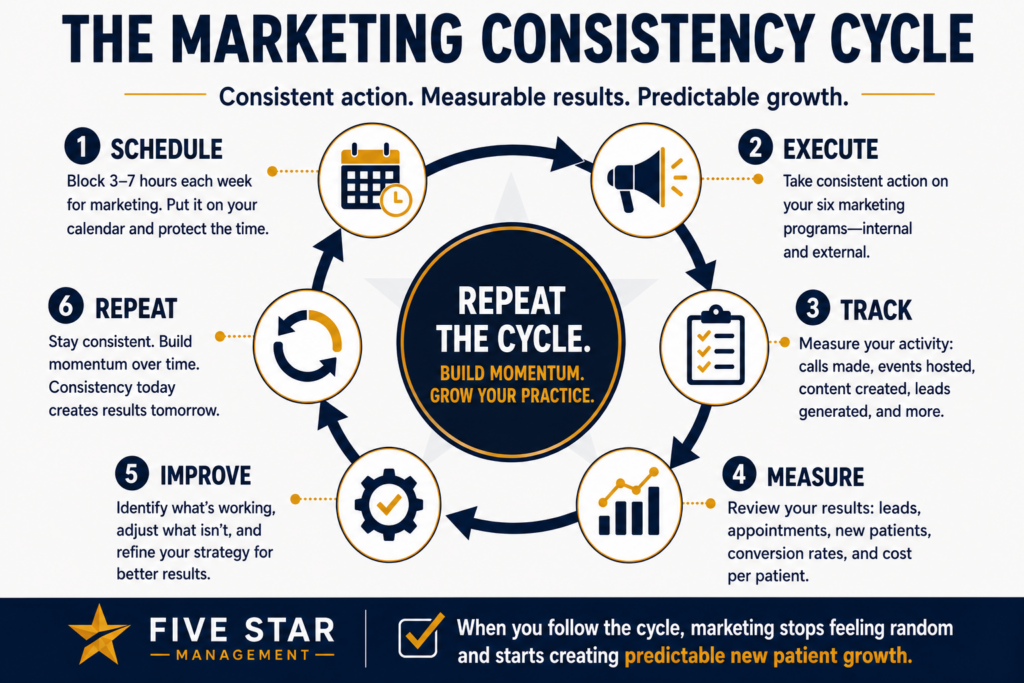
Dr. Lloyd’s recommendation is straightforward:
Schedule three to seven hours each week for marketing.
Put it on the calendar.
Protect the time.
Assign responsibility.
Track the results.
Then repeat what works.
Marketing shouldn’t be the thing you do when you have extra time.
Marketing is what creates the patients you’ll be caring for in the future.
Don’t Wait Until You Need New Patients
This may be the most dangerous marketing habit of all.
The schedule starts getting lighter.
New patient numbers fall.
Everyone panics.
Suddenly marketing becomes urgent.
But marketing has a lag.
The outreach you do today may produce a patient next week, next month, or months from now.
That’s why successful practices don’t turn marketing on and off depending on how busy they feel.
They build a rhythm.
When you’re busy, market.
When you’re slow, market.
When you have a great month, market.
When your schedule is packed, market.
Consistency creates predictability.
And predictability makes growth much easier to manage.
Measure Every Part of Your Six-Pack
You can’t improve what you aren’t tracking.
For each of your six marketing programs, know:
How much activity did we do?
How many leads did it create?
How many appointments were scheduled?
How many people showed up?
How many became patients?
What did it cost?
Without those numbers, it’s easy to continue doing marketing that feels productive without actually producing results.
One program may generate a lot of attention but very few patients.
Another may look boring but quietly generate several great new patients every month.
The scoreboard tells you where to invest your time.
Your Marketing Six-Pack Should Change
The framework stays.
The tactics can change.
That’s important.
The marketing strategies that worked 15 years ago don’t necessarily deserve the same percentage of your time today.
Digital search has changed.
Social media has changed.
Consumer behavior has changed.
AI is changing how people discover businesses.
But the underlying strategy remains remarkably useful:
Three ways to create opportunities from inside your practice.
Three ways to create opportunities outside your practice.
Test.
Measure.
Improve.
Replace underperforming strategies when necessary.
The goal isn’t to become emotionally attached to a marketing tactic.
The goal is to build a predictable new patient system.
Eventually, Get the Doctor Out of the Middle
At first, the doctor may need to drive much of the marketing.
That’s okay.
But if your practice grows, marketing can’t forever depend on whether the doctor personally has three to seven extra hours available.
The next step is turning what works into systems.
Document the process.
Create scripts.
Build checklists.
Track results.
Train the team.
And eventually, assign ownership.
That’s one reason Dr. Lloyd has been such a strong advocate for the Community Outreach Assistant model. In his own clinics, he used trained team members to carry external marketing into the community while the doctor stayed focused on patient care.
The owner may build the machine.
But eventually, the machine needs to run without the owner pushing every button.
Turn Your Marketing Into a Team-Driven System
Eventually, the goal isn’t for the doctor to personally execute every part of the Marketing Six-Pack.
It’s to build a team that can help carry the marketing forward.
That’s where the New Patient Academy comes in.
Five Star’s New Patient Academy is designed to help chiropractic practices find and train the right marketing assistant to consistently create new patient opportunities. The program trains marketing assistants in both internal and external marketing—from referrals and reviews to social media, community events, business relationships, and practice authority building.
Instead of the doctor trying to squeeze marketing into an already packed schedule, the practice develops someone who can take ownership of executing the systems.
The doctor shouldn’t have to choose between treating patients and growing the practice.
The right person, with the right training and the right systems, can help make consistent marketing part of how the practice operates every week.
Learn more about the New Patient Academy and how it can help you build a stronger new patient engine.
How Five Star Helps Chiropractors Build Predictable New Patient Growth
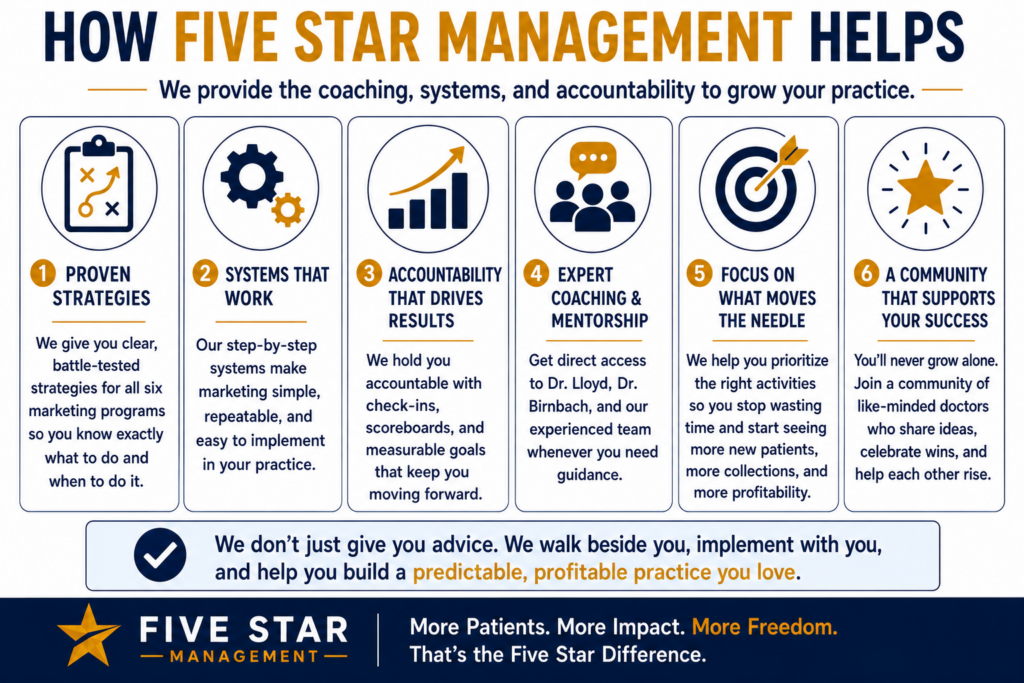
At Five Star Management, we don’t believe chiropractic marketing should be a collection of random promotions.
It should be a system.
We help chiropractic practice owners identify the right internal and external marketing strategies, create measurable processes around them, develop their teams, and build more predictable new patient growth.
That may mean strengthening referral systems.
Improving digital visibility.
Building community outreach.
Developing a COA.
Creating better accountability.
Or simply figuring out why the marketing you’re already doing isn’t producing the results it should.
Because the goal isn’t to do more marketing.
It’s to build marketing that consistently produces opportunities to help more people.
If your new patient numbers feel unpredictable—or your entire marketing strategy depends on one source—schedule a complimentary strategy call with Five Star Management.
We’ll help you identify where your new patient system is breaking down and what you can do next to strengthen it.
Final Thoughts
A full chiropractic practice rarely comes from discovering one magical marketing strategy.
It comes from consistency.
It comes from diversification.
It comes from measurement.
And it comes from refusing to wait until the schedule is empty before doing something about it.
Build your Marketing Six-Pack.
Choose three internal programs.
Choose three external programs.
Schedule the time.
Track the numbers.
Keep what works.
Improve what doesn’t.
Then do it again next week.
Because when marketing becomes a system instead of an emergency, new patient growth becomes a lot less mysterious.
And that’s when you can stop hoping for a full practice—and start building one.