
Hiring an associate doctor is exciting.
You finally have another doctor in the practice. More capacity. More opportunity. Maybe even the beginning of a practice that can grow beyond you.
Then Monday morning arrives.
And one question suddenly becomes very important:
What exactly am I supposed to teach them?
Too many chiropractic practice owners don’t have a good answer.
They introduce the new doctor to the team, show them the software, explain the schedule, let them observe a few patient visits, and then gradually start handing them patients.
The assumption is that because they’re a chiropractor, they’ll figure out the rest.
That’s not training.
That’s hoping.
And hope is a terrible associate development system.
A successful associate needs more than clinical ability. They need to learn how to communicate, educate patients, generate new patients, manage a schedule, understand the business, work with the team, and eventually operate with increasing independence.
The good news?
You don’t have to teach everything at once.
You need a system.
Here’s how to build one.
Why Great Chiropractors Can Still Struggle as Associates
Your associate graduated chiropractic school knowing how to be a chiropractor.
That doesn’t necessarily mean they know how to build and manage a successful chiropractic practice.
Those are different skill sets.
A new associate may still need significant development in:
- Patient communication
- Case acceptance
- Patient education
- Retention
- Referrals
- New patient generation
- Time management
- Practice systems
- Team communication
- Leadership
- Business fundamentals
That’s why simply telling a new doctor to “watch what I do” usually isn’t enough.
Observation has value.
But observation without explanation, practice, feedback, and accountability leaves too much to interpretation.
If you want your associate to reproduce a result, you need to teach the process that creates it.
Step 1: Define the Doctor You’re Trying to Develop
Before you create an associate training program, answer one question:
What should this doctor be capable of doing independently 12 months from now?
Don’t start with training modules.
Start with the outcome.
Do you want an associate who can simply adjust patients you’ve assigned to them?
Or do you want a doctor who can:
- Attract new patients
- Perform consultations and exams
- Communicate recommendations
- Build patient relationships
- Maintain strong retention
- Generate referrals
- Manage their own statistics
- Solve problems
- Work effectively with the team
- Contribute to practice growth
Those are two completely different associate models.
At Five Star, our goal is to develop doctors who become increasingly capable of producing, thinking, and leading rather than remaining dependent on the owner.
Once you know what the finished product should look like, you can work backward and build the training required to get there.
Step 2: Put the Training in Writing
One of my core management principles is:
You have no right to expect what isn’t written down and cross-trained.
That absolutely applies to associates.
If your entire training program exists inside your head, your associate has to guess what matters.
Instead, document the essentials.
Create written expectations for:
- New patient procedures
- Consultation
- Examination
- Report of findings
- Patient education
- Scheduling
- Re-examinations
- Referrals
- Reactivations
- Marketing
- Documentation
- Team communication
- Meetings
- Performance expectations
This doesn’t mean creating a 400-page manual your associate will never read.
Make it usable.
Checklists.
Scripts.
Videos.
Examples.
Scorecards.
Simple written procedures.
The goal is to create a centralized brain for the practice so the associate doesn’t have to rely on asking you the same questions repeatedly.
For more on building this kind of structure, see Chiropractic Onboarding Systems: How to Set New Team Members Up for Long-Term Success.
Step 3: Start With Culture Before Technique
There’s something your associate needs to understand before they learn every procedure:
How does this practice operate?
Teach them your mission.
Your values.
Your philosophy.
Your standards.
How patients should be treated.
How team members communicate.
How problems are handled.
What accountability looks like.
What behavior is—and isn’t—acceptable.
An associate who understands the procedures but doesn’t understand the culture can still create major problems.
This is especially important because doctors naturally carry influence inside a clinic. Patients listen to them. Team members watch them. Their attitude can quickly affect the energy of the practice.
Technical competence matters.
Cultural alignment matters too.
Your associate should understand not only what your practice does, but why you do it that way.
Step 4: Teach the Patient Journey From Beginning to End
Don’t train isolated tasks.
Train the entire patient journey.
Your associate should understand what happens from the moment someone first discovers the practice through every major stage of care.
Walk them through:
Lead → Appointment → Arrival → Consultation → Examination → Recommendations → Care → Progress Evaluation → Continued Care → Referral
Then teach their responsibility at each stage.
What should the patient understand?
What should the doctor communicate?
What does the team handle?
Where do patients commonly become confused?
Where do patients tend to drop out?
What should happen next?
When an associate understands the entire patient experience, they’re less likely to view their role as simply:
Walk into room. Adjust patient. Walk out.
They begin understanding how every interaction affects the success of the patient and the practice.
Step 5: Train Communication as Seriously as Clinical Skills
A doctor can be clinically excellent and still struggle in practice because they cannot communicate clearly.
Your associate needs to learn how to explain:
- What they found
- Why it matters
- What they recommend
- What progress looks like
- Why continued care may be appropriate
- What patients should expect
- How to respond to questions or concerns
Don’t assume they’ll naturally communicate exactly like you.
Train it.
Role-play it.
Listen to it.
Coach it.
Then have them do it again.
This is especially important for consultations and reports of findings.
A patient shouldn’t leave thinking:
“I have no idea what the doctor just said.”
The goal isn’t to turn your associate into a salesperson.
The goal is to help them become an excellent communicator.
Because if patients don’t understand the problem, the recommendation, or the plan, even excellent clinical care can be undermined by poor communication.
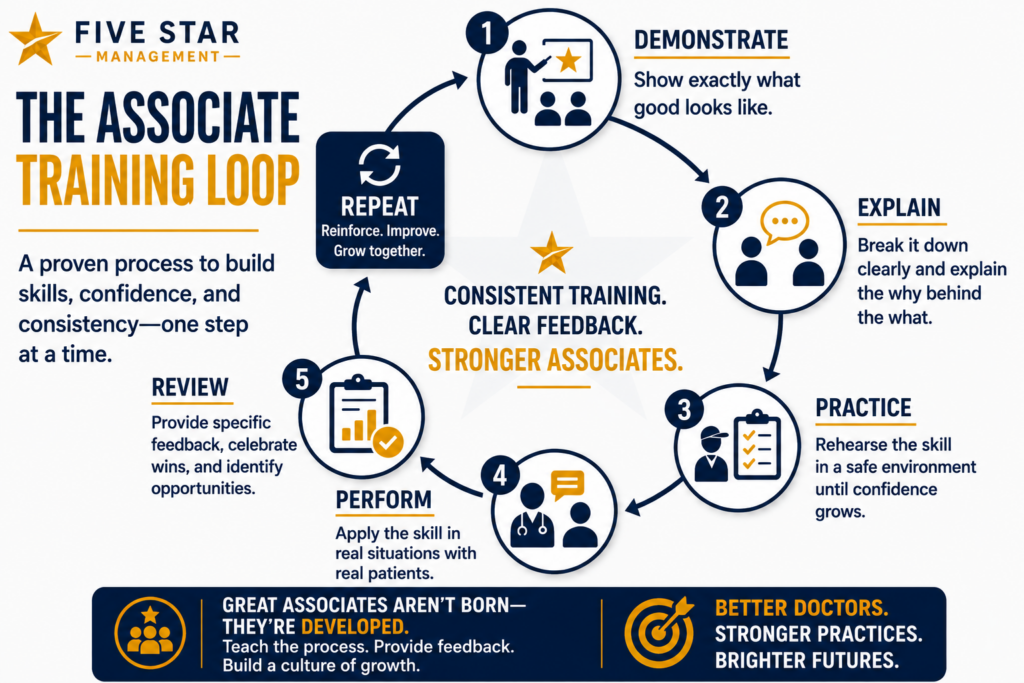
Step 6: Use Demonstrate → Practice → Perform → Review
Here’s a simple training sequence you can use throughout your associate program:
1. Demonstrate
Show the associate exactly what good looks like.
Let them observe you performing the skill correctly.
2. Explain
Break down what you did and why.
Don’t assume they noticed the important details.
3. Practice
Have the associate rehearse the skill in a low-risk environment.
Role-play.
Practice scripts.
Run scenarios.
4. Perform
Let them execute the skill in the real practice.
5. Review
Give specific feedback immediately afterward.
What worked?
What needs improvement?
What should they do differently next time?
Then repeat the cycle.
This is dramatically more effective than:
“Watch me for a couple weeks and then give it a shot.”
The feedback loop is where development happens.
Step 7: Teach Them How to Get New Patients
This is where many associate programs break down.
The owner knows how to get new patients.
The associate doesn’t.
And the owner’s training consists of:
“Go meet people.”
That’s not a strategy.
A doctor who’s never built a practice needs specific instruction.
Teach them:
- Where new patients come from
- How referrals happen
- How to ask for referrals appropriately
- How to build relationships in the community
- How to conduct screenings
- How to give health talks
- How to follow up
- How to reactivate patients
- How to create opportunities
- How to track their activity
Then give them targets.
How many outreach activities?
How many conversations?
How many events?
How many leads?
How many appointments?
A new associate shouldn’t have to reverse-engineer the owner’s 15 years of experience.
Turn what you know into a process they can follow.
This is one of the central ideas behind Five Star’s Win-Win Associate System: developing an associate who can contribute to growth rather than simply waiting for the owner to fill their schedule.
Step 8: Don’t Hand Them a Full Patient Base Too Soon
It’s tempting.
The owner is overwhelmed.
The associate has an empty schedule.
So the owner starts transferring patients.
Problem solved.
Except maybe it isn’t.
If the associate receives a full schedule without learning how to create and maintain one, you’ve developed a doctor who can service a practice, not necessarily one who can build a practice.
There’s nothing wrong with transitioning patients appropriately.
But patient transfers shouldn’t replace development.
Your associate still needs to learn how to:
Attract → Convert → Retain → Refer → Grow
That’s what creates long-term capability.
The goal isn’t merely to make the associate look busy.
It’s to teach them the skills necessary to become productive.
Step 9: Give Them a Scoreboard
Training feels subjective when there are no numbers.
The owner says:
“I think you’re doing pretty well.”
The associate thinks:
“I think I’m doing pretty well too.”
But what does the data say?
Create a simple associate scoreboard.
Depending on the doctor’s stage of development, you might track:
- New patient opportunities
- New patients
- Visits
- Conversion
- Retention
- Referrals
- Reactivations
- Marketing activity
- Collections
- Patient outcomes or progress metrics
Not every number needs to become a punishment.
The scoreboard is there to create clarity.
It answers:
Where are we winning?
Where are we struggling?
What should we coach next?
When numbers are reviewed consistently, coaching becomes far more specific.
Instead of:
“You need to do better.”
You can say:
“Your new patient numbers are strong, but we’re seeing a drop in retention. Let’s look at your progress conversations this week.”
That’s coaching.
Step 10: Hold Regular Coaching Meetings
Don’t wait until something goes wrong to coach your associate.
Development should be scheduled.
Your meetings don’t need to be complicated.
Review:
Wins → Numbers → Challenges → Training → Commitments
Start with what’s working.
Review the scoreboard.
Identify the biggest opportunity.
Coach one or two priorities.
Then finish with specific commitments for the next period.
Avoid turning every coaching meeting into an hour-long lecture.
Your associate should increasingly participate in solving their own problems.
Instead of immediately telling them what to do, ask:
“What do you think is causing this?”
“What have you tried?”
“What would you do differently?”
“What’s your plan?”
That’s how you begin developing an independent thinker rather than a permanently dependent employee.
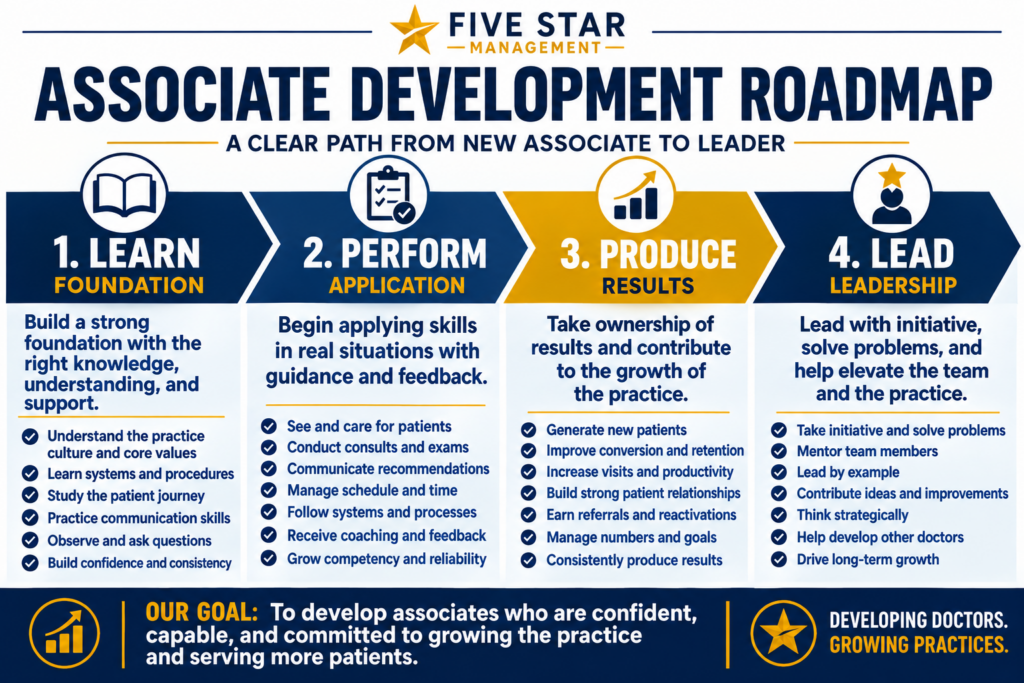
Step 11: Increase Responsibility in Stages
A brand-new associate shouldn’t have the same expectations as an experienced doctor.
Build progression into the system.
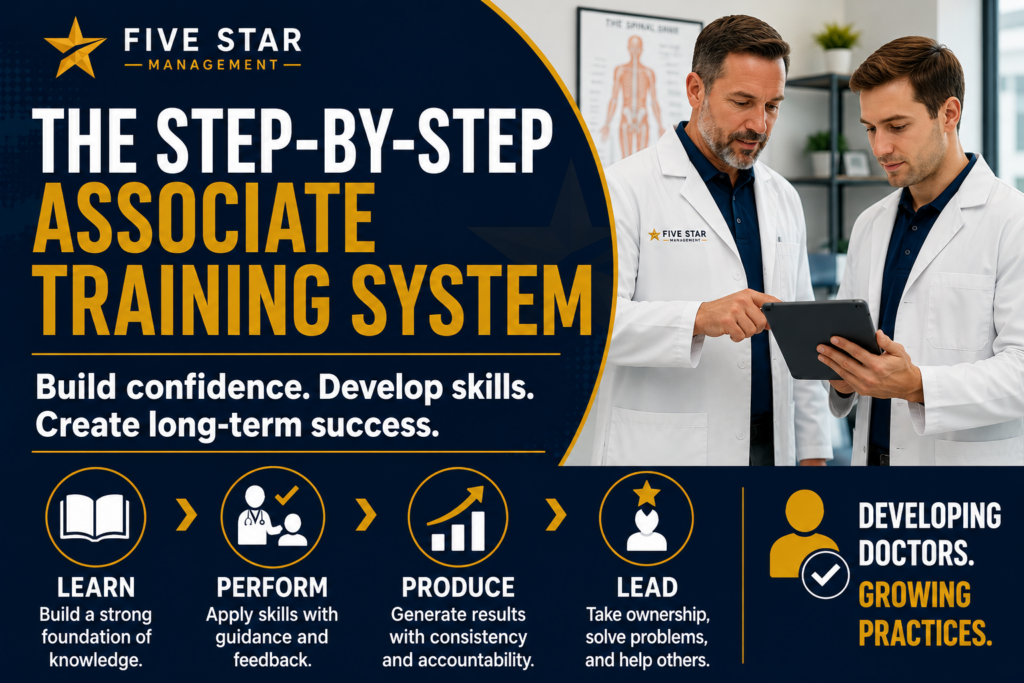
Phase 1: Learn
Observe, study systems, practice communication, understand culture, and master basic procedures.
Phase 2: Perform
Begin handling patients, consultations, exams, recommendations, and assigned responsibilities with supervision.
Phase 3: Produce
Take greater responsibility for new patient generation, retention, referrals, statistics, and productivity.
Phase 4: Lead
Solve problems, contribute ideas, mentor others, take ownership, and begin thinking beyond their individual schedule.
This gives both the owner and associate a clear development path.
Instead of asking:
“When will they finally be ready?”
You can identify exactly which competencies they’ve mastered and what comes next.
Step 12: Train Business Understanding
Eventually, your associate should understand that a chiropractic practice is both a healing environment and a business.
They should understand basic economics.
Where does revenue come from?
What does it cost to operate the practice?
What does an employee cost?
What makes an associate profitable?
Why do collections matter?
Why does retention matter?
Why do new patients matter?
Why does efficiency matter?
You don’t need to turn every associate into an accountant.
But when doctors understand the business behind their role, their decisions change.
They begin thinking beyond:
“How many patients did I see?”
And toward:
“How am I contributing to the health and growth of this organization?”
That’s an important shift.
The 90-Day Associate Training Roadmap
While every practice is different, a structured first 90 days can look something like this:
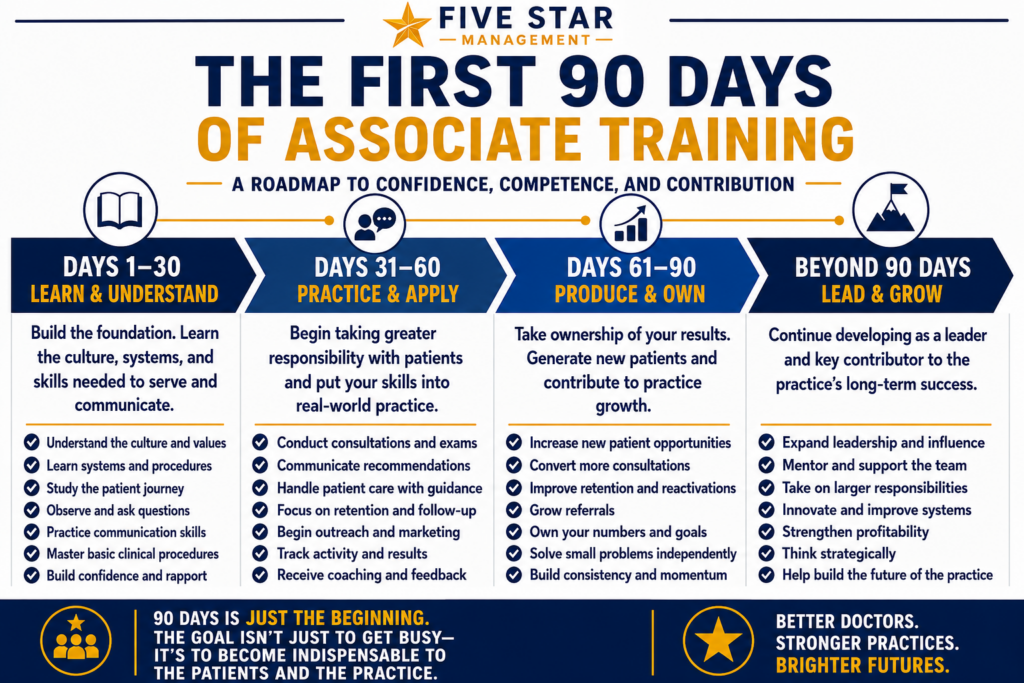
| Timeframe | Primary Focus |
| Days 1–30 | Culture, systems, patient journey, scripts, observation, role-play, basic procedures |
| Days 31–60 | Patient care responsibilities, consultations, communication, marketing activity, coaching |
| Days 61–90 | Increased independence, new patient generation, scoreboard ownership, retention, productivity |
| Beyond 90 Days | Advanced production, problem-solving, business understanding, leadership development |
The important point isn’t whether every associate progresses on the exact same day.
It’s that progression is intentional.
Your associate should know where they are, what they’re learning, what success looks like, and what they need to master next.
The Biggest Associate Training Mistake
The biggest mistake may be expecting independence without first providing mentorship.
Practice owners sometimes say:
“I figured it out. Why can’t they?”
But think about how long it took you to figure it out.
Years?
Thousands of patient interactions?
Dozens of mistakes?
Countless uncomfortable conversations?
Your associate doesn’t need to repeat every mistake you made to become capable.
That’s the value of mentorship.
You can shorten the learning curve.
You can provide structure.
You can give feedback.
You can help them avoid predictable mistakes.
And over time, you can reduce your involvement as their capability increases.
Good training creates independence.
It doesn’t create dependence.
Your Associate Training System Should Eventually Run Without You
There’s another level to this.
If you’re building a multi-doctor practice, you can’t personally provide every minute of every associate’s training forever.
Your training system needs to become scalable too.
Document your curriculum.
Record training videos.
Build checklists.
Create scripts.
Standardize scoreboards.
Define milestones.
Train leaders.
Create a repeatable coaching rhythm.
Then when Doctor #2, #3, or #4 arrives, you’re not rebuilding the associate program from scratch.
You’re plugging another doctor into a proven development system.
That’s one of the differences between having associates and actually building a multi-doctor organization.
For more on that transition, read How to Build a Multi-Doctor Practice.
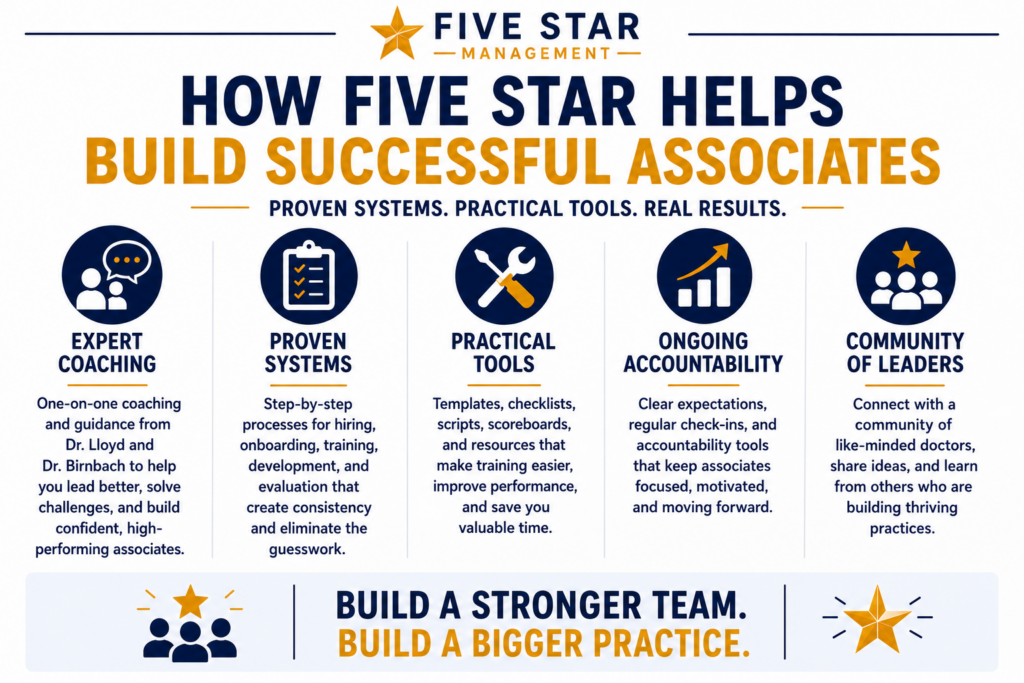
How Five Star Helps Build Successful Associates
At Five Star Management, we’ve seen what happens when practice owners hire good doctors without giving them a system for succeeding.
The owner gets frustrated.
The associate gets frustrated.
The team feels the tension.
And eventually, a relationship that had enormous potential falls apart.
That’s why associate development is such an important part of our Win-Win Associate System.
We help practice owners build structure around the entire associate journey—from determining whether the practice is ready to hire, to recruiting and onboarding, training, new patient generation, compensation, coaching, accountability, leadership, and long-term growth.
The goal isn’t simply to help you hire another chiropractor.
It’s to help you develop a productive doctor who can become an increasingly valuable part of the organization.
If you’re preparing to hire an associate—or you already have an associate who isn’t progressing the way you’d hoped—schedule a complimentary strategy call with Five Star Management.
We’ll help you identify what’s missing and what your next step should be.
Final Thoughts
Successful associates aren’t found fully formed.
They’re developed.
Give them clear expectations.
Put the systems in writing.
Teach the patient journey.
Train communication.
Practice before expecting performance.
Give feedback.
Teach new patient generation.
Track the numbers.
Coach consistently.
Increase responsibility.
Develop business understanding.
Then teach them to lead.
Because the ultimate goal of associate training isn’t to create a doctor who constantly needs the owner’s help.
It’s to develop a doctor who eventually helps the owner carry the practice forward.