
Most chiropractors don’t start a practice because they’re passionate about systems.
They start because they want to help people.
Then the practice grows.
More patients come in. More team members get hired. More responsibilities pile up. And somewhere along the way, the doctor realizes something:
Being a great chiropractor and running a great chiropractic practice are two very different jobs.
Without systems, the practice begins depending on memory, personality, and the owner’s constant involvement.
The front desk asks you what to do.
The team handles the same situation three different ways.
Marketing happens when someone remembers.
New employees learn by watching whoever happens to be working that day.
Associate doctors develop through trial and error.
And when the owner leaves the building, things start slipping.
That’s not necessarily a people problem.
It’s often a systems problem.
A well-run chiropractic practice shouldn’t require the owner to personally hold everything together.
It should have clear, repeatable processes that tell the team what needs to happen, who is responsible, how success is measured, and what to do when something goes wrong.
So how systematic is your practice?
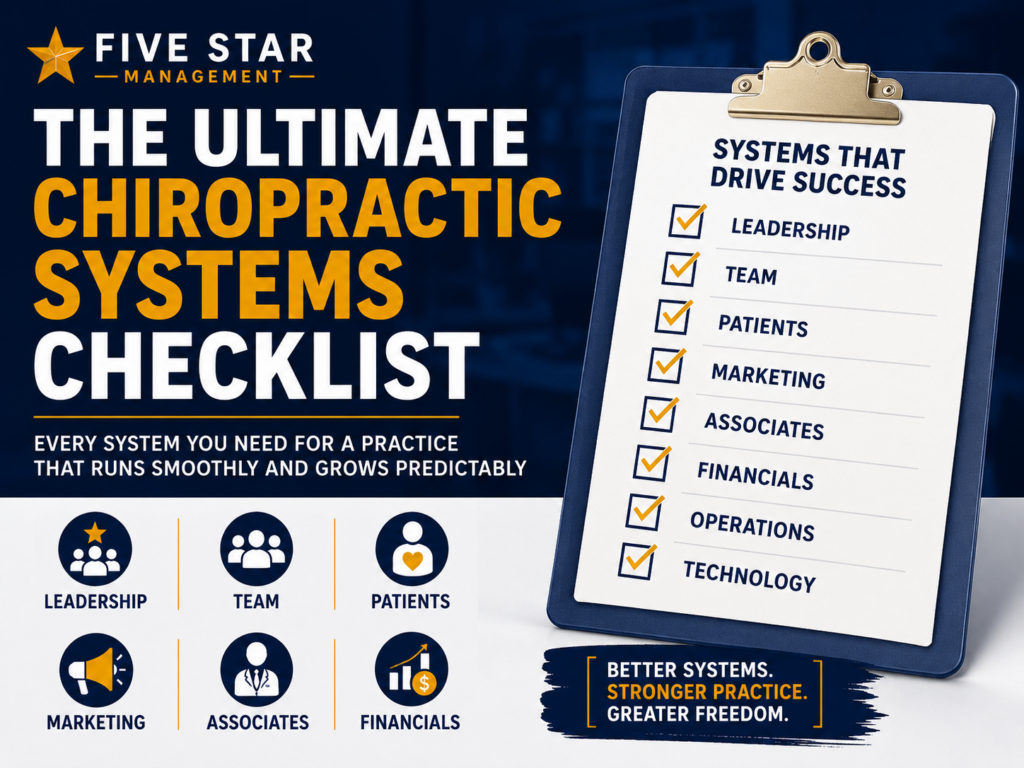
Use this checklist to find out.
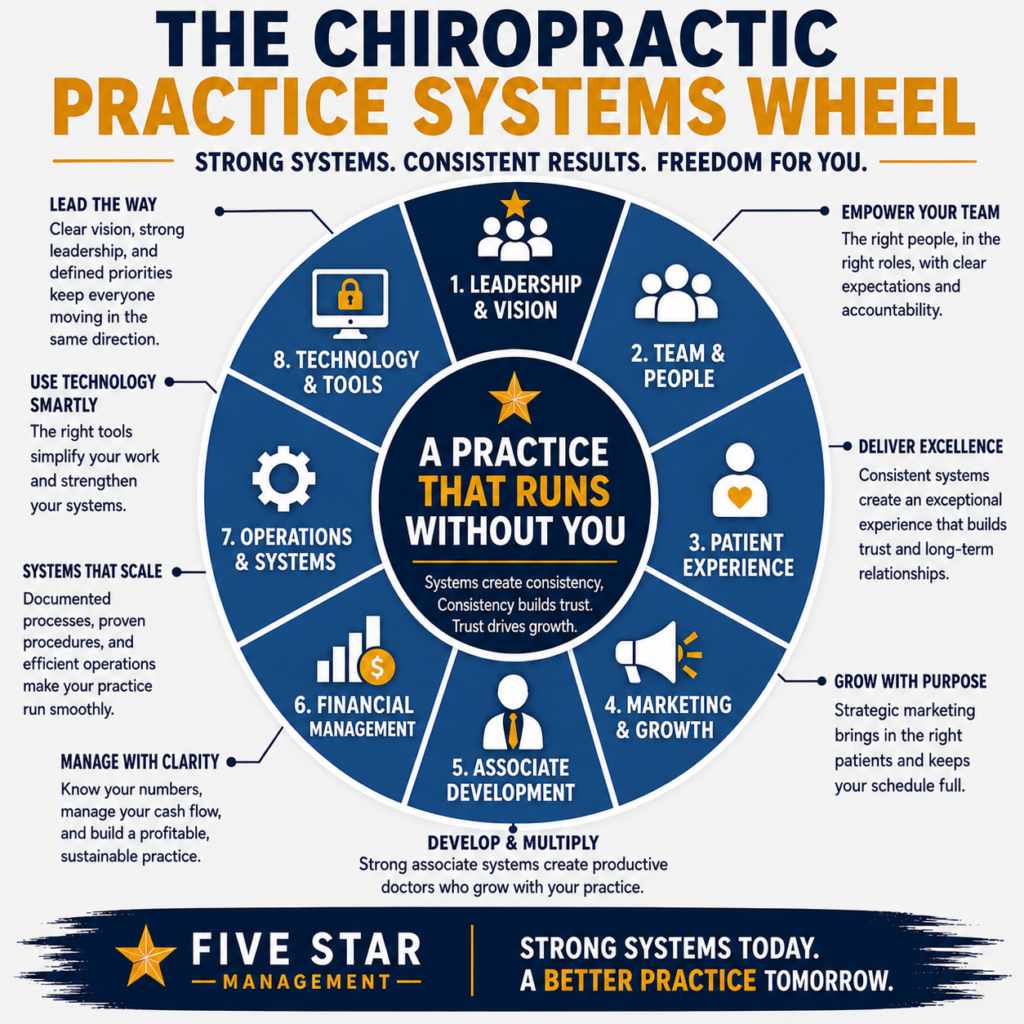
What Is a Chiropractic Practice System?
A system is simply a repeatable way of producing a desired result.
It answers questions like:
What needs to happen?
Who owns it?
How should it be done?
When should it happen?
How do we know it worked?
That last question matters.
A checklist nobody follows isn’t a system.
A procedure only one employee understands isn’t a system.
And instructions that exist only inside the owner’s head definitely aren’t a system.
One of Dr. Noel Lloyd’s management principles says it best:
“You have no right to expect what isn’t written down and cross-trained.”
The goal isn’t bureaucracy.
It’s consistency.
Because when the important parts of your practice are systematic, you create a business that can deliver a great patient experience even when the owner isn’t personally supervising every interaction.

1. Leadership & Vision Systems
Let’s start at the top.
Before your team can execute consistently, they need to know what they’re trying to build.
Practice owners sometimes spend enormous amounts of time teaching employees how to perform tasks without explaining why those tasks matter.
Your leadership system should create clarity around the direction of the practice.
Leadership Systems Checklist
☐ Written mission or purpose
☐ Clearly defined core values
☐ Annual practice goals
☐ Quarterly priorities
☐ Defined leadership responsibilities
☐ Regular leadership meetings
☐ Clear decision-making process
☐ Problem-solving process
☐ Accountability structure
☐ Communication expectations
Your team shouldn’t need to guess what matters most.
When priorities are clear, decisions become easier.
Instead of asking the owner about every situation, employees can begin asking:
“What decision best supports our standards and goals?”
That’s the beginning of owner independence.
2. Job Description & Accountability Systems
Every position in the practice should have a clearly defined purpose.
Not just a title.
A purpose.
Your chiropractic assistant shouldn’t simply be responsible for “helping patients.”
Your front desk shouldn’t just “answer phones.”
Your office manager shouldn’t be responsible for “keeping things running.”
Those descriptions are too vague to manage.
Each position should have a written job book or role description that outlines responsibilities, procedures, expectations, and measurable outcomes.
Job Systems Checklist
☐ Written job description for every position
☐ Clearly defined responsibilities
☐ Daily responsibilities
☐ Weekly responsibilities
☐ Monthly responsibilities
☐ Written procedures for recurring tasks
☐ Scripts where appropriate
☐ Performance standards
☐ Key statistics or KPIs
☐ Backup person for critical responsibilities
☐ Cross-training completed
If a team member suddenly left tomorrow, could another person understand what that job requires?
If the answer is no, the practice has unnecessary vulnerability.
A system protects the business from depending on one person’s memory.
3. Hiring Systems
Hiring shouldn’t begin when you’re desperate.
That’s when standards tend to disappear.
The practice gets busy.
Someone quits.
Everyone feels overwhelmed.
And suddenly the hiring requirement becomes:
“Can this person start Monday?”
That’s how expensive hiring mistakes happen.
Instead, create a repeatable hiring process before you need it.
Hiring Systems Checklist
☐ Clearly defined position
☐ Written ideal-candidate profile
☐ Consistent job posting process
☐ Resume/application screening criteria
☐ Structured phone screening
☐ Structured interview questions
☐ Multiple-step interview process
☐ Reference-check process
☐ Skills or personality assessment where appropriate
☐ Clear compensation expectations
☐ Written offer process
☐ Defined onboarding start date
Your hiring system should help you evaluate more than whether you like someone.
You need to determine whether the candidate fits the role, culture, expectations, and future of the practice.
For a deeper look at this, read The Hiring Mistakes That Cost You Thousands.
4. Employee Onboarding & Training Systems
Hiring the right person is only the beginning.
Now you have to turn them into a productive team member.
Too many chiropractic offices use what could politely be called the “follow Sarah around” onboarding system.
The new employee watches another employee for a few days.
They take notes.
They ask questions.
Eventually, everyone assumes they know what they’re doing.
Six months later, the owner discovers they’ve been performing an important procedure incorrectly since Week 2.
Training should be intentional.
Onboarding Checklist
☐ First-day agenda
☐ Culture and mission orientation
☐ Written job book
☐ Systems and procedures training
☐ Scripts and communication training
☐ Software training
☐ Patient journey training
☐ Role-playing
☐ Observation period
☐ Supervised performance
☐ Competency sign-offs
☐ 30-day review
☐ 60-day review
☐ 90-day review
A strong onboarding process should move employees through:
Learn → Practice → Perform → Review
Don’t simply show someone a task once and assume training is complete.
For more on this process, see Chiropractic Onboarding Systems: How to Set New Team Members Up for Long-Term Success.
5. Front Desk & Patient Flow Systems
The front desk is one of the busiest intersections in your entire practice.
Phones.
Patients arriving.
Patients leaving.
Scheduling.
Payments.
Questions.
Paperwork.
Team communication.
And somehow it all needs to happen while the patient feels welcomed rather than processed.
That’s why front-desk procedures should be extremely clear.
Front Desk Systems Checklist
☐ Phone answering script
☐ New patient call procedure
☐ Appointment scheduling process
☐ Appointment confirmation system
☐ Patient arrival procedure
☐ Check-in procedure
☐ Waiting-room standards
☐ Late-patient procedure
☐ Missed-appointment procedure
☐ Rescheduling procedure
☐ Check-out procedure
☐ Payment collection process
☐ Future scheduling process
☐ End-of-day procedure
The goal isn’t robotic service.
It’s eliminating preventable confusion so your team has more mental space to provide excellent service.
6. New Patient Systems
A prospective patient forms an opinion about your practice long before the first adjustment.
How quickly did someone answer?
Was scheduling easy?
Did they know what to expect?
Were they greeted by name?
Did the consultation feel organized?
Did the doctor communicate clearly?
Every step matters.
New Patient Systems Checklist
☐ Lead-response procedure
☐ New patient phone script
☐ Online scheduling process
☐ New patient paperwork
☐ Pre-visit communication
☐ Arrival and greeting procedure
☐ Consultation process
☐ Examination procedure
☐ Imaging process, if applicable
☐ Report of findings
☐ Recommendations process
☐ Financial conversation
☐ First-adjustment procedure
☐ Follow-up scheduling
☐ New patient tracking
You should be able to map your entire new patient journey from:
Lead → Appointment → Arrival → Consultation → Examination → Recommendation → Care
Then identify where people are falling through the cracks.
7. Patient Education & Retention Systems
Getting someone through the front door isn’t the finish line.
Patients need to understand what’s happening throughout care.
If communication stops after the report of findings, patients may begin making decisions based only on how they feel that day.
“I’m feeling better, so I guess I’m done.”
That makes ongoing education critical.
Patient Retention Checklist
☐ Clear expectations established at the beginning of care
☐ Consistent patient education
☐ Progress-review process
☐ Re-examination schedule
☐ Missed-visit follow-up
☐ Dropout prevention procedure
☐ Patient concern procedure
☐ Reactivation system
☐ Referral conversations
☐ Patient appreciation strategy
☐ Long-term care communication
☐ Retention statistics tracked
Retention isn’t about trapping patients into care.
It’s about making sure they understand their progress, recommendations, and options well enough to make informed decisions.
8. Scheduling & Capacity Systems
A packed schedule can still be an inefficient schedule.
In fact, sometimes the practice feels overwhelmed precisely because the schedule has no system behind it.
You need to know:
How long does each visit actually take?
Where do delays occur?
Which appointments require the doctor’s full attention?
Where are the natural bottlenecks?
How many visits can your current facility and team realistically handle?
Scheduling Systems Checklist
☐ Defined appointment types
☐ Standard appointment lengths
☐ Scheduling templates
☐ New patient blocks
☐ Re-examination blocks
☐ Peak-hour strategy
☐ Patient-flow standards
☐ Doctor capacity tracked
☐ Team capacity tracked
☐ Wait times monitored
☐ Check-in/check-out times measured
☐ Procedures for schedule disruptions
Don’t build the schedule around what feels busy.
Measure it.
Objective data will tell you far more than the feeling everyone has at 5:15 on a Tuesday afternoon.
9. Marketing Systems
Marketing should never become an emergency response to an empty schedule.
If the practice waits until new patient numbers fall to start marketing, it’s already behind.
Build marketing into the weekly operating rhythm.
Dr. Lloyd’s Marketing Six-Pack provides a useful framework:
Three internal marketing programs.
Three external marketing programs.
Marketing Systems Checklist
☐ Weekly marketing time scheduled
☐ Three internal marketing strategies selected
☐ Three external marketing strategies selected
☐ Patient referral system
☐ Reactivation system
☐ Review/reputation strategy
☐ Website maintained
☐ Local SEO strategy
☐ Social media plan
☐ Community outreach strategy
☐ Educational marketing strategy
☐ Marketing calendar
☐ Lead tracking
☐ Source tracking
☐ Cost-per-lead tracked
☐ New patients by source tracked
For the full framework, read The Marketing “Six-Pack” That Builds a Full Practice.
The goal isn’t to do every marketing tactic available.
It’s to know which strategies work for your practice and execute them consistently.
10. New Patient Follow-Up Systems
Not every lead schedules immediately.
Not every scheduled patient shows up.
Not every former patient remembers to return.
That’s why follow-up deserves its own system.
Follow-Up Checklist
☐ Unscheduled lead follow-up
☐ Missed-call follow-up
☐ No-show follow-up
☐ Cancelled new patient follow-up
☐ Incomplete paperwork reminder
☐ Missed regular visit follow-up
☐ Reactivation follow-up
☐ Referral follow-up
☐ Event lead follow-up
☐ Follow-up responsibility assigned
☐ Follow-up results tracked
A lead sitting untouched inside your CRM isn’t a marketing problem.
It’s a follow-up problem.
11. Team Communication Systems
Communication problems are often systems problems wearing disguises.
“Nobody told me.”
“I thought she was doing it.”
“That’s not how I was trained.”
“I didn’t know we changed that.”
Sound familiar?
Create predictable places for information to move through the practice.
Communication Systems Checklist
☐ Daily huddle
☐ Weekly team meeting
☐ Leadership meeting
☐ Written meeting agenda
☐ Meeting notes
☐ Assigned action items
☐ Deadlines
☐ Clear communication channels
☐ Escalation process
☐ Procedure for announcing system changes
☐ Follow-up accountability
Meetings shouldn’t simply create more talking.
They should create decisions, ownership, and action.
12. Statistics & Scoreboard Systems
You can’t manage a practice based entirely on feelings.
“It seems slower.”
“I think referrals are down.”
“We’re pretty busy.”
“The associate seems to be doing okay.”
Those aren’t measurements.
Build a scoreboard.
Practice KPI Checklist
☐ New leads
☐ New patients scheduled
☐ New patients arrived
☐ Conversion
☐ Patient visits
☐ Retention
☐ Referrals
☐ Reactivations
☐ Collections
☐ Accounts receivable
☐ Marketing results
☐ Associate production
☐ Team productivity
☐ Capacity utilization
You don’t necessarily need 75 statistics.
You need the right statistics reviewed consistently.
Numbers help you identify problems while they’re still small.
13. Financial Systems
Revenue alone doesn’t tell you whether the practice is healthy.
A practice can collect more money than ever and still create financial stress if expenses, payroll, debt, and profitability aren’t being managed.
Financial Systems Checklist
☐ Annual budget
☐ Monthly financial review
☐ Profit-and-loss review
☐ Payroll tracking
☐ Expense categories
☐ Accounts receivable process
☐ Collection procedures
☐ Financial controls
☐ Cash reserve target
☐ Profitability tracked
☐ Associate profitability tracked
☐ Marketing ROI reviewed
☐ Major purchase approval process
The goal is financial visibility.
The owner should know where the money is coming from, where it’s going, and whether growth is actually creating greater profitability.
14. Associate Doctor Systems
Adding an associate without systems doesn’t automatically create freedom.
Sometimes it creates another person for the owner to manage.
Your associate program needs structure from recruiting through long-term development.
Associate Systems Checklist
☐ Associate readiness criteria
☐ Recruiting process
☐ Interview process
☐ Compensation structure
☐ Written expectations
☐ Onboarding plan
☐ Clinical training
☐ Communication training
☐ New patient training
☐ Marketing expectations
☐ 30/60/90-day development plan
☐ Associate scoreboard
☐ Coaching meetings
☐ Performance reviews
☐ Leadership development
☐ Long-term growth path
The objective isn’t simply to hire someone capable of adjusting patients.
It’s to develop a doctor capable of contributing to the growth and future of the practice.
For the training side of that equation, read The Step-by-Step Associate Training System.
15. Culture Systems
Culture sounds intangible.
But it becomes very tangible when a new employee asks:
“How do we handle things around here?”
Culture is shaped by what leadership teaches, models, rewards, corrects, and tolerates.
Culture Checklist
☐ Core values defined
☐ Values included in hiring
☐ Values included in onboarding
☐ Behavioral standards established
☐ Recognition system
☐ Accountability standards
☐ Conflict-resolution process
☐ Team feedback process
☐ Leadership models expectations
☐ Culture discussed regularly
Don’t leave culture entirely unwritten and hope the right one develops.
Your patients experience your culture every time they interact with the team.
16. Patient Experience Systems
Clinical outcomes matter.
So does the experience surrounding them.
How does your practice make patients feel?
Do you greet them?
Do you remember important details?
Is the office running on time?
Does the team communicate with confidence?
Are problems resolved quickly?
Patient Experience Checklist
☐ Greeting standard
☐ Phone experience standard
☐ Waiting-room standard
☐ On-time standard
☐ Communication standards
☐ Patient concern procedure
☐ Service-recovery process
☐ Feedback collection
☐ Review-request process
☐ Patient appreciation
☐ Team hospitality expectations
You can’t script genuine care.
But you can build systems that make it easier for your team to deliver it consistently.
17. Technology & Documentation Systems
Technology should reduce complexity, not create six different places to look for the same information.
Review the tools your practice uses and establish standards around them.
Technology Systems Checklist
☐ Practice management software procedures
☐ CRM procedures
☐ Documentation standards
☐ File naming/storage standards
☐ Password/access management
☐ Permission levels
☐ Backup procedures
☐ Automation review
☐ Form management
☐ Template library
☐ Technology onboarding
☐ Offboarding/access removal process
Every new tool should answer one question:
Does this make the practice simpler, more measurable, or more effective?
If not, it may just be another subscription.
18. Owner Independence Systems
Here’s the ultimate test.
What happens when you leave?
Not for lunch.
For a week.
If everything slows down, decisions pile up, employees wait for answers, and problems sit unresolved until you return, the practice is still highly owner-dependent.
That doesn’t mean you have a bad practice.
It means you’ve found the next systems to build.

Owner Independence Checklist
☐ Leadership roles established
☐ Decision-making authority delegated
☐ Critical systems documented
☐ Team cross-trained
☐ Scoreboards reviewed without owner prompting
☐ Meetings can run without owner
☐ Problems have assigned owners
☐ Marketing continues without owner
☐ Patient experience remains consistent
☐ Associate doctors operate independently
☐ Financial reporting continues
☐ Owner can take uninterrupted time away
A successful practice shouldn’t become less successful because the owner took a vacation.
That’s one of the clearest signs that you’ve built an organization rather than simply creating a very demanding job for yourself.
How to Use This Chiropractic Systems Checklist
Don’t read this article, identify 47 missing systems, and announce at Monday’s meeting that you’re rebuilding the entire practice.
That’s a great way to make everyone hate systems.
Instead, start with the area creating the most friction.
Ask:
Where are mistakes happening repeatedly?
What questions does the team keep asking me?
Where are patients falling through the cracks?
What depends too heavily on one person?
What stops working when I’m not there?
Pick one system.
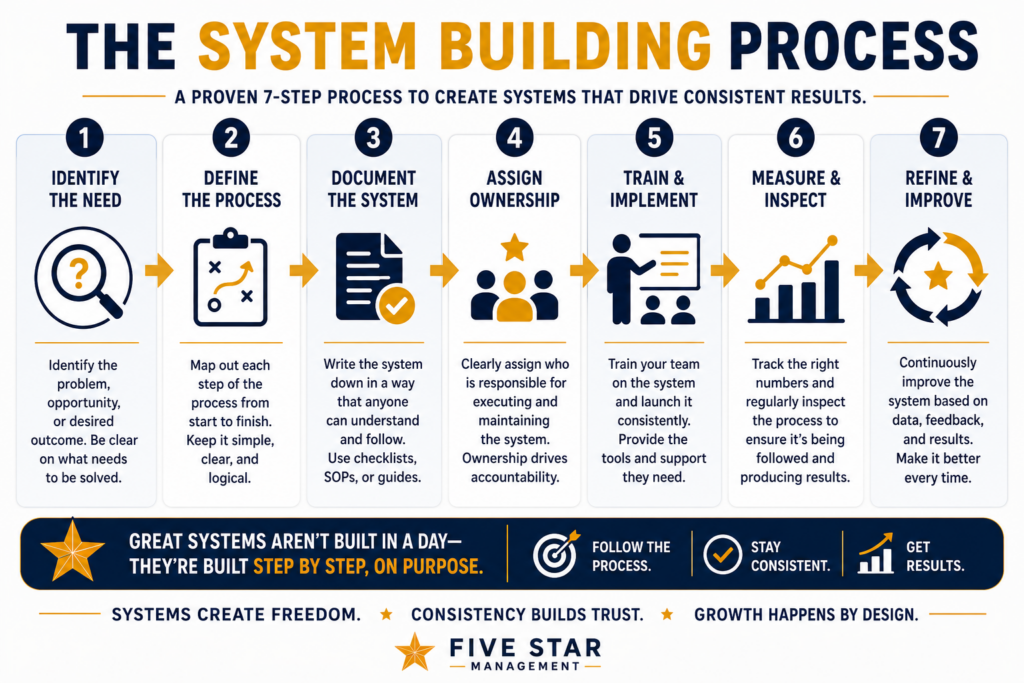
Then work through this process:
1. Define the Outcome
What should this system reliably accomplish?
2. Document the Process
Write down how it should work.
3. Assign Ownership
Someone must be responsible for the result.
4. Train the Team
Don’t assume a written SOP equals training.
5. Measure It
Determine how you’ll know whether the system is working.
6. Inspect It
Review performance and identify problems.
7. Improve It
Systems aren’t carved into stone.
Fix what’s unclear. Simplify what’s cumbersome. Update what no longer works.
Then move to the next system.
The System Test: Can Someone Else Run It?
Here’s a simple way to evaluate any system in your chiropractic practice.
Ask:
Could a properly trained person follow this without me standing beside them?
If not, keep working.
A strong system should be:
Clear enough to teach.
Simple enough to follow.
Measurable enough to inspect.
Repeatable enough to produce consistent results.
That’s what makes systems scalable.
And scalability matters whether your goal is to build a highly profitable single-doctor practice, add associates, create a multi-doctor clinic, or eventually expand into multiple locations.
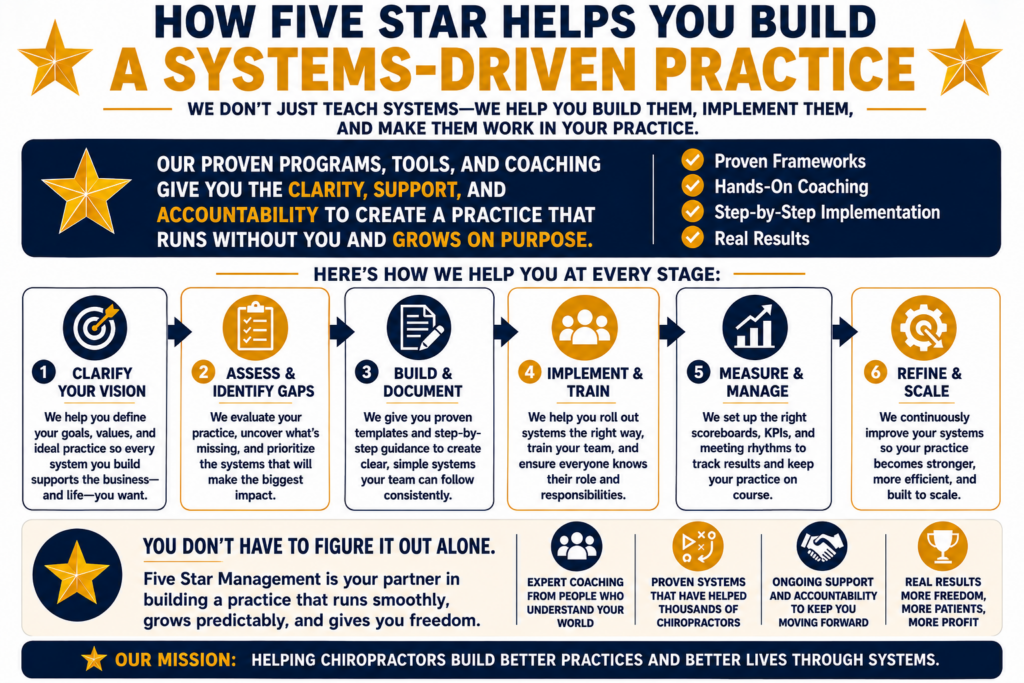
How Five Star Helps Chiropractors Build Practices That Run on Systems
At Five Star Management, we’ve spent decades helping chiropractors build practices that are less dependent on the owner’s constant involvement.
Because growth without systems usually creates one thing:
More complexity.
More patients without patient-flow systems create chaos.
More employees without management systems create confusion.
More associates without training systems create frustration.
More marketing without tracking systems creates waste.
And more revenue without financial systems doesn’t necessarily create more freedom.
Five Star helps practice owners put structure around the areas that drive the business—from team development and accountability to patient flow, marketing, associates, leadership, statistics, and growth.
The goal isn’t to turn your chiropractic office into a rigid corporation.
The goal is to create enough structure that great people can consistently do great work.
If your practice has grown but everything still seems to depend on you, schedule a complimentary strategy call with Five Star Management.
We’ll help you identify where stronger systems could create the greatest improvement in your practice.
Final Thoughts
Systems aren’t the exciting part of owning a chiropractic practice.
Until they start working.
Then suddenly:
The team asks fewer questions.
Training gets easier.
Patients receive a more consistent experience.
Marketing happens without panic.
Problems get solved faster.
Associates become more independent.
Numbers become clearer.
And the owner finally gets some room to lead instead of constantly reacting.
You don’t need to systematize everything tomorrow.
Start with what repeatedly creates friction.
Write it down.
Train it.
Measure it.
Inspect it.
Improve it.
Then build the next one.
Because the strongest chiropractic practices don’t rely on the owner remembering everything.
They build a practice that knows what to do—even when the owner isn’t in the room.