
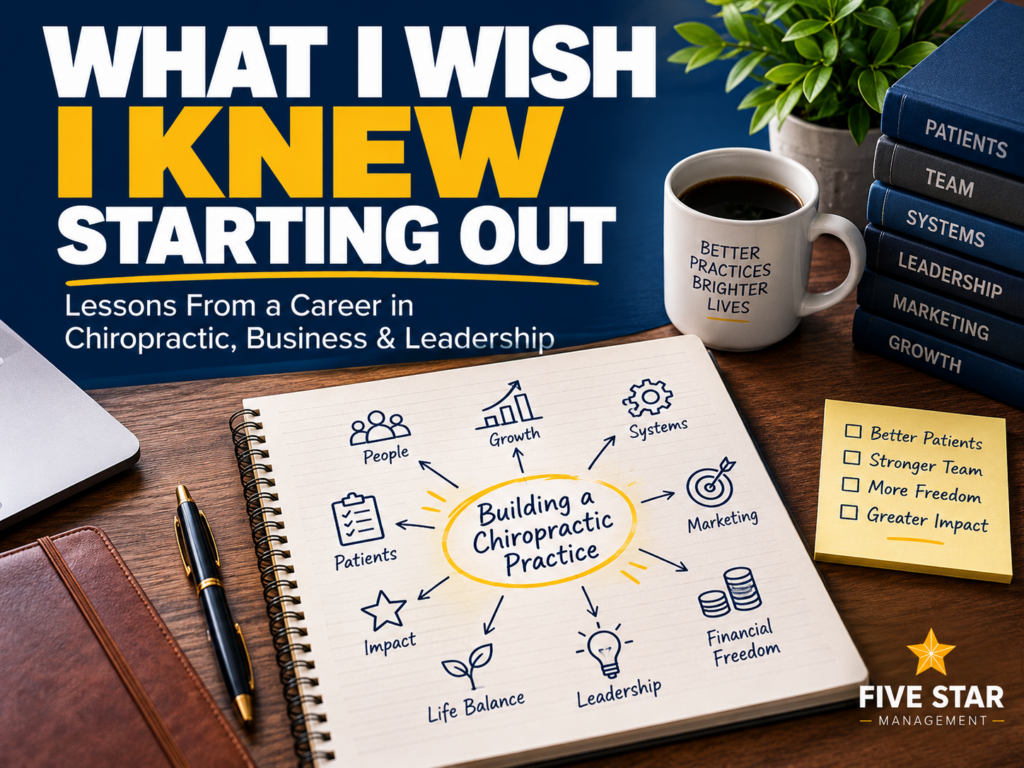

If I could sit down with myself when I first started in practice, I’d have a lot to say.
Some of it would be about patients.
Some of it would be about money.
A lot of it would be about people.
And almost all of it would be about things I thought I understood at the time but really didn’t.
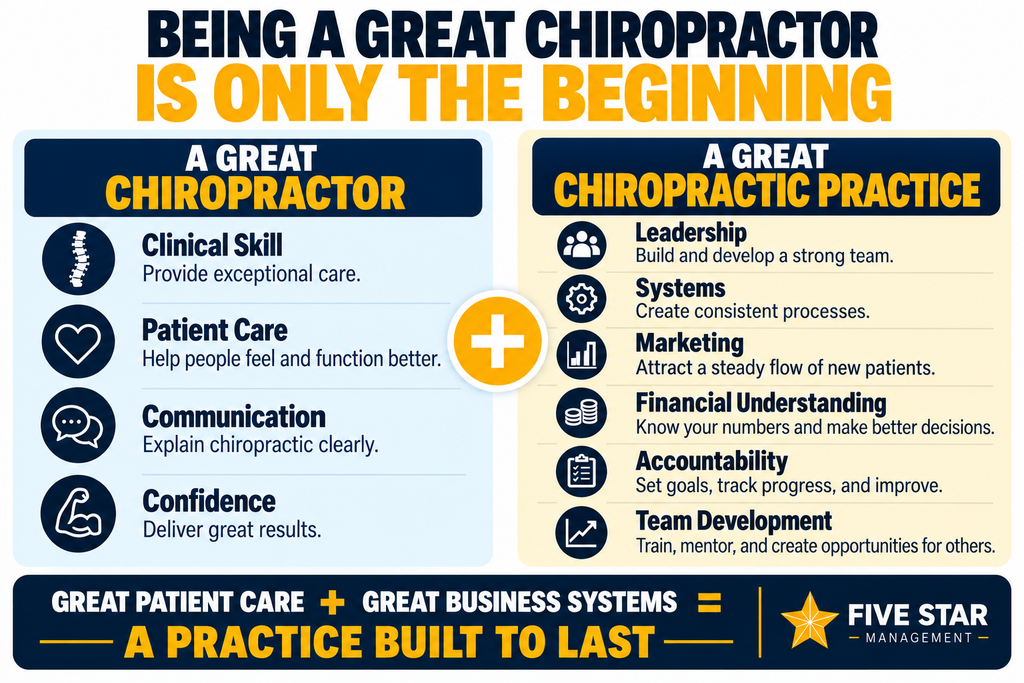
When you first become a chiropractor, you think your biggest job is becoming a great chiropractor.
And it is important.
You need to know how to take care of people. You need confidence in what you do. You need to communicate chiropractic clearly and deliver great care.
But somewhere along the way, you discover something they don’t spend nearly enough time teaching you in school:
Taking great care of patients and building a great chiropractic practice are two different skills.
You can be an outstanding chiropractor and still struggle financially.
You can have patients who love you and still feel trapped by your practice.
You can have a full schedule and still wonder why there isn’t more money left at the end of the month.
You can even build a successful practice that eventually becomes the very thing keeping you from the life you wanted it to create.
I learned a lot of these lessons by doing things wrong first.
So if you’re early in practice, or even if you’ve been doing this for 10, 20, or 30 years and recognize yourself in some of these, here are a few things I wish I’d understood sooner.
Being Busy Is Not the Same as Being Successful
This one took me a while.
When you’re starting out, a busy schedule feels like the goal.
More patients.
More visits.
More hours.
More production.
You look at a packed schedule and think:
“I’m doing it.”
But here’s the question I wish someone had asked me:
What happens if you stop?
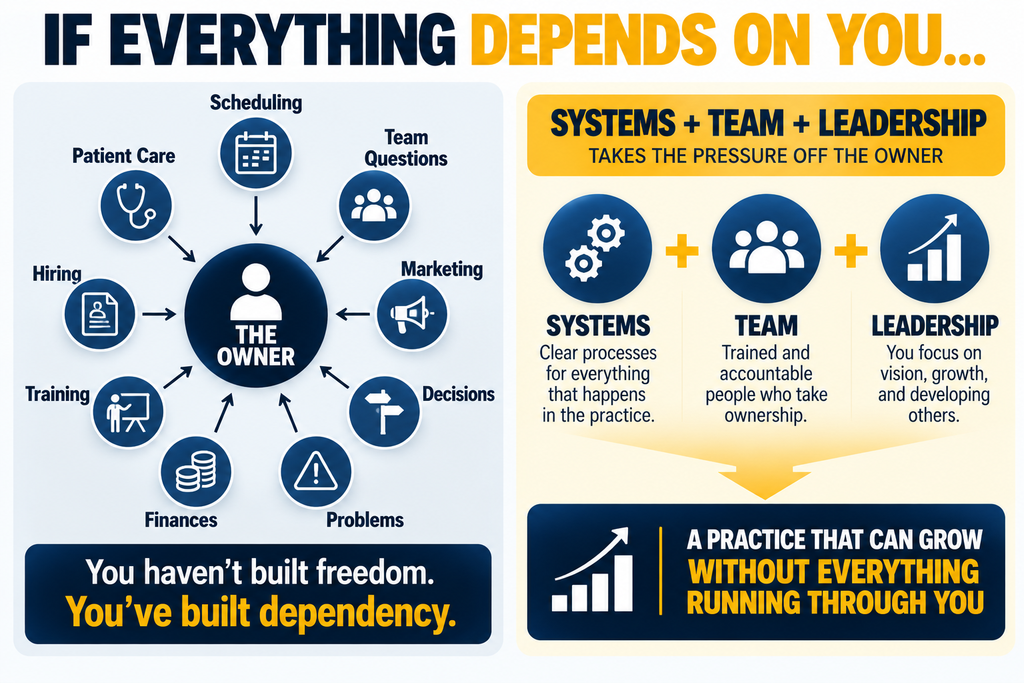
If the answer is that the entire practice stops with you, you haven’t built much of a business yet.
You’ve built yourself a very demanding job.
There is nothing wrong with working hard. In fact, there are seasons when you’re going to have to work incredibly hard.
But the goal should be to turn that effort into something.
Systems.
A team.
Leadership.
Processes.
Other doctors.
A practice that gets stronger instead of simply requiring more from you.
If every increase in revenue requires another hour from the owner, eventually you hit the ceiling.
And the ceiling is you.
Learn Your Numbers Earlier Than You Think You Need To
I wish I’d understood earlier that numbers aren’t just for accountants.
They’re for leaders.
When I talk to chiropractors who feel overwhelmed by their practice, one of the first things I want to know is whether they actually know what’s happening inside it.
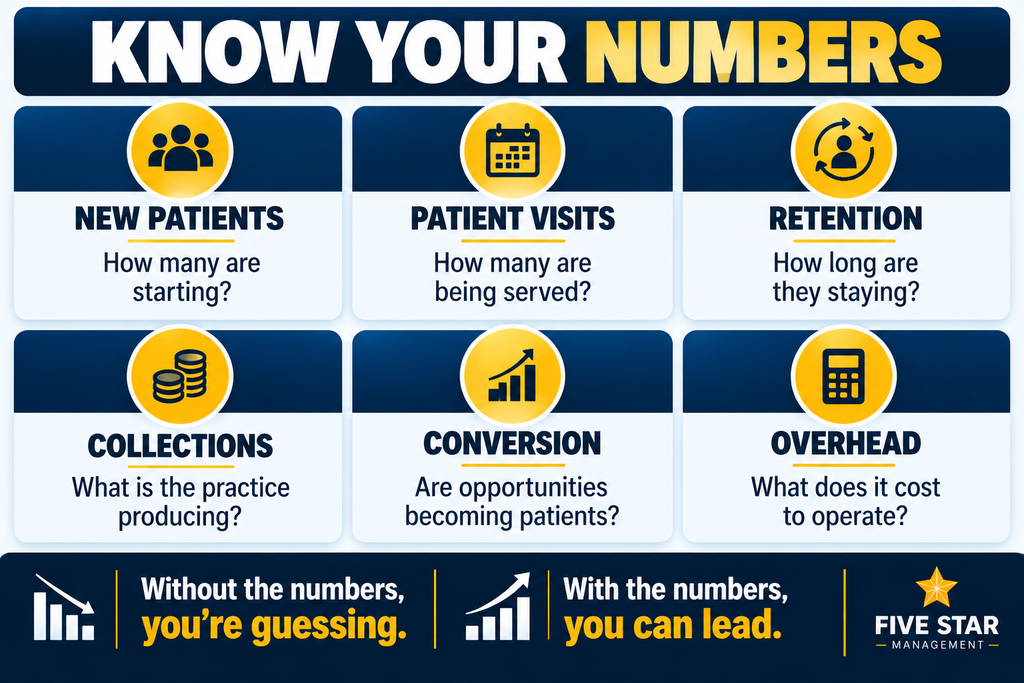
How many new patients did you have last month?
How many patient visits?
What’s your visit average?
What’s your collection per visit?
What’s your overhead?
How many leads became appointments?
How many appointments showed?
How productive is each area of the practice?
Where are patients dropping out?
A lot of practice owners can’t confidently answer those questions.
They know whether the month felt busy.
That’s not the same thing.
Your numbers tell you where the problem is.
Without them, everything feels like the problem.
You start changing your marketing when the real issue is conversion.
You blame your team when the real issue is training.
You look for more new patients when the real issue is retention.
You think you need another doctor when the real issue is scheduling.
Numbers replace emotion with clarity.
The sooner you learn to run your practice by statistics instead of feelings, the better decisions you’ll make.
Don’t Wait Until You’re Drowning to Build Systems
Most chiropractors don’t build systems when things are calm.
They build them when something breaks.
A team member quits.
A patient falls through the cracks.
The schedule gets chaotic.
The doctor takes a vacation and spends the entire trip answering texts.
Then suddenly everyone decides:
“We need a system for this.”
I wish I’d understood that systems aren’t something you create once you’re successful.
Systems are part of how you become successful.
If something important happens repeatedly in your practice, there should be a clear way to do it.
How do you answer the phone?
How do you schedule a new patient?
What happens when somebody misses an appointment?
How do you onboard a new employee?
How do you train an associate?
How do you handle a patient concern?
How do you ask for referrals?
How do you run a team meeting?
How do you follow up with a lead?
How do you review statistics?
If the answer lives only in your head, you don’t have a system.
And if everything lives in the owner’s head, the owner can never truly leave.
If you want to dig deeper into this, our Ultimate Chiropractic Systems Checklist walks through the major systems every growing practice should examine.
Hire for Where You’re Going, Not Just Where You Are
Early in practice, every hire feels expensive.
I understand that.
You’re looking at payroll and thinking:
“I can just do this myself.”
And you probably can.
That’s the problem.
You can answer the phones.
You can schedule patients.
You can do billing.
You can manage the team.
You can handle marketing.
You can clean up at the end of the day.
You can probably do 50 things yourself.
But every job you continue doing is one less job you’re available to do that only you can do.
Eventually, you have to start asking:
“What is the highest and best use of my time?”
That’s a very different question from:
“What am I capable of doing?”
One keeps you busy.
The other helps you build.
Hire carefully. Train people well. Set clear expectations. Inspect their work.
But don’t wait until you’re completely overwhelmed to start building the team your future practice will require.
Your Team Cannot Read Your Mind
This might be one of the biggest leadership lessons I’ve learned.
Practice owners say things like:
“They should know that.”
Why?
Did you teach them?
Did you write it down?
Did you practice it with them?
Did you inspect it?
Did you give them feedback?
Did you explain what “good” actually looks like?
Or did you mention it once six months ago and assume everyone understood?
Your team cannot execute expectations that exist only in your head.
I wish I’d learned earlier that clarity is one of the greatest gifts you can give your team.
Tell people what winning looks like.
Give them a scoreboard.
Train the process.
Role-play it.
Inspect it.
Celebrate when they do it well.
Coach them when they don’t.
That’s leadership.
And when you do that consistently, accountability stops feeling like confrontation.
It becomes part of the culture.
If you’re trying to build stronger leaders inside your practice, that’s also the thinking behind our Clinic Directors Empowerment Program (CDEP): developing people who can take greater ownership, lead others, and help the practice function at a higher level.
Don’t Keep the Wrong Person Because Replacing Them Feels Hard
This is a painful one.
Most practice owners know when somebody isn’t working out long before they actually do anything about it.
They know.
The attitude isn’t right.
The performance isn’t there.
Other team members are frustrated.
Patients notice.
The owner is constantly compensating for them.
But then comes the thought:
“I don’t have time to hire and train somebody new.”
So they keep the wrong person.
And the cost keeps growing.
A bad fit doesn’t only affect that person’s job.
It affects your culture.
Your good employees.
Your patients.
Your energy.
Your standards.
Sometimes the short-term inconvenience of making a change is much less expensive than the long-term cost of avoiding it.
I wish I’d understood sooner that protecting your culture is part of your job as the leader.
That doesn’t mean being harsh.
It means being clear.
Train people.
Coach people.
Give them a real opportunity to succeed.
But when someone consistently demonstrates that they aren’t the right fit, don’t make your entire team pay the price because you’re afraid of the inconvenience of change.
Marketing Should Be a System, Not a Panic Button
Here’s a pattern I’ve watched chiropractors repeat for years.
New patients slow down.
Everybody panics.
Marketing becomes the emergency.
They launch an ad.
Run a promotion.
Ask for referrals.
Schedule an event.
Numbers go back up.
Everybody gets busy.
And marketing disappears again.
Then two months later, they’re right back where they started.
I wish I’d understood sooner that you should market when you’re busy, not just when you’re slow.
A healthy practice has multiple ways new patients consistently discover it.
That’s why we teach the Marketing Six-Pack, with internal and external marketing strategies working together rather than relying on one source.
Referrals.
Community outreach.
Digital visibility.
Reactivation.
Patient education.
External marketing.
The individual tactics will change over time.
The principle won’t.
Never let one source become your entire new patient strategy.
If you’d like to go deeper on this, listen to The Six Pack Marketing Solution for Chiropractors: 3 Internal + 3 External Growth Systems on The Successful Chiro Podcast.
Learn How to Develop People, Not Just Hire Them
Hiring a great person is wonderful.
Developing one is better.
Early on, it’s easy to think:
“I just need to find someone good.”
Later, you realize that’s only the beginning.
People need training.
Feedback.
Standards.
Repetition.
Responsibility.
Accountability.
A path to grow.
This is especially important with associates.
You can’t hire a young chiropractor, hand them an adjusting table and a schedule, and expect them to magically think like an owner.
You have to develop them.
Teach them how to communicate.
Teach them how to lead.
Teach them how to understand the business.
Give them opportunities to win.
Help them see how their success connects to the success of the practice.
That’s one of the reasons the Win-Win Associate philosophy became so important to us.
The relationship has to work for both sides.
The owner needs a productive, committed doctor who helps the practice grow.
The associate needs mentorship, opportunity, fair compensation, and a future worth working toward.
When both sides win, you can build something that lasts.
Don’t Make Yourself the Hero of Every Story
This one can sneak up on you.
You’re good at solving problems.
That’s probably one of the reasons you became successful.
A team member comes to you with a problem.
You solve it.
Another problem.
You solve that too.
Eventually, everybody learns something:
Bring every problem to the owner.
Congratulations.
You have now trained your team to need you.
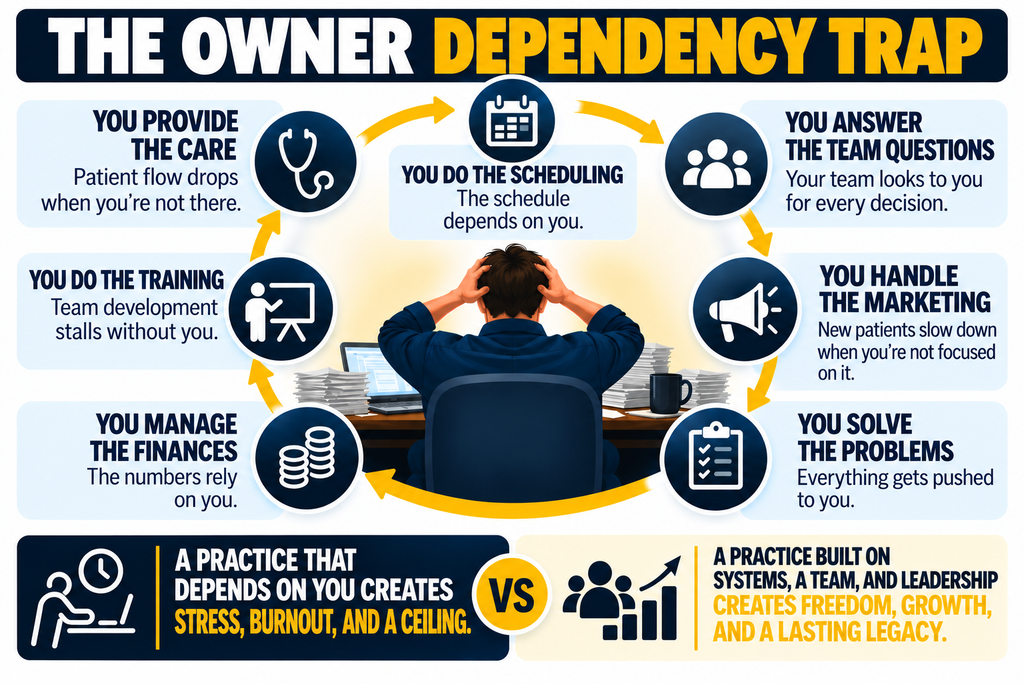
Leadership isn’t proving you’re the smartest person in the room.
It’s developing people who can think.
The next time someone brings you a problem, resist the urge to immediately give them the answer.
Ask:
“What do you think we should do?”
You might be surprised.
And if their answer isn’t right, now you have a coaching opportunity.
The goal isn’t to become unnecessary as a leader.
It’s to stop being necessary for every decision.
That’s how organizations grow.
Start Building an Associate Practice Before You Think You’re Ready
For a lot of chiropractors, the first associate comes too late.
They wait until they’re exhausted.
Completely full.
Turning patients away.
Working every hour available.
Then they decide:
“I need an associate.”
Now they’re trying to recruit, hire, onboard, train, and launch another doctor while already operating at maximum capacity.
That’s a tough place to start.
I wish more chiropractors understood that an associate shouldn’t simply be an emergency pressure-release valve.
Done correctly, an associate can be part of the growth strategy.
They can create additional capacity.
Serve more patients.
Expand hours.
Develop new patient relationships.
Allow the owner to spend more time leading.
Eventually, they can help create something even more valuable:
freedom.
But that only happens when the associate program is built intentionally.
Compensation matters.
Training matters.
Marketing matters.
Mentorship matters.
Expectations matter.
Leadership matters.
You aren’t simply filling a position.
You’re developing another doctor.
Your Practice Should Eventually Give You Your Life Back
This may be the biggest one.
When you’re starting out, you’re willing to work like crazy.
And sometimes you should.
There is a season for hustle.
There is a season for staying late.
There is a season for doing whatever needs to be done.
But that season isn’t supposed to last forever.
At some point, your practice should begin giving something back to you.
Time.
Financial security.
Opportunity.
Freedom.
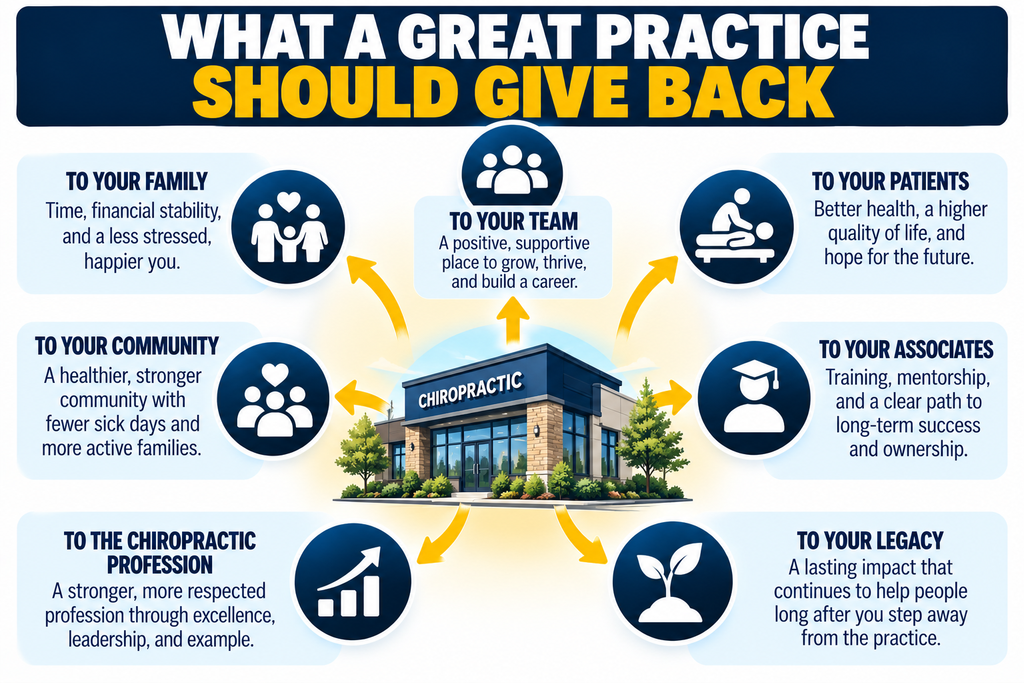
The ability to take a vacation without checking your phone every 20 minutes.
The ability to spend time with your family.
The ability to mentor younger doctors.
The ability to step away for a day and know the practice isn’t going to fall apart.
If your practice grows every year but requires more and more of you every year, something is wrong with the equation.
Growth should eventually create freedom, not eliminate it.
That requires systems.
It requires leadership.
It requires a team.
And for many practice owners, it requires learning how to stop being the center of everything.
Don’t Compare Your Chapter One to Someone Else’s Chapter Twenty
This one isn’t really about practice systems.
It’s about keeping your head straight.
You’ll meet chiropractors with bigger practices.
More doctors.
More locations.
More money.
More patients.
A nicer building.
A bigger team.
And if you’re not careful, you’ll use somebody else’s results as evidence that you’re behind.
You usually don’t know their whole story.
You don’t know how many years they’ve been building.
You don’t know what went wrong along the way.
You don’t know the mistakes they made.
You don’t know what their life looks like behind the numbers.
Learn from successful people.
Absolutely.
But don’t let comparison distract you from building the practice that’s right for you.
The question isn’t:
“Am I ahead of that doctor?”
The question is:
“Am I building something better than I had a year ago?”
Keep moving.
Find Mentors Earlier
I made plenty of mistakes that somebody else had already made.
That’s one of the most expensive ways to learn.
Experience is a wonderful teacher.
But it doesn’t always have to be your experience.
One of the smartest things you can do in business is get around people who are farther down the road.
Ask questions.
Listen.
Borrow frameworks.
Learn from their failures.
See what’s possible.
Then do the work yourself.
A good coach isn’t there to run your practice for you.
A good coach helps you see what you can’t see, challenges your thinking, gives you proven tools and frameworks, and holds you accountable to doing the things you already know need to be done.
You still have to implement.
You still have to lead.
You still have to make the decisions.
But you don’t have to figure out every lesson from scratch.
Sometimes the shortcut is simply learning from somebody who’s already walked the road.
What I Would Tell a Young Chiropractor Today
If I had to boil all of this down, I’d say this:
Become an excellent chiropractor. But don’t stop there.

Learn business.
Learn leadership.
Learn your numbers.
Learn marketing.
Learn how to hire.
Learn how to train.
Learn how to communicate.
Learn how to build systems.
Learn how to develop other people.
And perhaps most importantly, decide what you’re actually trying to build.
Is the goal simply to have a busy practice?
Or are you trying to build a practice that serves patients exceptionally well, creates opportunities for your team, provides for your family, and gives you a life outside the office?
Those are different goals.
The second one requires you to think beyond today’s schedule.
You Don’t Have to Learn Everything the Hard Way
I’ve spent decades in chiropractic.
I’ve made mistakes.
I’ve watched other doctors make mistakes.
And I’ve also had the privilege of watching chiropractors build incredible practices when they finally put the right systems, people, leadership, and accountability in place.
That’s a big part of why we do what we do at Five Star Management.
We don’t run your practice for you.
We help you become better equipped to run it.
Our coaching gives chiropractors frameworks, training, tools, accountability, and support to help them build stronger practices and stronger teams.
Because you can learn all of these lessons through trial and error.
But you don’t necessarily have to.
If you’re building your practice and wondering what your next move should be, schedule a complimentary strategy session with a Five Star coach. We’ll help you take a look at where you are, where you want to go, and what may be standing between the two.
Final Thoughts
If I could go back, I wouldn’t tell myself to avoid every mistake.
Some mistakes teach you things success never could.
But I would tell myself to pay attention sooner.
Build systems sooner.
Learn the numbers sooner.
Develop leaders sooner.
Ask for help sooner.
And remember why I was building the practice in the first place.
Because at the end of your career, I don’t think you’ll wish you’d personally answered more phone calls, worked more Saturdays, or solved more problems your team could have learned to solve.
You’ll care about the people you helped.
The people you developed.
The opportunities you created.
The family you provided for.
And the life you were able to live because of what you built.
Build a great practice.
But make sure you’re also building a great life.