
Every chiropractor wants more new patients.
More calls.
More consultations.
More people walking through the front door.
But there’s another number that can have an enormous impact on the health of your practice:
How many of those patients are still with you after the initial problem is gone?
A patient walks into your clinic with back pain.
You help them.
They start feeling better.
And then they disappear.
From the patient’s perspective, the story makes sense:
“I hurt. I went to the chiropractor. I feel better. I’m done.”
But what if that patient never understood the bigger picture?
What if they saw chiropractic as something you use when you’re hurting instead of part of a long-term approach to health and wellness?
That’s where lifetime patient relationships begin.
Building lifetime patients isn’t about convincing someone to come forever.
It isn’t about creating dependency.
And it certainly isn’t about keeping people in care they don’t need.
It’s about creating such a clear, valuable, consistent patient experience that people understand why chiropractic can remain relevant to their lives long after the original symptom improves.
That’s a very different goal.
And it requires a very different retention strategy.
What Is a Lifetime Chiropractic Patient?
A lifetime patient isn’t necessarily someone who comes into your office every week for the rest of their life.
Think bigger than frequency.
A lifetime patient is someone who develops a long-term relationship with chiropractic and your practice.
They understand what you do.
They trust your recommendations.
They recognize the value of proactive care.
They return when appropriate.
They refer friends and family.
And they don’t view your clinic as merely the place they went when their back hurt in 2026.
That’s the real opportunity.
Because there is a massive difference between:
“My chiropractor fixed my back.”
and:
“That’s our chiropractor.”
The second statement represents a relationship.
And relationships are what create long-term retention.
1. Build Retention From Day One
One of the biggest mistakes clinics make is treating retention like something that happens near the end of a care plan.
By then, you’re late.
Patient retention begins before the first adjustment.
It begins with:
The first phone call.
The way they’re greeted.
The appearance of the office.
How long they wait.
How clearly the process is explained.
Whether the team knows their name.
Whether the doctor listens.
Whether they feel rushed.
Whether they leave knowing exactly what happens next.
Your patient is forming an opinion about your practice during every one of those moments.
Our Day One WOW framework emphasizes this exact point: the first visit can establish trust and set the stage for both retention and referrals before clinical outcomes have had time to develop.
The first visit shouldn’t feel like paperwork followed by an adjustment.
It should communicate:
You’re in the right place.
We understand why you’re here.
We have a process.
We’re going to guide you through it.
That’s where lifetime relationships start.
2. Give Patients a Roadmap
Imagine getting on an airplane without knowing where it’s going.
You might tolerate that uncertainty for a few minutes.
But eventually, you’d start asking questions.
Patients are no different.
If they don’t understand where their care is going, every appointment becomes another decision:
Should I come back?
Do I still need this?
How much longer will this take?
I’m feeling better. Maybe I’m done.
That’s dangerous.
Instead, patients should understand the journey.
Explain:
- Where they are now
- What you’re trying to accomplish
- What the phases of care look like
- What progress you’ll measure
- When you’ll reevaluate
- What may change along the way
- What options may exist after active care
Don’t make the patient rediscover the value of chiropractic at every visit.
Give them a roadmap and keep showing them where they are on it.
3. Don’t Let Pain Become the Only Scoreboard
This may be one of the most important retention concepts in chiropractic.
A patient comes in at an 8 out of 10 pain level.
A few weeks later, they’re at a 2.
Great news, right?
Clinically, perhaps.
From a retention standpoint, it can become a dangerous moment if the only thing you’ve taught the patient to measure is pain.
Because their scoreboard now says:
8 → 2 = problem basically solved.
That’s one reason our retention training identifies the early visits as a particularly important period for preventing drop-off. The clinic needs to reinforce the broader care journey rather than accidentally communicating that early symptom relief means the patient is finished.
Help patients recognize progress beyond pain alone.
Maybe they’re:
Sleeping better.
Moving more easily.
Exercising again.
Sitting longer without discomfort.
Experiencing fewer headaches.
Returning to hobbies.
Playing with their kids.
Feeling more confident in their body.
People value progress they can see.
Make the improvement visible.
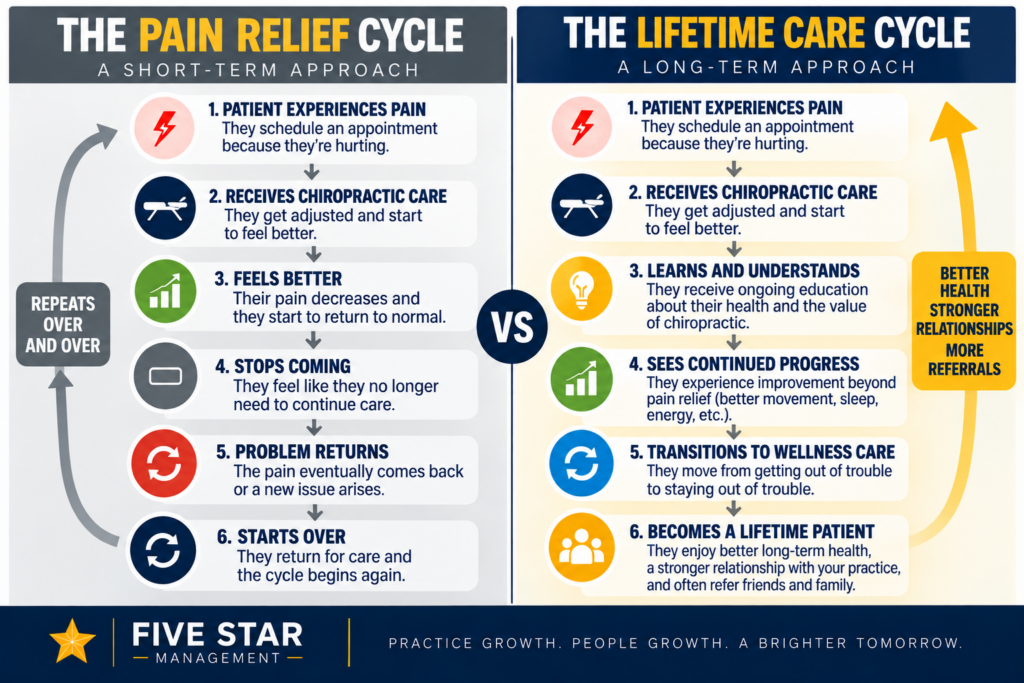
The difference is education. When patients only understand chiropractic in the context of pain, feeling better can feel like the end of the journey. When they understand their progress, their health, and the purpose behind each phase of care, they can make a more informed decision about what comes next.
4. Educate Throughout the Patient Journey
You explained chiropractic during the report of findings.
Great.
They probably don’t remember half of it.
That’s not an insult to the patient.
It’s human nature.
People need repetition.
Especially when they’re learning something new.
If you want patients to understand the long-term value of chiropractic, patient education cannot be a one-time event.
Build education into the entire experience.
That could include:
Short conversations with the doctor.
Educational videos.
Email or SMS education.
Posters and visual aids.
Progress reviews.
FAQs.
Workshops.
Social media.
Printed materials.
Conversations with trained team members.
The goal isn’t to overwhelm people.
It’s to reinforce important ideas at the right time.
A patient in visit two needs different information than a patient approaching the end of active care.
Education should evolve as the patient evolves.
5. Make Progress Reviews Matter
Re-exams shouldn’t feel like administrative checkpoints.
They’re opportunities to reconnect the patient with their progress.
Show them where they started.
Show them what’s changed.
Talk about what still needs work.
Then explain what happens next.
A good progress review answers three questions:
Where were you?
Where are you now?
Where are we going next?
Without that conversation, patients are left to evaluate care based primarily on how they happen to feel that day.
That’s not enough.
6. Introduce Wellness Before Relief Care Ends
Here’s another common mistake.
A patient completes active care.
Then, suddenly:
“Would you like to continue with wellness care?”
To the patient, it can feel like an entirely new product appeared out of nowhere.
Instead, the concept of long-term wellness should fit naturally into the story you’ve been telling since the beginning.
That doesn’t mean pushing maintenance care on every patient.
It means making sure patients understand the difference between:
Getting out of trouble
and
Staying out of trouble.
That distinction is important.
Lifetime patients aren’t created by an awkward sales conversation at the end of care. They’re created by understanding built throughout care.
Want to Go Deeper?
Want to create a clearer transition from active care to long-term wellness?
In this episode of The Successful Chiro Podcast, we break down how chiropractors can build a structured wellness care program that improves patient retention and helps patients understand the value of continued care. You’ll learn how to introduce wellness throughout the patient journey, use progress reviews effectively, and create a more natural transition from pain relief to wellness.
Listen to: How to Increase Chiropractic Patient Retention With a Wellness Care Program.
7. Give Your Wellness Program an Identity
If long-term care matters to your practice philosophy, don’t treat it casually.
Structure it.
Define it.
Give patients a clear understanding of what it means.
That may include:
A defined purpose.
A clear schedule or cadence based on clinical recommendations.
Periodic progress evaluations.
Educational touchpoints.
Simple payment processes.
Patient communication.
A recognizable program name.
Our wellness-care training specifically discusses how a structured and named wellness program can help make the transition clearer for patients.
The idea is simple:
Structure communicates intention.
If your wellness program feels improvised, patients will treat it as optional and vague.
If it feels like a deliberate phase of the patient journey, it’s easier to understand.
8. Make Staying Easy
Sometimes retention problems aren’t philosophical.
They’re operational.
The patient believes in chiropractic.
They like the doctor.
They like the team.
Then life gets busy.
They miss an appointment.
Nobody follows up.
Two weeks pass.
Then six weeks.
Then six months.
Now returning feels strangely awkward.
This is why systems matter.
Look for unnecessary friction around:
Scheduling.
Rescheduling.
Appointment reminders.
Payment.
Missed-visit follow-up.
Reactivation.
Future appointments.
The easier it is for patients to remain engaged, the more likely they are to do it.
Your clinic shouldn’t make a committed patient work hard to stay a committed patient.
9. Create Personal Connection at Scale
Patients want consistency.
But they don’t want to feel processed.
There’s a difference.
You can build systems without making your practice feel robotic.
Know people’s names.
Remember important details.
Celebrate progress.
Ask about the race they were training for.
Remember that their daughter just started college.
Ask how their golf game is going.
Notice when someone has been away.
Patients may forget exactly what happened during visit 17.
They’ll remember how your practice made them feel.
That doesn’t mean your doctor needs to spend 30 minutes chatting with every patient.
It means your systems should create enough structure that your team has room for human connection.
That’s hard to replicate.
And it’s one of the biggest reasons patients stay loyal.
10. Train the Entire Team on Retention
Lifetime patients aren’t built by the doctor alone.
Imagine the doctor gives a fantastic explanation of the patient’s care plan.
Then the patient reaches the front desk and hears:
“Do you want to schedule next week, or just call us?”
Everything the doctor just established has been weakened in one sentence.
Your team needs to understand:
Why patients are scheduled the way they are.
How to reinforce care recommendations.
How to handle missed appointments.
How to communicate progress.
How to answer common questions.
How to respond to objections.
When to bring the doctor back into the conversation.
What the clinic believes about long-term care.
Our retention training emphasizes consistent communication between the doctor, chiropractic assistant, and patient, including structured handoffs rather than leaving important scheduling decisions disconnected from the care recommendation.
Patients should hear one message from one team.
When all of these pieces work together, retention stops depending on one great conversation or one team member. It becomes part of the entire patient experience.

11. Catch the Quiet Quitters
Not every patient announces they’re leaving.
Most don’t.
They start drifting.
They reschedule.
Then reschedule again.
They miss a visit.
They stop pre-scheduling.
They ask more questions about whether care is still necessary.
They become less engaged.
Then one day, their name disappears from the schedule.
The danger zone often appears when a patient starts feeling better but hasn’t yet developed a clear understanding of what comes next. Without education, visible progress, and a clear next step, symptom improvement can accidentally become the patient’s signal that care is finished.

Your team should learn to recognize those signals.
Our retention framework refers to these disengaging patients as “quiet quitters” and emphasizes identifying the signs before the patient completely drops out of care.
Create a process.
When someone misses an appointment, what happens?
When someone falls behind on their recommended schedule, who notices?
When a previously consistent patient begins disengaging, who reaches out?
Retention shouldn’t depend on someone at the front desk randomly remembering:
“Hey, whatever happened to Susan?”
Build the follow-up into the system.
12. Create an Experience Worth Talking About
Lifetime patients often become something else:
Lifetime referral sources.
When patients trust you enough to send their spouse, children, coworkers, neighbors, and friends, your relationship with them changes.
You’re no longer just a provider.
You’re their chiropractor.
That’s why patient experience and referrals are so closely connected.
Ask yourself:
Would someone tell a friend about their experience here?
Is there anything memorable about it?
Do patients feel recognized?
Does your team celebrate wins?
Does the office feel organized?
Do people feel genuinely cared for?
Is the experience consistent from the first phone call through wellness care?
You don’t need gimmicks.
You need moments worth remembering.
13. Stay Relevant Even When Patients Aren’t in the Office
A lifetime relationship shouldn’t disappear the second someone walks out your door.
Stay connected appropriately.
That could mean:
Educational emails.
Helpful videos.
Social content.
Health workshops.
Practice newsletters.
Birthday messages.
Community events.
Reactivation campaigns.
Seasonal health education.
Useful resources.
The goal isn’t to bombard patients with marketing.
It’s to remain useful.
If someone hasn’t been in your practice for eight months but regularly sees valuable information from you, the relationship isn’t completely cold.
And when they need chiropractic care again, you aren’t a stranger.
You’re the obvious call.
14. Measure Retention Like You Measure New Patients
Most practices know exactly how many new patients they had last month.
Ask about retention and things can get fuzzy.
That’s a problem.
If retention matters, measure it.
Depending on your practice model, useful metrics may include:
- Percentage of new patients reaching the first re-exam
- Visit average
- Missed appointment rate
- Re-exam completion
- Care plan completion
- Re-sign or continuation rate
- Wellness conversion
- Reactivation
- Referral rate
- Patient attrition
Your specific targets will depend on your practice model and clinical approach.
The bigger principle is universal:
What gets measured can be managed.
Don’t just say:
“It feels like patients have been dropping out lately.”
Find out.
The Lifetime Patient Journey
When you put everything together, the process looks something like this:
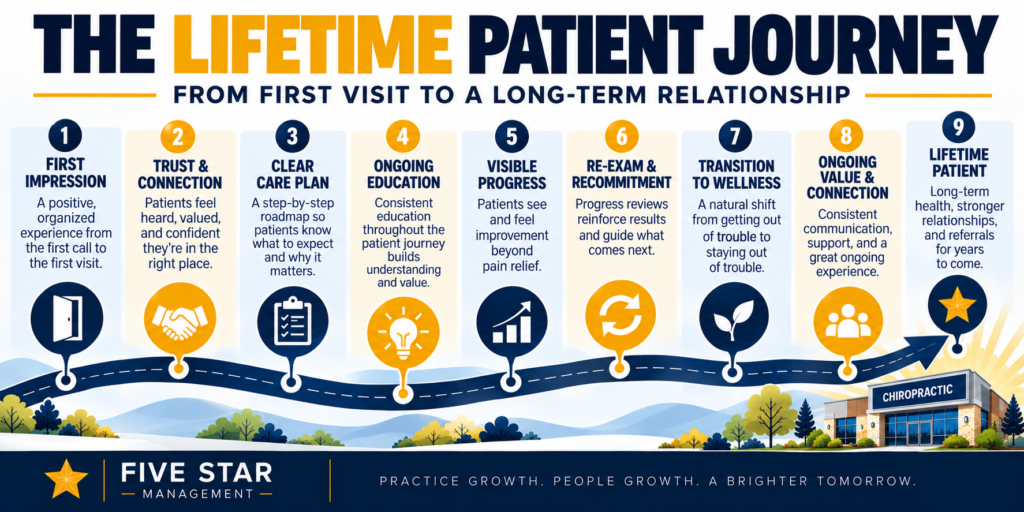
Notice what’s missing?
A magical retention script.
Because there isn’t one.
Lifetime patients are built through an experience, not a sentence.
Retention Is Not About Keeping Everyone Forever
This distinction matters.
A successful retention strategy doesn’t mean every person who walks into your clinic becomes a lifetime patient.
Some patients will move.
Some will have financial changes.
Some will choose a different approach.
Some won’t want ongoing care.
Some won’t be a good fit for your practice.
And care recommendations should always be based on what’s clinically appropriate for the individual patient.
The goal is not 100% lifetime retention.
The goal is to eliminate avoidable attrition caused by confusion, poor communication, inconsistent experiences, weak follow-up, or a failure to communicate value.
Patients should be able to make informed decisions about their care.
Your responsibility is to give them the clarity to do that.
How Five Star Helps Chiropractors Build Stronger Patient Retention
Strong retention isn’t created by one perfect conversation.
It’s built through systems.
At Five Star Management, we help chiropractors develop the systems, communication, team training, and accountability needed to create a more consistent patient experience.
That includes helping practices strengthen areas such as:
Patient education.
Care-plan communication.
Front desk systems.
Re-exams.
Scheduling.
Team training.
Patient follow-up.
Wellness transitions.
Statistics and accountability.
Because getting more new patients is only half the equation.
You also need a practice capable of keeping, serving, and building relationships with the patients you already have.
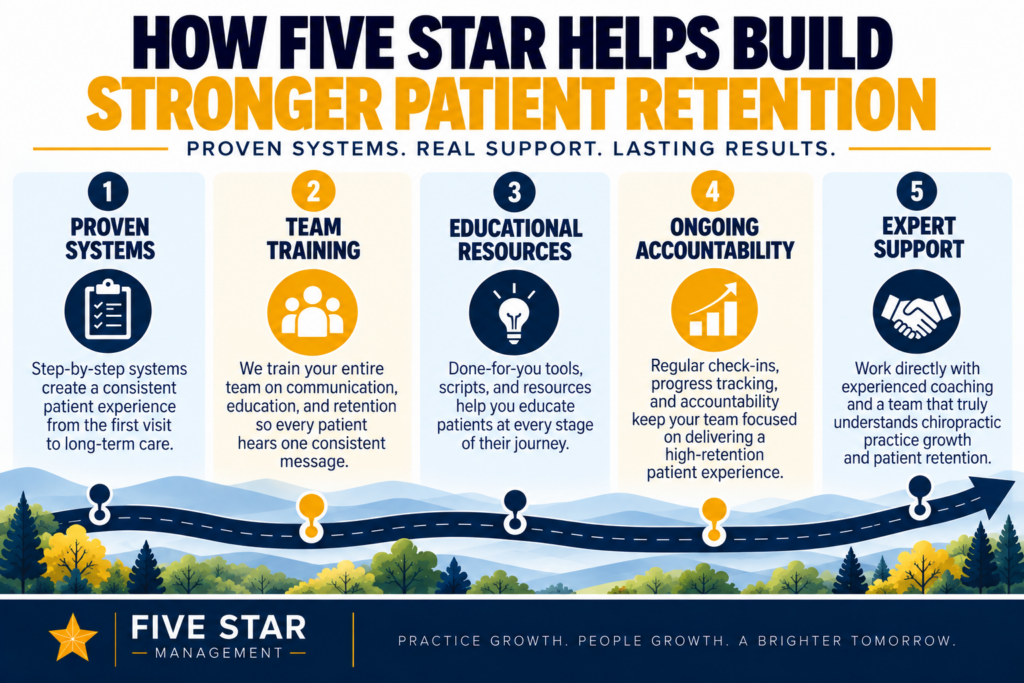
If patients are disappearing too early, your visit average is lower than you’d like, or you’re constantly depending on new patients to replace the ones leaving, it may be time to look at the systems behind your retention.
Final Thoughts
The strongest chiropractic practices don’t simply attract patients.
They build relationships.
Patients know what to expect.
They understand their care.
They see their progress.
They trust the team.
They know what comes next.
And when the initial pain disappears, the value of the relationship doesn’t disappear with it.
That’s the real secret to building lifetime patients.
Don’t spend your entire career trying to convince people to stay.
Build a practice experience that continually gives them reasons to value the relationship.
Because eventually, the goal is for a patient to stop saying:
“I went to a chiropractor.”
And start saying:
“This is my chiropractor.”