
Most chiropractors know they need more new patients.
They know they need to get out into their communities, build relationships, and introduce more people to chiropractic care.
But here’s where things get interesting.
Knowing you need more community outreach and actually having a system that produces results are two very different things.
I’ve seen practices hire someone to handle marketing, send them into the community, and hope they come back with appointments.
Sometimes it works.
Sometimes it doesn’t.
And when it doesn’t, the practice owner usually comes to one of two conclusions:
Either community outreach doesn’t work, or they hired the wrong person.
But what if neither conclusion is correct?
What if the real problem is that the person was never given a clear system to follow?
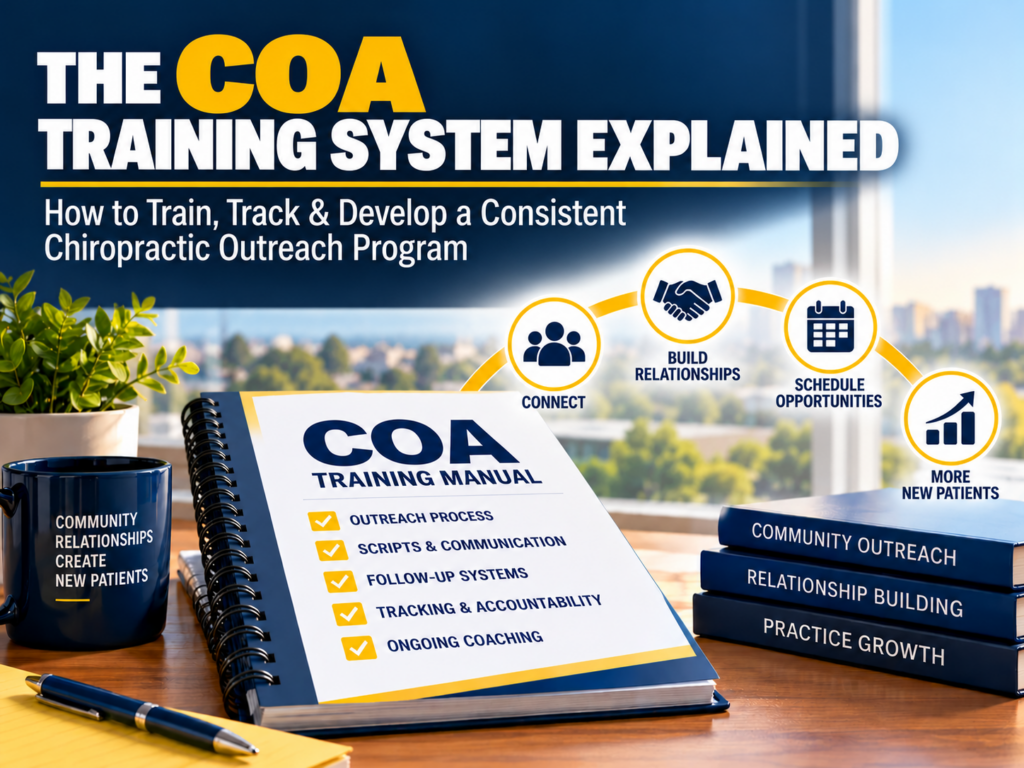
That’s where the Community Outreach Assistant (COA) training system comes in.
The purpose of a COA isn’t simply to hand out business cards, attend events, or introduce your practice to local businesses.
It’s to help create a consistent, measurable process for turning community relationships into new patient opportunities.
And just like any other important position in your practice, that process needs training, structure, accountability, and leadership.
Let’s break it down.
What Is a Community Outreach Assistant (COA)?
A Community Outreach Assistant, or COA, is a team member responsible for developing relationships and creating new patient opportunities outside the four walls of your chiropractic practice.
Think of your COA as a bridge between your practice and your community.
Your doctors and clinical team provide excellent patient care.
Your front desk helps patients navigate their experience.
Your COA focuses on making sure more people in your community know who you are, what you do, and how you can help them.
Depending on your practice and the outreach opportunities available, this may include:
- Building relationships with local businesses
- Connecting with community organizations
- Coordinating workplace wellness opportunities
- Participating in local events
- Developing strategic referral relationships
- Scheduling outreach appointments
- Following up with community contacts
- Tracking outreach activity and new patient opportunities
But here’s the important distinction.
A COA is not simply someone who goes out and talks to people.
A properly trained COA understands how to start conversations, identify opportunities, develop relationships, follow up, and help move interested people toward scheduling an appointment.
That requires more than enthusiasm.
It requires a repeatable system.
If you’re unfamiliar with the position, start with our article, What Is a COA? (And Why You Need One ASAP)
Understanding the role is the first step. Training someone to perform that role consistently is where the real opportunity begins.
Why Most Chiropractic Community Outreach Programs Struggle
Let’s say you hire a friendly, outgoing person to represent your practice.
They’re enthusiastic.
They have a great personality.
They enjoy meeting people.
You send them into the community and tell them to introduce the practice to local businesses.
A few weeks later, you ask how things are going.
They tell you they’ve met a lot of people.
They’ve had some great conversations.
They’ve handed out information.
Everyone seems interested.
Sounds encouraging, right?
But then you ask the question that actually matters:
How many new patient appointments have we scheduled?
Suddenly, the conversation gets a little less specific.
This is one of the biggest problems with unstructured community outreach.
Activity gets mistaken for productivity.
Being busy is not the same as producing results.
And unless you define what successful outreach looks like, your COA may spend an entire week doing things that feel productive without moving the practice forward.
The solution isn’t to tell them to work harder.
The solution is to give them a better system.
The COA Training System: Six Essential Components
When I think about training a Community Outreach Assistant, I don’t think about teaching someone a handful of scripts and sending them out the door.
I think about building a complete operating system for the position.
That means your COA needs to understand what they’re trying to accomplish, how they’re supposed to accomplish it, and how their performance will be evaluated.
Here are six essential components of an effective COA training system.
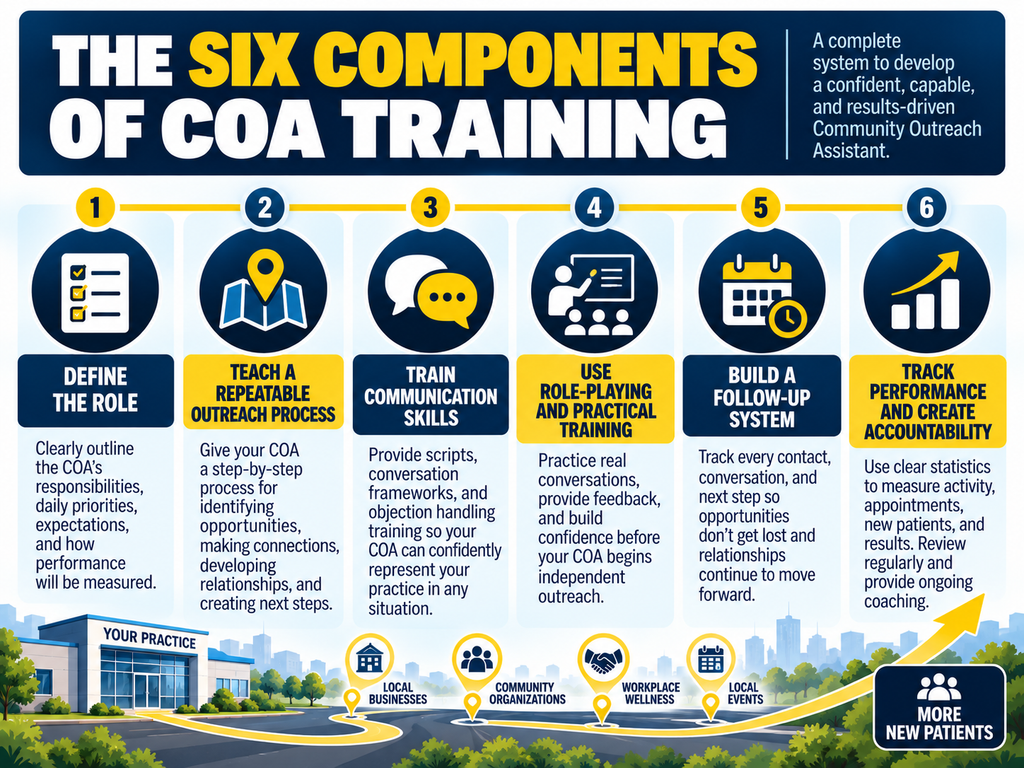
1. Define the COA’s Role and Responsibilities
Before you train someone, you need to define the job.
That sounds obvious.
But you’d be surprised how many practices hire people without clearly defining what success looks like.
Is your COA responsible for scheduling workplace presentations?
Building relationships with local businesses?
Generating opportunities through community events?
Following up with existing contacts?
Coordinating appointments with the front desk?
The answer may be all of the above.
But those responsibilities need to be clearly documented.
A COA should know:
- What activities they’re responsible for
- What their daily priorities are
- What outcomes they’re expected to produce
- Who they report to
- How they communicate with the practice
- How their performance will be measured
Without that clarity, you create confusion.
And confusion eventually creates inconsistency.
Coaching principle: You cannot hold someone accountable for a job that has never been clearly defined.
2. Teach a Repeatable Outreach Process
Now let’s talk about the actual outreach.
One of the biggest mistakes practice owners make is assuming that a naturally outgoing person will automatically be effective at community marketing.
They won’t.
At least not consistently.
Being comfortable talking to strangers is helpful, but it doesn’t replace a process.
Your COA needs a clear approach for identifying potential relationships, initiating conversations, explaining the value of chiropractic care, and creating an appropriate next step.
For example, a structured outreach process might look like this:
Identify → Contact → Connect → Present → Follow Up → Schedule

Let’s walk through it.
Identify: Build a targeted list of local businesses, organizations, employers, and community groups that may be good outreach opportunities.
Contact: Make the initial connection through a phone call, visit, email, or introduction.
Connect: Learn about the organization and determine whether there’s an opportunity to provide value.
Present: Explain an appropriate wellness opportunity, educational presentation, or other community initiative.
Follow Up: Maintain the relationship and move the conversation forward.
Schedule: Coordinate the next step, whether that’s a presentation, event, consultation, or new patient appointment.
Notice that each stage has a purpose.
Your COA isn’t wandering around hoping to meet someone interested in chiropractic.
They’re following a process designed to create opportunities.
And when a process is repeatable, it becomes trainable.
3. Train Communication Skills and Outreach Scripts
Here’s something I want every chiropractic practice owner to understand.
A script is not designed to make someone sound robotic.
A script is designed to give someone confidence.
When your COA knows what to say, they can focus more attention on the person they’re speaking with.
Instead of worrying about how to introduce themselves, they can listen.
Instead of struggling to explain the opportunity, they can ask better questions.
Instead of ending a conversation awkwardly, they can confidently suggest the next step.
Your COA should receive training in several communication situations.
Initial introductions
How do they explain who they are and why they’re reaching out?
Business outreach
How do they approach a local employer or business owner without sounding like they’re making a sales pitch?
Community relationship building
How do they identify opportunities that benefit both the organization and the practice?
Handling objections
What happens when someone says they’re too busy, aren’t interested, or already work with another healthcare provider?
Scheduling next steps
How do they move a positive conversation toward an actual appointment or event?
Follow-up conversations
How do they reconnect without becoming pushy or repetitive?
The goal isn’t memorization.
It’s competence.
Your COA should understand the purpose behind each conversation and become comfortable adapting the communication to the situation.
That competence comes from practice.
Which brings us to the next component.
4. Use Role-Playing and Practical Training
If I could change one thing about how more practices train their teams, it would be this:
Stop assuming that explaining something once means someone knows how to do it.
It doesn’t.
Training requires demonstration, repetition, feedback, and correction.
Think about how chiropractors develop their adjusting skills.
They don’t become competent by reading about an adjustment one time.
They practice.
They receive feedback.
They improve their technique.
Community outreach works the same way.
Before your COA begins representing your practice independently, they should practice the conversations they’ll encounter.
Have them role-play an introduction to a local business.
Practice responding to someone who isn’t interested.
Practice asking for an appointment.
Practice explaining the purpose of a workplace wellness presentation.
Then provide specific feedback.
Not simply, “That was good.”
Instead, tell them what worked, what could be clearer, and what to improve next time.
As their confidence develops, transition from practice scenarios to supervised outreach and eventually independent execution.
A simple training progression is:
Learn → Demonstrate → Practice → Receive Feedback → Execute → Improve
That’s how you build competence.
And competent people are far more likely to produce consistent results.
5. Build a Follow-Up System
Let’s imagine your COA visits a local business.
The owner seems interested in having your practice provide a wellness presentation.
They exchange contact information.
The business owner says, “That sounds great. Give me a call next week.”
What happens next?
If your answer is, “Hopefully our COA remembers to call,” you’ve identified a problem.
Community outreach depends on follow-up.
Not every opportunity turns into an appointment during the first conversation.
People are busy.
They need to check calendars.
They need approval.
They forget.
They get distracted.
That’s normal.
What isn’t acceptable is allowing potentially valuable relationships to disappear because nobody followed up.
Your COA needs a system for documenting:
- Who they contacted
- When the conversation occurred
- What was discussed
- Whether there was interest
- What the next step should be
- When the next follow-up is due
- What happened after the follow-up
This could be managed through your CRM or another consistent tracking system.
The specific tool matters less than the discipline of using it.
And follow-up should always be respectful, appropriate, and consistent with the contact’s preferences.
The goal is to build relationships, not chase people.
When your COA has a reliable follow-up process, outreach becomes cumulative.
Every week adds new relationships and opportunities to the ones already being developed.
That’s how a community outreach program begins building momentum.
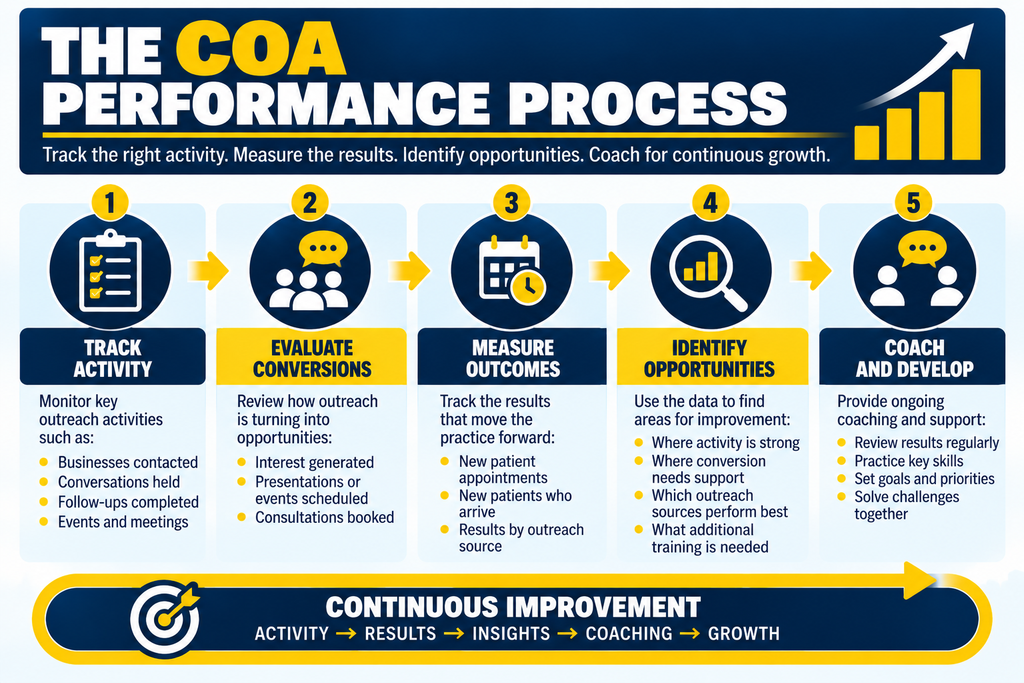
6. Track Performance and Create Accountability
Now we get to one of my favorite subjects.
Statistics.
Because if you’re not measuring the results, how do you know whether your training is working?
You don’t.
And if you can’t identify where performance is breaking down, how do you know what to improve?
You don’t.
Your COA should have a clear scoreboard.
At a minimum, I would want visibility into several important categories.
Outreach activity
How many businesses, organizations, or community contacts were approached?
Meaningful conversations
How many actual conversations took place?
Opportunities created
How many businesses or organizations expressed interest in a presentation, event, or relationship?
Appointments scheduled
How many appointments or outreach activities were successfully booked?
New patient appointments
How many prospective patients scheduled through the outreach program?
New patients who arrived
How many of those scheduled appointments actually showed up?
Results by outreach source
Which relationships, events, and activities are producing the strongest outcomes?
You don’t need a complicated reporting system.
You need one that gives you useful information.
For example, suppose your COA is making plenty of contacts but scheduling very few presentations.
That may indicate a communication or conversion issue.
Suppose they’re scheduling presentations but very few attendees become interested in appointments.
That may indicate the presentation or next-step process needs improvement.
Suppose appointments are being scheduled but people aren’t showing up.
That may indicate a confirmation or follow-up problem.
See the difference?
Without statistics, you might assume your COA isn’t working hard enough.
With statistics, you can identify where additional training is needed.
Statistics turn frustration into a coaching opportunity.
What Does a COA’s Daily and Weekly Schedule Look Like?
One of the most important parts of training a COA is establishing a consistent working rhythm.
You don’t want someone waking up every morning wondering what they’re supposed to do.
You want them starting the day with a clear plan.
A practical COA schedule might include dedicated time for prospecting, outreach conversations, relationship development, follow-up, event preparation, and reporting.
For example:
| Activity | Primary purpose |
| Daily planning | Identify priorities and scheduled follow-ups |
| Prospecting | Find new community relationship opportunities |
| Outreach | Contact businesses and organizations |
| Relationship development | Build trust and arrange next steps |
| Follow-up | Advance existing conversations |
| Event coordination | Prepare for scheduled outreach activities |
| Reporting | Update the scoreboard and identify opportunities |
The exact schedule will depend on whether your COA works full-time, part-time, or shares responsibilities with another position.
But the principle remains the same.
Important activities should have a place on the calendar.
Otherwise, urgent tasks tend to push them aside.
And when outreach becomes something that happens only when there’s extra time, consistency disappears.
The Importance of Weekly COA Coaching Meetings
Now here’s where practice leadership becomes especially important.
You cannot train your COA once, hand them a manual, and assume the program will run itself forever.
People need coaching.
They need feedback.
They need encouragement.
And they need someone helping them solve problems.
I recommend establishing a consistent weekly review with the person responsible for managing the COA.
During that meeting, review the previous week’s performance and discuss the coming week’s priorities.
Ask questions like:
What worked well this week?
Identify the activities and conversations producing results.
Where did you struggle?
Look for obstacles, objections, or missed opportunities.
What do the statistics tell us?
Compare activity levels with actual outcomes.
What needs to improve?
Choose one or two specific skills or processes to strengthen.
What’s the plan for next week?
Set clear priorities and expectations.
This meeting shouldn’t become an interrogation.
It should be a coaching conversation.
The objective is to help your COA become more capable and productive over time.
That’s what leadership is supposed to do.
And if you’re working on strengthening accountability throughout your practice, our article The Secret to Building a High-Performance Chiropractic Team explores why clear expectations, training, and consistent feedback are so important.
How Long Does It Take to Train a Community Outreach Assistant?
This is a question I hear frequently.
And the answer depends on several factors.
Does the person already have experience in sales, outreach, or community relations?
Are they familiar with chiropractic?
Do they understand your practice’s philosophy and services?
How much time can your team dedicate to training?
How clearly documented are your systems?
There isn’t one universal timeline.
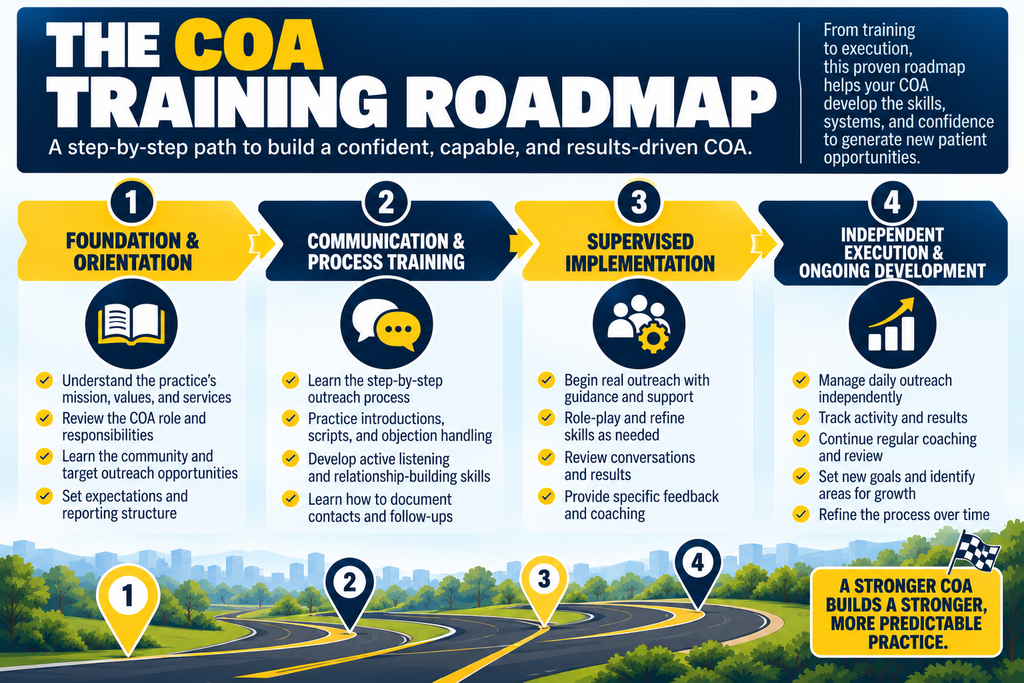
But I would approach training in stages rather than expecting immediate independence.
Phase 1: Foundation and Orientation
Start with the practice itself.
Your COA needs to understand your mission, the patients you serve, your community, and the role outreach plays in the overall growth strategy.
Introduce the job description, expectations, communication standards, and reporting system.
Phase 2: Communication and Process Training
Teach the outreach process.
Practice introductions.
Review scripts.
Role-play common conversations.
Demonstrate how to document contacts and follow-up activities.
Phase 3: Supervised Implementation
Begin actual outreach with appropriate oversight.
Review conversations and results.
Provide coaching and correction.
Focus on building confidence and consistency.
Phase 4: Independent Execution and Ongoing Development
As competence improves, allow the COA to manage more of the daily outreach independently.
Continue reviewing statistics, practicing skills, and refining the system.
The important thing is not how quickly someone finishes training.
It’s whether they can perform the job competently and consistently.
Training is not complete because you’ve covered the material. Training is effective when the person can demonstrate the skill.
How Many New Patients Should a COA Generate?
Every practice owner wants to know what kind of return to expect.
That’s understandable.
But I want to be careful about how we approach this question.
Community outreach results depend on your market, the COA’s training and experience, the number of hours dedicated to outreach, the opportunities available, and how well the rest of your practice handles scheduling and patient conversion.
In Five Star’s COA model, a working benchmark is approximately 3–7 new patients per week per doctor from a well-functioning outreach program.
That is a performance target to work toward, not a guarantee or an expectation for every new hire.
The more important question is whether your outreach program is becoming increasingly consistent and measurable.
If you’re generating activity but not appointments, improve conversion.
If you’re scheduling appointments but people aren’t arriving, improve follow-up and confirmation.
If you’re getting results from one outreach source but not another, adjust where you spend your time.
The objective is continuous improvement.
And remember, community outreach is just one component of a broader new patient growth strategy.
Our article The Marketing Six-Pack That Builds a Full Chiropractic Practice explains why practices benefit from developing multiple internal and external sources of new patients rather than depending on a single marketing activity.
Why Your COA Can’t Succeed Without the Rest of Your Team
Here’s a mistake I want you to avoid.
Don’t treat your COA as an entirely separate department responsible for solving every new patient problem.
Your COA may create an opportunity.
But what happens after that opportunity enters your practice?
Who answers the phone?
Who schedules the appointment?
Who sends the confirmation?
Who welcomes the patient?
Who communicates the value of care?
Who follows up when someone doesn’t show?
Your COA can do an excellent job generating interest, but if the rest of the practice doesn’t support that process, opportunities can still be lost.
That’s why I want the COA working within your overall practice systems.
The outreach process and the patient experience should connect.
Think about it this way:
Community Outreach → Interest → Scheduling → First Visit → Patient Experience → Ongoing Care
Every stage matters.
And every stage needs someone who understands their responsibility.
This is also why our Ultimate Chiropractic Systems Checklist is a valuable companion resource. Strong marketing results are easier to sustain when scheduling, communication, training, and accountability systems work together.
Common COA Training Mistakes to Avoid
Before we wrap up, I want to highlight several mistakes that can undermine an otherwise promising community outreach program.
Hiring for Personality Without Training for Performance
An outgoing personality is helpful.
But personality alone doesn’t create a repeatable outreach system.
Hire carefully, then train the skills the position requires.
Sending Someone Into the Community Without a Plan
Your COA should know where they’re going, why they’re going, and what outcome they’re trying to create.
Random activity rarely produces predictable results.
Measuring Conversations Instead of Outcomes
Conversations matter.
Relationships matter.
But you also need to know whether those activities are producing appointments and new patients.
Track both activity and results.
Failing to Practice Communication Skills
Scripts don’t become useful just because someone reads them.
Practice, repetition, and feedback build confidence.
Ignoring Follow-Up
Many opportunities require multiple appropriate interactions before a next step is scheduled.
Without a follow-up system, relationships lose momentum.
Expecting Results Without Leadership
A COA needs management, coaching, clear expectations, and accountability.
Don’t confuse delegation with abandonment.
If you want someone to perform well, help them become excellent at the job.
How Five Star Helps Chiropractors Develop Their COA Systems
At Five Star Management, we believe practice growth should be built on systems rather than guesswork.
That includes community outreach.
Our COA approach gives chiropractic practice owners a framework for developing a more organized and measurable outreach program.
Through our coaching, training, and resources, we help practices understand how to:
- Define the COA position and its responsibilities
- Establish clear outreach processes
- Train communication and relationship-building skills
- Develop scripts and follow-up systems
- Create measurable activity and performance standards
- Build accountability through regular coaching and review
- Connect community outreach with the practice’s broader new patient systems
Our role is to provide the education, tools, guidance, and accountability that help you and your team implement these systems effectively.
Because the goal isn’t to make your practice dependent on another outside marketing company.
It’s to help you build the internal capability to create new patient opportunities consistently.
And when your team knows what to do, how to do it, and how to measure the results, you begin developing something much more valuable than a temporary marketing campaign.
You begin developing a system.
Ready to Build a More Predictable New Patient Outreach Program?
If your practice needs more consistent new patient opportunities, or you’ve tried community outreach without getting the results you wanted, let’s look at the system behind it.
A complimentary strategy session with a Five Star coach can help you identify gaps in your current outreach approach and determine which areas deserve attention first.
Book Your Complimentary Strategy Session.
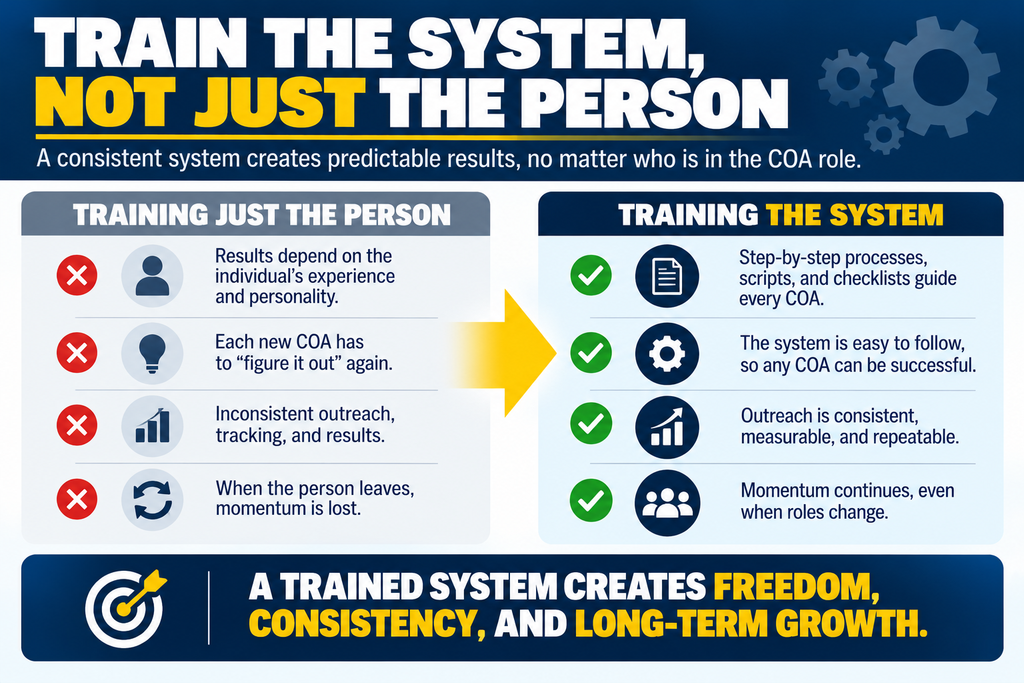
Final Thoughts: Train the System, Not Just the Person
If there’s one thing I want you to take away from this article, it’s this:
A successful COA program isn’t built by finding one extraordinary person. It’s built by creating a system that helps the right person become extraordinary at the job.
Define the role.
Teach the process.
Practice the conversations.
Build the follow-up system.
Measure the results.
Coach the performance.
Then repeat.
Because when your outreach process becomes trainable, measurable, and repeatable, you stop depending on random bursts of activity.
You start developing a more reliable source of new patient opportunities.
And that’s how you build a stronger practice.