

Every chiropractic practice needs new patients.
You can have an incredible team, deliver excellent care, and build efficient systems, but if there aren’t enough new people consistently walking through the door, eventually the practice feels it.
The schedule gets lighter.
Collections flatten.
The team starts worrying.
And the owner begins asking the question:
“Why aren’t we getting more new patients?”
Usually, that’s when the search for a new marketing idea begins.
Maybe you need to run Facebook ads.
Maybe you need better SEO.
Maybe you should post more on Instagram.
Maybe you need a referral campaign.
Maybe you should sponsor an event.
Maybe Google Ads will fix it.
Any of those strategies could help. But jumping from one marketing tactic to another without understanding why your new patient numbers are low can create an expensive cycle.
Because most practices don’t have an idea problem.
They have a new patient system problem.
If your practice isn’t getting the number of new patients you want, the answer isn’t necessarily to add more marketing.
First, you need to figure out where the system is breaking down.
Start With the Number: How Many New Patients Do You Actually Need?
Before asking how to get more new patients, answer a more important question:
How many new patients does your practice actually need?
Not “more.”
Not “as many as possible.”
An actual number.
If you don’t have a defined target, it’s almost impossible to know whether your marketing is working.
Start with your practice goals and work backward.
Consider:
- Your current patient volume
- Your desired patient volume
- Your capacity
- Your average case value
- Your retention
- Your collections goals
- Your available doctor hours
- Your associate capacity
A practice that needs 15 new patients per month requires a very different marketing strategy than one that needs 60.
Once you establish the number, you can stop guessing and start building a system designed to produce it.
Clarity comes before strategy.
One of the biggest mistakes we see is relying too heavily on one source of new patients.
1. Stop Looking for One Magic Marketing Strategy
A clinic starts running Facebook ads and gets great results.
So Facebook becomes the marketing plan.
Until the results change.
Another clinic gets most of its patients from referrals.
That’s great until referrals slow down.
Another relies almost entirely on Google.
Then rankings change, competition increases, or lead volume drops.
No single marketing channel should carry the entire weight of your practice.
That’s why our training focuses on building multiple dependable sources of new patients instead of constantly searching for the next marketing trick.
Think of it like an investment portfolio.
You wouldn’t want your entire financial future dependent on one investment. Your new patient pipeline shouldn’t depend on one marketing channel either.
The stronger approach is to create several systems that work together.
2. Build Your Chiropractic Marketing Six-Pack
One of the core marketing concepts we teach is the Marketing Six-Pack: three internal and three external sources of new patients working together.
The exact tactics may evolve as technology and patient behavior change, but the principle remains the same:
Build multiple engines for growth.
Your internal marketing might include strategies such as:
- Patient referrals
- Patient education
- Reactivation campaigns
Your external marketing might include:
- Community outreach
- Digital marketing
- Strategic partnerships and events

When one source has a slower month, another can continue producing.
That creates something every practice owner wants:
predictability.
Instead of waking up wondering where next month’s patients will come from, you have multiple systems continually working to introduce new people to the practice.
Want to Go Deeper? Build Your Marketing Six-Pack
If your practice relies too heavily on one source of new patients, this episode of The Successful Chiro Podcast breaks down the Six-Pack approach and how chiropractors can create a more balanced marketing system.
Listen to: The Six Pack Marketing Solution for Chiropractors: 3 Internal + 3 External Growth Systems
3. Look Inside Your Practice Before Spending More Money
Before increasing your advertising budget, look at the opportunity already sitting inside your clinic.
Your existing patients know people.
They have spouses.
Children.
Parents.
Coworkers.
Friends.
Neighbors.
Teammates.
The question is whether you’ve created a patient experience that naturally makes them want to talk about your practice.
Referral marketing isn’t simply asking:
“Do you know anyone who needs a chiropractor?”
It starts much earlier.
Was the first visit memorable?
Did the patient feel heard?
Did the team know their name?
Was the process organized?
Did the doctor clearly explain what was happening?
Did the patient experience progress worth talking about?
Was there a moment where they thought:
“Someone I know needs this.”
A remarkable patient experience can become one of your most powerful marketing systems.
That’s why new patient generation and patient retention shouldn’t be treated as completely separate problems.
The experience that keeps patients can also create the patients who come next.
4. Give Your Patients Something Worth Referring
Sometimes practices want more referrals but make referrals surprisingly difficult.
Patients may love the doctor but have no idea:
- Who else the practice helps
- What conditions or problems they should listen for
- Whether you’re accepting new patients
- How someone should contact you
- What they should say to a friend
- Whether their family members would be a good fit
Don’t assume patients understand your practice as well as you do.
Educate them.
If someone tells your patient at work:
“My neck has been killing me for three weeks.”
You want your patient immediately thinking:
“You should call my chiropractor.”
That association is built through consistent education.
You aren’t pressuring patients to become salespeople.
You’re helping satisfied patients understand who you can help and how they can connect those people with your office.
5. Get Out Into Your Community
There is an entire world of prospective patients outside your clinic walls.
Yet many chiropractors spend almost all of their marketing energy trying to reach those people through a screen.
Digital marketing matters.
So does human connection.
Community outreach can put your practice directly in front of local businesses, organizations, schools, gyms, events, and groups filled with people who may otherwise never encounter your brand.
This is where a Community Outreach Assistant (COA) can become valuable.
A COA’s role is focused on building relationships and creating opportunities for the practice within the community.
That might include:
- Connecting with local businesses
- Scheduling community events
- Building referral relationships
- Coordinating screenings or educational opportunities
- Following up with community contacts
- Keeping outreach activity consistent
The key word is consistent.
Doing one community event and deciding “outreach doesn’t work” isn’t a system.
A real outreach strategy requires activity, tracking, follow-up, and repetition.
Your community can’t choose a practice it doesn’t know exists.
6. Make Sure Patients Can Actually Find You Online
Imagine someone drives past your clinic.
Later that evening, their back starts bothering them, so they search for a chiropractor.
They don’t remember your exact name.
They search:
“chiropractor near me.”
Do you show up?
Or imagine one of your patients tells a friend about you.
The friend searches your name.
What do they find?
Your online presence has become part of the patient journey whether you intentionally built it or not.
At minimum, practices should pay attention to areas such as:
- Google Business Profile
- Local search visibility
- Patient reviews
- Website quality
- Location information
- Helpful content
- Mobile usability
- Clear calls to action
- Consistent business information across the web
This isn’t just about “ranking on Google.”
It’s about being easy to find, easy to trust, and easy to contact.
We’ve put together a full guide to this in Chiropractic SEO Strategies for Clinics: How to Get Found by More New Patients.
7. Don’t Ignore AI Search
Patient search behavior is changing.
People aren’t only typing short phrases into Google anymore.
They’re increasingly asking longer, conversational questions through AI-powered search experiences.
Questions like:
“Who is a good chiropractor near me for headaches?”
“What chiropractor near me has strong reviews?”
“Where can I find a family chiropractor in my area?”
That means online visibility is expanding beyond traditional search rankings.
Fortunately, many of the fundamentals that help with traditional search also help search engines and AI systems better understand a practice:
Clear information.
Helpful content.
Consistent business details.
Strong reviews.
Demonstrated expertise.
Local relevance.
We’ve created an AI Visibility System to help chiropractors understand how their practice is showing up online and identify areas where their visibility can be strengthened.
Remember, the goal isn’t to chase every new technology.
It’s to make sure your practice remains visible wherever prospective patients are looking for answers.
8. Create Content That Answers the Questions Patients Are Already Asking
You don’t need to become a full-time content creator.
But your website should answer the questions prospective patients are searching for.
Think about what people ask before they ever schedule:
Can chiropractic help with my problem?
What happens during the first visit?
How much does chiropractic care cost?
Is chiropractic safe?
How long will I need care?
Do I need a referral?
What should I expect after my first adjustment?
Every useful article, video, FAQ, podcast, or resource gives search engines and prospective patients another way to understand your practice.
Over time, you’re building a library of trust.
Instead of your website simply saying:
“We’re a chiropractic clinic. Schedule today.”
it begins answering the questions standing between a prospective patient and an appointment.
That’s much more powerful.
9. Visibility Doesn’t Matter If Nobody Takes the Next Step
Getting found is only the beginning.
Imagine 1,000 people visit your website this month.
That sounds great.
But if nobody schedules?
You don’t have a traffic victory.
You have a conversion problem.
Look at your website from a prospective patient’s perspective.
Can they immediately understand:
- Who you help?
- What makes your practice different?
- Where you’re located?
- What they should do next?
- How to schedule?
- What the first visit looks like?
Your call to action shouldn’t be hidden at the bottom of a maze.
Make the next step obvious.
Call. Schedule. Request an appointment.
Whatever action you want someone to take should be easy to understand and easy to complete.
10. Answer the Phone Like the Marketing Matters
Here’s an uncomfortable reality:
You can spend thousands of dollars generating leads and lose them in a 90-second phone call.
Marketing doesn’t stop when the phone rings.
Your front desk is part of your marketing system.
If a prospective patient calls and hears:
“Yeah, we’re pretty booked. Maybe sometime next week?”
that’s a very different experience from a confident team member who knows exactly how to guide a new patient.
Track what happens after inquiries arrive.
How many people call?
How many schedule?
How many online leads are contacted?
How quickly?
How many scheduled patients actually show up?
Where are prospective patients being lost?
Sometimes the fastest way to generate more new patients isn’t generating more leads.
It’s doing a better job with the leads you already have.
11. Follow Up With People Who Don’t Schedule
Not every prospective patient will schedule during the first interaction.
That doesn’t necessarily mean they’re not interested.
Life happens.
They get distracted.
They need to check their schedule.
They want to talk to their spouse.
They aren’t ready yet.
They forget.
Without a follow-up process, those opportunities disappear.
Your practice should have a clear system for what happens when someone expresses interest but doesn’t immediately schedule.
Who follows up?
When?
How many times?
By phone, text, or email?
When does follow-up stop?
Don’t leave this to:
“I think somebody called them.”
Build a process.
12. Stop Confusing Leads With New Patients
This is one of the biggest marketing measurement mistakes.
A campaign generates 50 leads.
Was it successful?
Maybe.
How many scheduled?
How many showed?
How many became patients?
How much did it cost to acquire them?
Were they the right type of patient for your practice?
Leads are not the finish line.
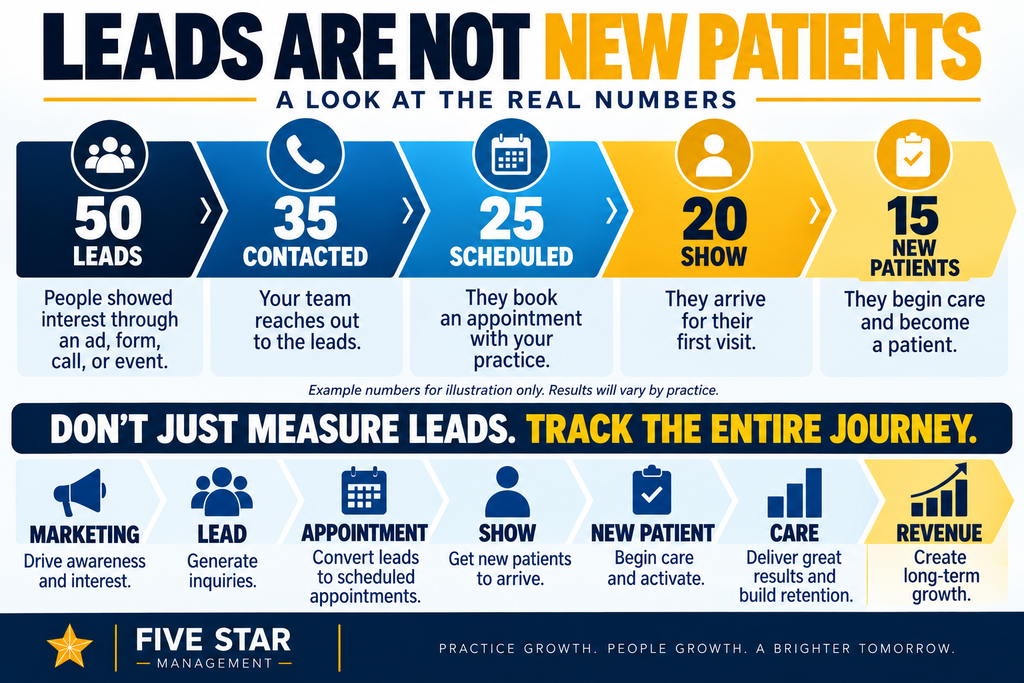
Ultimately, what matters is whether your marketing contributes to real new patients and sustainable practice growth.
That’s why you need visibility across the entire process:
Marketing Activity → Lead → Appointment → Show → New Patient → Care → Revenue
If you’re only measuring the first step, you can’t accurately diagnose what’s working.
13. Know Your Numbers
Marketing becomes much easier when you stop managing it based on feelings.
Instead of:
“Facebook doesn’t seem to be working.”
Ask:
How much did we spend?
How many leads did it generate?
How many did we contact?
How many scheduled?
How many showed?
How many became new patients?
What did each acquired patient cost?
What was the value of those patients?
Do the same thing with community outreach, referrals, events, Google, reactivations, and other channels.
You don’t need a hundred complicated metrics.
You need enough information to answer:
Where are our new patients coming from, and where are we losing them?
When you know that, marketing decisions become much clearer.
14. Find the Leak Before You Add More Water
Picture your new patient system as a pipeline.
At the beginning is awareness.
Then interest.
Then inquiry.
Then scheduling.
Then showing up.
Then becoming a patient.
If there is a leak somewhere in that pipeline, simply pouring more marketing into the top can waste money.
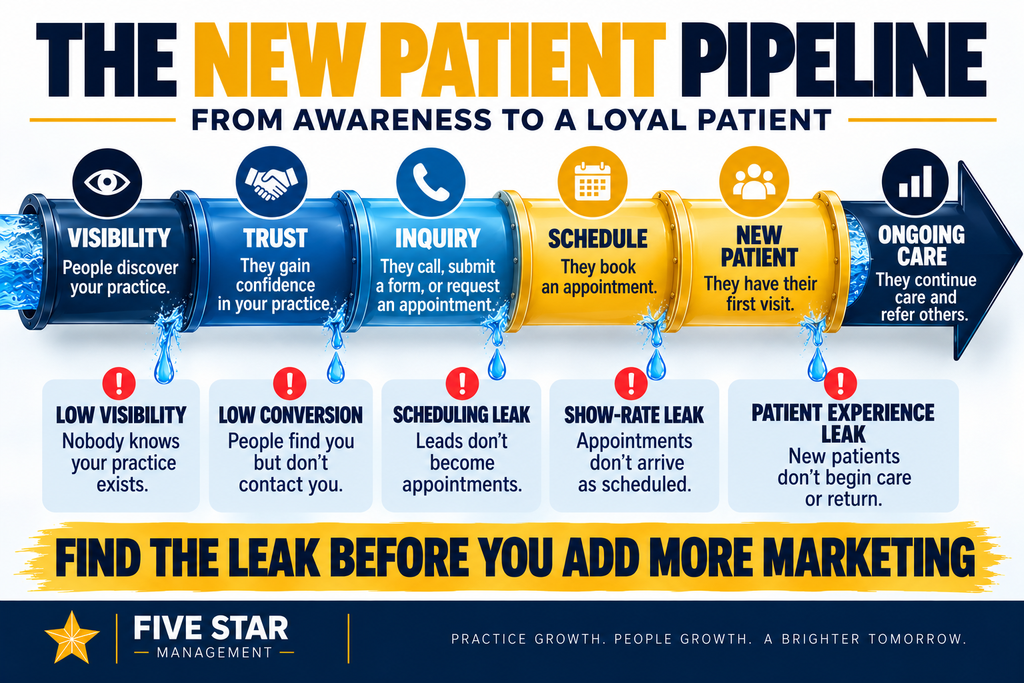
For example:
If nobody knows about you, you have a visibility problem.
If people find you but don’t contact you, you may have a trust or conversion problem.
If leads contact you but don’t schedule, you may have a conversion problem.
If they schedule but don’t show, you may have a confirmation or follow-up problem.
If they show but don’t begin care, you may have a patient experience or communication problem.
Different problems require different solutions.
Diagnose first. Market second.
15. Consistency Beats Random Bursts of Marketing
A lot of chiropractic marketing looks like this:
New patients slow down.
Everyone panics.
The practice launches a campaign.
Numbers improve.
Everyone gets busy.
Marketing stops.
A few weeks later, new patients slow down again.
Then the cycle repeats.
That’s not predictable growth.
That’s emergency marketing.
Your marketing systems should continue functioning before you desperately need them.
Referral education continues.
Community outreach continues.
Reviews continue.
Content continues.
Digital visibility continues.
Follow-up continues.
Tracking continues.
The goal isn’t to become obsessed with marketing.
The goal is to make marketing systematic enough that you don’t have to be.
The New Patient Growth System
When all of these pieces work together, new patient growth becomes much less mysterious.
It looks something like this:

Notice something?
Marketing doesn’t end when someone schedules.
New patient growth is connected to the entire patient experience.
You Don’t Need Every Marketing Strategy
There will always be another platform.
Another advertising strategy.
Another social media trend.
Another piece of software.
Another person promising to fill your schedule.
You don’t need to do everything.
You need to identify the handful of strategies that make sense for your practice and execute them consistently enough to measure the results.
A smaller number of well-run systems will usually beat a giant collection of half-finished marketing ideas.
If referrals are working, strengthen them.
If community outreach is producing patients, build the system.
If Google is bringing qualified prospects, improve your visibility.
If content is generating traffic, create more useful content.
If something isn’t working, figure out why before abandoning it.
Don’t chase marketing. Build marketing systems.
How We Help Chiropractors Build Predictable New Patient Growth
When new patient numbers aren’t where you want them, it can be tempting to assume you simply need more advertising.
But often, the bigger opportunity is understanding which part of your new patient system needs attention.
Our training helps chiropractic practice owners build a more systematic approach to growth through areas such as:
- Internal and external marketing systems
- Patient referral strategies
- Community outreach
- COA development and training
- Online visibility education
- Team systems
- Lead tracking
- Conversion
- Follow-up
- Statistics and accountability
The goal isn’t to make the practice owner responsible for becoming a marketing expert.
It’s to build repeatable systems your team can understand, implement, track, and improve.
Because predictable growth doesn’t come from finding one brilliant marketing idea.
It comes from having multiple systems consistently doing their jobs.
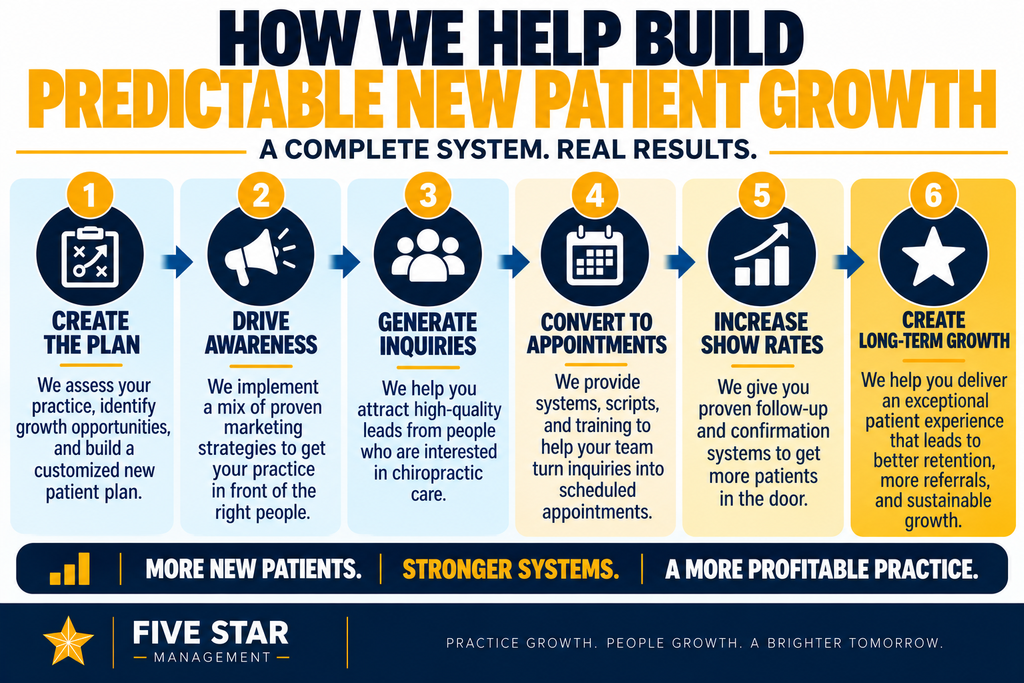
If your new patient numbers aren’t where you want them to be, schedule a complimentary strategy session with a Five Star coach. We’ll help you identify where the gaps may be and what areas of your growth system deserve attention first.
Final Thoughts
If you’re not getting enough new patients, don’t immediately assume you need another ad campaign.
Look at the entire system.
Are enough people finding you?
Do they trust what they find?
Are your existing patients referring?
Are you active in your community?
Are you visible online?
Are inquiries becoming appointments?
Are appointments showing up?
Are you tracking where your patients actually come from?
Are you consistently executing your marketing systems?
Somewhere in those questions is probably an opportunity.
And once you find it, you can stop guessing.
You don’t need random marketing.
You need a predictable new patient system.
Build that, measure it, improve it, and new patient growth becomes something you can manage rather than something you simply hope for.