

Your next new patient may already be looking for you.
They have back pain.
Their neck has been bothering them for weeks.
They were just in an auto accident.
Or maybe they’re simply tired of feeling stiff every morning.
So they pull out their phone and search:
“Chiropractor near me.”
“Chiropractor for back pain.”
“Best chiropractor in [city].”
“Chiropractor open today.”
The question isn’t whether people are searching for chiropractic care.
The question is:
When they search, do they find you?
That’s where chiropractic SEO comes in.
Search engine optimization, or SEO, is the process of making your practice easier for search engines to understand, trust, and display when potential patients search for the services you provide.
And today, that doesn’t mean stuffing “chiropractor near me” onto your website 47 times.
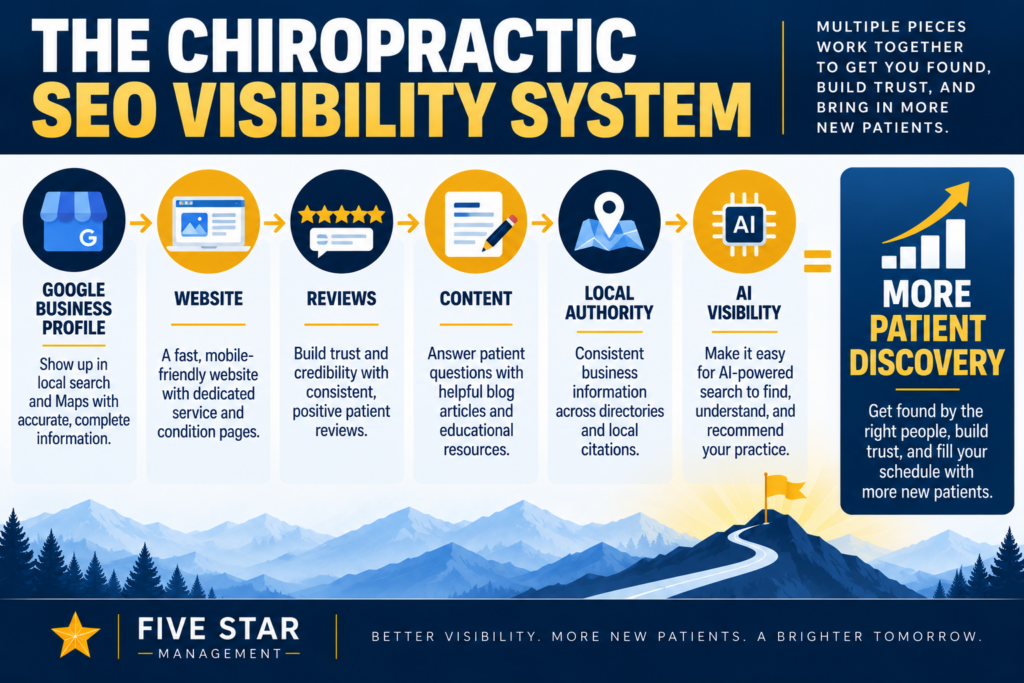
Effective chiropractic SEO is about building a strong digital presence across your website, Google Business Profile, reviews, local information, content, and increasingly, AI-powered search.
Let’s break down how to do it.
What Is Chiropractic SEO?
Chiropractic SEO is the process of improving your practice’s online visibility so that people searching for chiropractic care in your area are more likely to discover your clinic.
There are really two major battles happening.
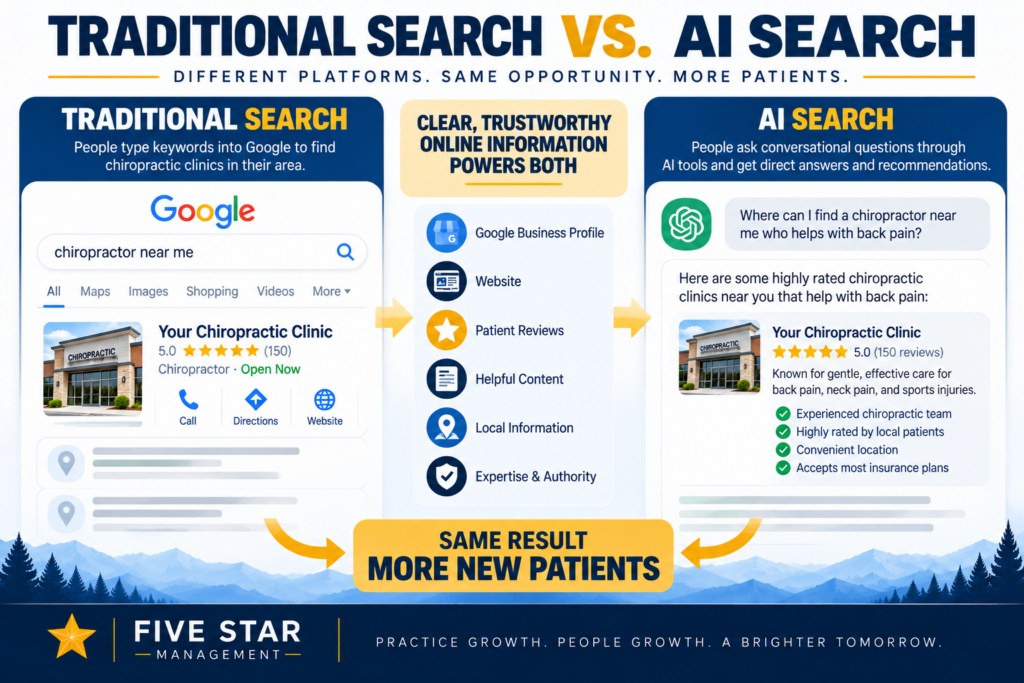
Traditional Search
Someone searches Google for something like:
“Chiropractor in Dallas”
or
“Sciatica chiropractor near me.”
Google then determines which businesses and websites are most relevant to that search.
AI-Powered Discovery
Patients are also beginning to ask more conversational questions through AI-powered search experiences and assistants.
Instead of typing:
“Chiropractor near me”
they might ask:
“Where can I find a chiropractor near me who works with athletes?”
or:
“What kind of doctor should I see for recurring lower back pain?”
The way people search is changing.
But the underlying principle remains remarkably similar:
Search engines need to understand who you are, where you are, what you do, and whether your practice appears trustworthy and relevant.
Your job is to make those answers unmistakably clear.
1. Start With Your Google Business Profile
If you’re a local chiropractic clinic, your Google Business Profile should be one of the first places you focus.
Google says verified Business Profiles can help customers find businesses through Search and Maps, while allowing businesses to maintain their hours, location, website, phone number, photos, videos, and reviews.
This is what often appears when someone searches for your clinic or searches locally for chiropractic care.
Make sure your profile includes accurate:
- Practice name
- Address
- Phone number
- Website
- Business hours
- Business category
- Services
- Photos
- Practice information
Don’t create the profile and forget about it.
Treat it like an extension of your website.
Because for some potential patients, your Google Business Profile may be their first impression of your practice.
2. Understand How Local SEO Works
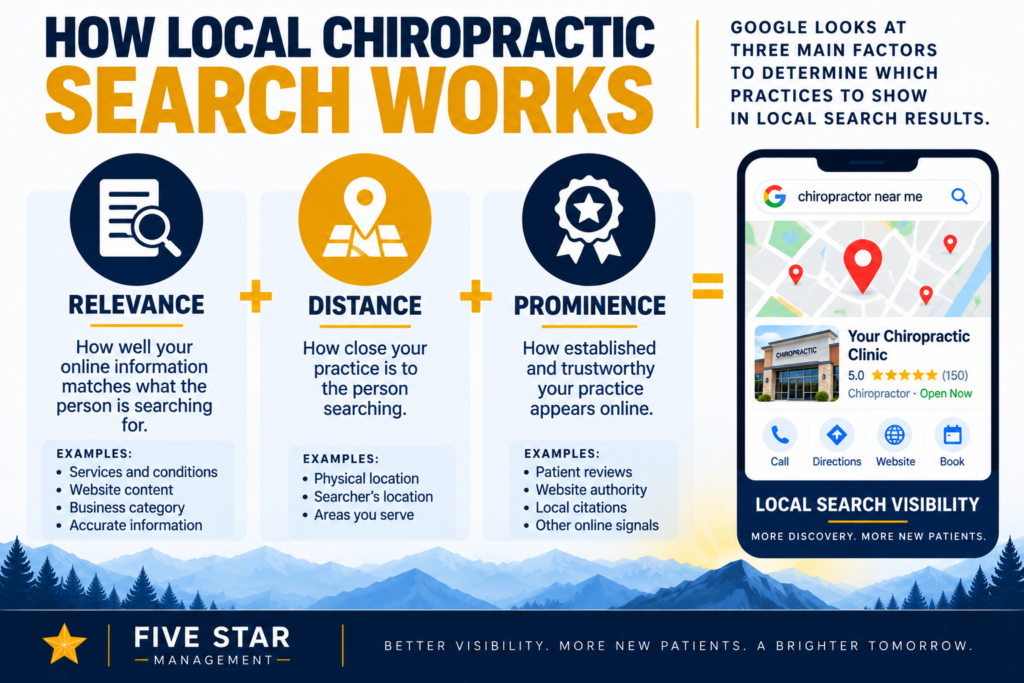
Google’s local search system considers factors including relevance, distance, and prominence when determining local results.
That distinction matters.
You can’t control everything.
You can’t move your office closer to every person searching for a chiropractor.
But you can improve how clearly Google understands your practice.
Relevance
Does your online presence clearly communicate what you do?
If you’re a chiropractor who treats athletes, families, auto accident patients, or people dealing with specific conditions, does your website actually explain that?
Distance
How close is the searcher to your practice?
This is largely outside your control.
Prominence
How established and trustworthy does your practice appear online?
Reviews, links, articles, directories, your website, and other signals can contribute to this.
That means local SEO isn’t about discovering a secret trick.
It’s about building enough clear, consistent signals that search engines understand exactly when your practice is relevant.
3. Stop Trying to Rank One Page for Everything
One of the most common website mistakes is trying to make the homepage do every job.
The homepage says:
Chiropractic.
Back pain.
Neck pain.
Headaches.
Sports injuries.
Auto accidents.
Family chiropractic.
Wellness.
Sciatica.
And twelve other things.
Then the practice wonders why it doesn’t rank strongly for any of them.
Instead, build dedicated pages around important services, conditions, and patient needs.
Depending on your practice, that could include pages for:
Back Pain Chiropractic Care
Neck Pain
Sciatica
Headaches
Sports Chiropractic
Auto Accident Chiropractic
Prenatal Chiropractic
Family Chiropractic
Pediatric Chiropractic
The exact pages should reflect the services you genuinely provide and the patients you’re trying to attract.
Each page can then answer questions specific to that searcher’s problem.
That’s far more useful than throwing every keyword onto one giant services page.
4. Think Like a Patient, Not a Chiropractor
Here’s a simple SEO mistake that happens all the time.
Doctors write websites using the terminology they use.
Patients search using the terminology they use.
Those aren’t always the same.
A patient may not search for the technical name of a technique or diagnosis.
They might search:
“Why does my lower back hurt when I sit?”
“Chiropractor for headaches.”
“Can a chiropractor help after a car accident?”
“Why does my neck hurt after sleeping?”
“Chiropractor for runners near me.”
Those searches tell you what content to create.
Think about the questions patients ask during consultations.
Think about what they ask at the front desk.
Think about the misconceptions you hear repeatedly.
Think about what they’re worried about before their first visit.
Then answer those questions online.
Great SEO content often starts with great patient communication.
5. Build a Chiropractic Content Library
A website with five pages doesn’t give search engines much information about your expertise.
A website with dozens of genuinely useful resources creates a much richer picture.
That’s why blogging can become such a powerful long-term SEO strategy.
Your content might cover topics like:
How Often Should You See a Chiropractor?
What Causes Lower Back Pain?
What to Expect at Your First Chiropractic Visit
Chiropractic Care After an Auto Accident
Can Chiropractic Help With Sciatica?
How Sitting All Day Affects Your Spine
Chiropractic Care for Athletes
What Is Corrective Chiropractic Care?
But here’s the important part:
Don’t publish just to publish.
Every article should have a purpose.
Ask:
What question are we answering?
Who is searching for this?
What would genuinely help them?
What should they do after reading it?
Then connect related articles to your important service pages.
Over time, you begin building a network of useful content around the major topics your practice wants to be known for.
6. Use Internal Links Strategically
Internal links are links from one page of your website to another.
You’re seeing them throughout this article.
If you publish an article about sciatica and mention chiropractic treatment for sciatica, link to your dedicated sciatica service page.
If you publish an article about headaches and have another resource explaining posture, connect them.
This helps readers continue exploring your website.
It also helps search engines understand the relationship between your pages.
Think of your website less like a pile of independent pages and more like a connected library.
Your major service pages are the shelves.
Your articles fill those shelves with useful information.
And internal links connect everything together.
7. Create a Consistent Review System
SEO gets someone to notice your practice.
Trust helps them choose it.
That’s where reviews become incredibly important.
Google Business Profiles allow businesses to collect and respond to customer reviews, making those reviews visible during the discovery process.
Don’t leave review generation entirely to chance.
Build a simple, ethical process for asking satisfied patients to share their experience.
That might include:
A verbal request.
A follow-up text.
An email.
A QR code at checkout.
An automated request after an appropriate point in the patient journey.
And don’t make this a one-month campaign.
Consistency matters more than a sudden burst followed by silence.
You should also respond appropriately to reviews while protecting patient privacy and complying with applicable healthcare privacy requirements.
The goal is not simply to collect stars.
It’s to build an ongoing digital reputation that reflects the experience patients actually receive.
8. Keep Your Business Information Consistent
Search engines are trying to determine whether information about your practice is reliable.
Don’t make that harder.
Your practice’s core information should be consistent wherever it appears online.
Especially your:
Name
Address
Phone number
You may hear marketers call this NAP consistency.
Check places such as:
Google.
Your website.
Facebook.
Yelp.
Healthcare directories.
Local directories.
Professional associations.
Old listings.
If one website says “Five Star Chiropractic,” another says “Five Star Chiropractic & Wellness,” and another has an old address and phone number, you’ve created unnecessary confusion.
Consistency creates clarity.
9. Make Your Website Technically Sound
You can create fantastic content and still hurt your visibility with a poor website experience.
At minimum, your website should:
Load quickly.
Work well on mobile devices.
Use HTTPS.
Have logical navigation.
Avoid broken links.
Use clear page titles.
Use descriptive headings.
Have unique meta titles and descriptions.
Use descriptive image alt text where appropriate.
Make contact information easy to find.
Make booking or requesting an appointment simple.
You don’t need to become a web developer.
But you do need a website that search engines can access and patients can actually use.
If someone finds your practice through Google and lands on a slow, confusing website that’s impossible to navigate on a phone, ranking wasn’t the real victory.
The patient taking the next step is.
10. Use Local SEO Throughout Your Website
Your location shouldn’t be a secret.
Make it clear which community you serve.
That doesn’t mean awkwardly inserting your city into every sentence.
Nobody wants to read:
“If you’re looking for a Seattle chiropractor in Seattle, our Seattle chiropractic clinic helps Seattle chiropractic patients…”
Please don’t do that.
Instead, naturally communicate your location through your:
Page titles.
Contact page.
Homepage.
Service pages.
Footer.
About page.
Local content.
Structured data.
Google documents LocalBusiness structured data as a way of giving search engines structured information about details such as a business’s address, hours, and other information.
For clinics with multiple physical locations, each legitimate location should also have clear information specific to that office rather than a collection of thin, near-duplicate city pages.
11. Build Authority Around the Doctor
Healthcare is different from selling shoes.
People want to know:
Who is giving me this information?
That’s why your doctors shouldn’t be invisible on your own website.
Create detailed provider pages that include relevant:
- Education
- Credentials
- Experience
- Professional memberships
- Areas of clinical focus
- Publications or media appearances
- Community involvement
- Author information
Then connect your educational content to the actual people responsible for it.
Your practice is the brand.
But your doctors are the experts behind that brand.
Make both visible.
12. Prepare Your Practice for AI Search
This is the part chiropractic clinics can’t afford to ignore.
Search is becoming more conversational.
Five Star’s AI Visibility System is built around this shift: making a clinic’s online presence clear enough that AI systems can read, understand, trust, and potentially surface it when relevant.
Traditional SEO isn’t suddenly dead.
Quite the opposite.
Many of the fundamentals that help traditional search also give machines clearer information to work with:
Accurate business information.
Well-organized websites.
Clear service descriptions.
Helpful content.
Strong authority signals.
Structured data.
Consistent online information.
Reviews and reputation.
Expert attribution.
But your content should also increasingly answer real questions clearly.
Instead of writing a 2,000-word article that takes 700 words to answer a basic question, give the answer.
Then explain it.
Make headings descriptive.
Use FAQs when they’re genuinely useful.
Clearly identify doctors and credentials.
Explain what your clinic does in plain language.
Don’t make humans or machines work unnecessarily hard to understand you.
If you’d like a framework for auditing this side of your online presence, Five Star’s AI Visibility System is a natural companion resource for this article.
13. Don’t Forget About Conversion
Ranking #1 feels great.
But ranking #1 and generating no appointments doesn’t accomplish much.
Once someone reaches your website, ask:
Is it obvious what we do?
Is it obvious who we help?
Can they tell where we’re located?
Can they easily find our phone number?
Is there a clear way to request an appointment?
Does the site establish trust?
Do we answer the questions preventing someone from booking?
SEO generates visibility.
Your website has to turn that visibility into action.
That’s why the best SEO strategy isn’t just:
Rank → Traffic
It’s:
Search → Discovery → Trust → Action → New Patient
Keep the entire journey in mind.
14. Measure New Patients, Not Just Rankings
SEO dashboards can give you a mountain of numbers.
Keyword positions.
Impressions.
Clicks.
Traffic.
Sessions.
Views.
Those numbers are useful.
But there’s one question that ultimately matters:
Is SEO helping us generate the right new patients?
Track:
- Organic website traffic
- Google Business Profile activity
- Calls from organic search
- Appointment requests
- Important keyword visibility
- Which pages generate inquiries
- Which services generate traffic
- New patients attributed to search
Then look at trends over time.
SEO isn’t usually a one-week project.
You’re building an asset.
The goal is to create a digital presence that becomes more useful, authoritative, and discoverable over time.
The Chiropractic SEO Flywheel
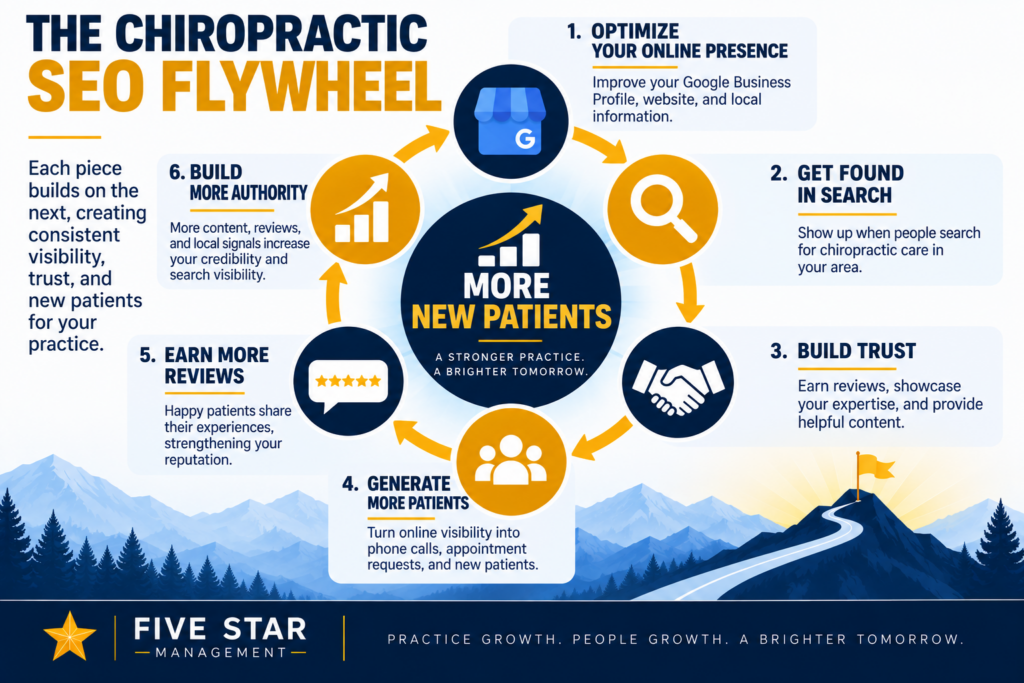
Here’s how all of this begins working together.
You improve your Google Business Profile.
That helps more local patients discover you.
You earn reviews.
Those reviews strengthen trust.
You create service and condition pages.
Those pages make your expertise clearer.
You publish helpful educational content.
That content expands the number of questions your website can answer.
You build authority and local signals.
Search engines gain a clearer understanding of the practice.
More people discover the clinic.
More patients have great experiences.
More reviews and referrals are generated.
And the cycle continues.
That’s the difference between “doing SEO” and building a visibility system.
A Simple Chiropractic SEO Checklist
If you’re wondering where to start, work through these areas:
Google Business Profile
☐ Information is complete and accurate
☐ Correct business category selected
☐ Services are listed
☐ Hours are current
☐ Website and phone number are correct
☐ Current practice photos are available
☐ Reviews are monitored and appropriately answered
Website
☐ Mobile-friendly
☐ Fast and secure
☐ Clear navigation
☐ Dedicated service pages
☐ Location clearly communicated
☐ Strong calls to action
☐ Doctor/provider pages completed
☐ Structured data implemented appropriately
Content
☐ Patient questions drive topics
☐ Important conditions have useful resources
☐ Content is original and genuinely helpful
☐ Related articles are internally linked
☐ Authors and expertise are clear
☐ Older important content is periodically reviewed
Local Authority
☐ Business information is consistent
☐ Relevant directories are accurate
☐ Review generation is ongoing
☐ Local relationships and mentions are developed
☐ Practice information is consistent across platforms
Measurement
☐ Organic traffic tracked
☐ Calls and forms tracked
☐ Google Business Profile performance reviewed
☐ New patient sources measured
☐ SEO is evaluated based on business results, not vanity metrics
You don’t have to fix all of it today.
Start with the weakest area and build from there.
The Best SEO Strategy Is Consistency
There isn’t one magical keyword.
There isn’t one blog article that’s going to fill your schedule forever.
And there isn’t one trick that suddenly makes Google put your clinic at the top of every search.
Good chiropractic SEO is much less exciting than that.
It’s consistent.
You keep your information accurate.
You collect reviews.
You improve your website.
You answer patient questions.
You publish useful content.
You strengthen your local presence.
You measure what produces new patients.
Then you do it again.
That consistency compounds.
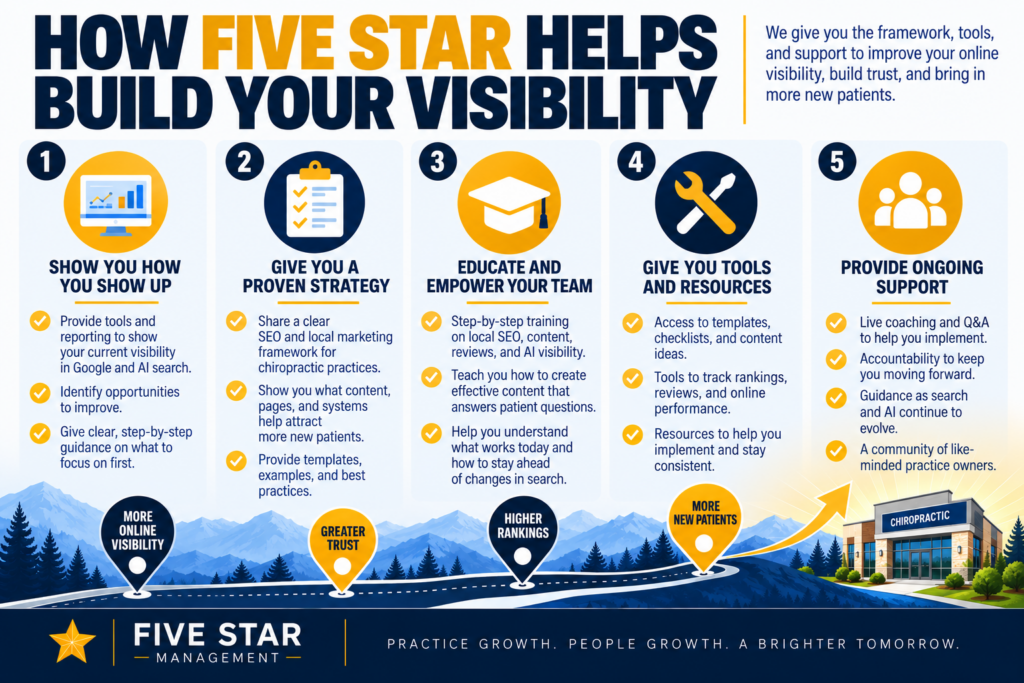
How Five Star Helps Chiropractors Build Predictable New Patient Growth
SEO shouldn’t exist in a vacuum.
Your practice needs more than website traffic.
It needs a complete new patient generation system.
At Five Star Management, we help chiropractors look at the bigger picture, including:
Digital visibility
Marketing systems
Community outreach
Patient referrals
New patient conversion
Retention
Tracking and accountability
Team systems
Because ranking on Google is valuable.
But the ultimate goal isn’t more clicks.
It’s building a healthier, more predictable practice.
Our New Patient Academy helps practices create systematic new patient generation, including developing a Community Outreach Assistant and building consistent community marketing activity.
And our AI Visibility System helps chiropractors evaluate how clearly their practice is represented as patient discovery continues evolving toward AI-driven search. Five Star describes the system as including an AI Visibility Scorecard, optimization blueprint, content plan, and visibility tracker.
If you’d like help determining where your practice’s marketing and growth systems can improve, schedule a complimentary strategy session with a Five Star coach.
Final Thoughts
Your next new patient may already be searching.
They may search Google.
They may open Maps.
They may ask an AI assistant.
The platform may change.
The fundamental challenge doesn’t:
Can the internet clearly understand who you are, what you do, where you are, and why your practice is relevant?
Build that foundation.
Optimize your local presence.
Create genuinely useful content.
Develop your authority.
Earn patient trust.
Track what works.
And keep improving.
Because being a great chiropractor matters.
But if the people who need you can’t find you, they may never get the chance to discover how great your practice is.