

Hiring the wrong person is expensive.
And the cost is rarely limited to their paycheck.
Think about everything that happens when a new team member doesn’t work out.
You spend time recruiting them.
You interview them.
You train them.
Your existing team helps get them up to speed.
Your schedule slows down while they learn.
Then, a few weeks or months later, you realize they’re not the right fit.
Now you’re back where you started.
Except you’ve lost time, energy, momentum, and potentially thousands of dollars along the way.
For chiropractic practice owners, hiring isn’t simply an HR responsibility.
It’s a growth strategy.
The right people can help you serve more patients, strengthen your culture, develop new leaders, and eventually build a practice that doesn’t depend entirely on you.
The wrong people can do exactly the opposite.
So before you post your next job opening, let’s look at some of the most expensive hiring mistakes chiropractic practice owners make—and how to avoid them.
The Real Cost of a Bad Hire
It’s tempting to measure a bad hire by one number:
How much did we pay them?
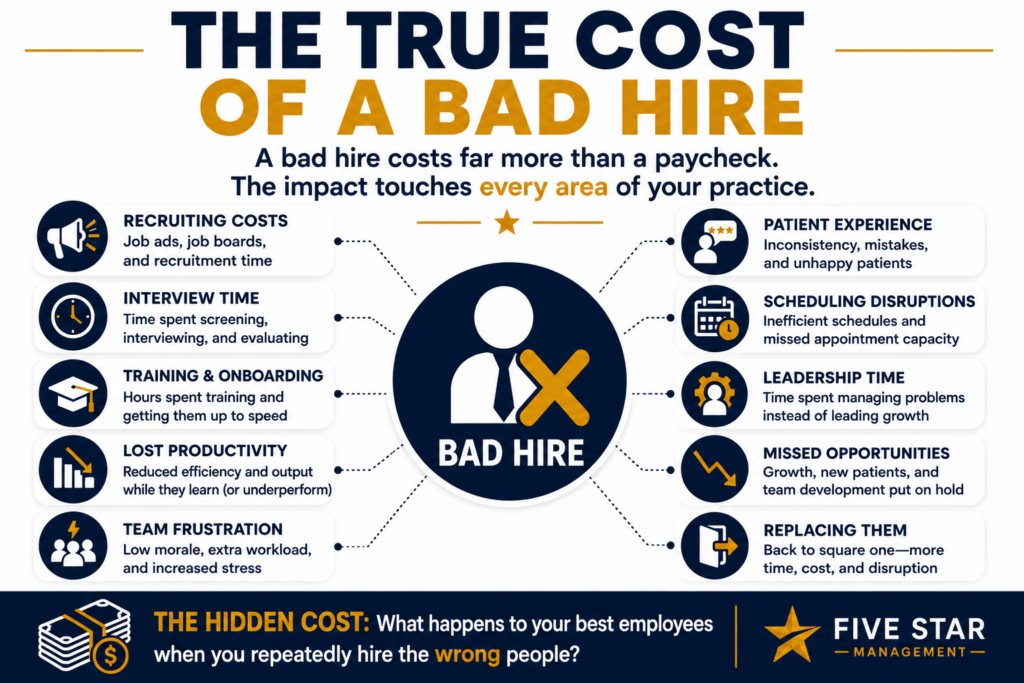
But salary is only part of the equation.
The true cost can include:
- Recruiting and advertising expenses
- Interviewing time
- Training hours
- Lost productivity
- Leadership time
- Team frustration
- Scheduling disruptions
- Patient experience issues
- Missed opportunities
- Additional recruiting when the person leaves
And there’s another cost that’s much harder to calculate:
What happens to your best employees when you repeatedly hire the wrong people?
High performers notice when someone isn’t carrying their weight.
They notice when standards aren’t enforced.
They notice when leadership tolerates behavior that doesn’t align with the culture.
Eventually, one bad hire can begin affecting people you absolutely don’t want to lose.
That’s why hiring deserves more attention than simply filling an empty seat.
Hiring Mistake #1: Hiring Because You’re Desperate
Someone quits unexpectedly.
The front desk is overwhelmed.
The phones are ringing.
Patients are waiting.
And suddenly your hiring criteria becomes:
Can you start Monday?
This is where expensive hiring decisions begin.
Urgency causes owners to overlook warning signs they would normally notice.
Instead of asking:
Is this the right person?
They ask:
Can this person solve my immediate problem?
Those are two very different questions.
An empty position creates temporary pressure.
The wrong person can create months of problems.
Build a recruiting process before you’re desperate so you’re not forced to lower your standards when someone leaves.

Hiring Mistake #2: Hiring for Skills Instead of Character
Experience is attractive.
Someone who has already worked in a chiropractic office may seem like the obvious choice.
But experience doesn’t automatically mean alignment.
You can teach someone how to use your software.
You can teach your scheduling system.
You can teach procedures.
You can teach scripts.
It’s much harder to teach:
- Integrity
- Work ethic
- Positivity
- Accountability
- Coachability
- Empathy
- Teamwork
That’s why character should carry enormous weight in your hiring decisions.
Ask yourself:
Would I want this person’s attitude influencing the rest of my team every day?
Because it will.
Every person you hire either strengthens your culture or changes it.
There really isn’t a neutral option.
If you want to understand how hiring and culture work together, listen to our podcast, How to Build a Strong Chiropractic Practice Culture That Keeps Great Team Members. We break down how intentional culture helps chiropractic practices attract, develop, and retain the right people.
Hiring Mistake #3: Not Defining What Success Looks Like
Imagine hiring someone to play a game without telling them how to win.
That’s what happens when a new employee receives a job title but no clear expectations.
“Front Desk.”
“Chiropractic Assistant.”
“Office Manager.”
“Associate Doctor.”
Those titles don’t define success.
Before hiring anyone, determine:
- What are they responsible for?
- What results should they produce?
- What standards must they meet?
- What numbers will be measured?
- What behaviors are expected?
- What does excellent performance look like?
If you can’t clearly answer those questions, your new employee probably won’t be able to either.
You can’t hold someone accountable to expectations you never clearly established.
Hiring Mistake #4: Talking Too Much During the Interview
Practice owners often spend interviews selling the job.
They explain the practice.
They describe the culture.
They talk about the patients.
They explain the position.
They talk about themselves.
Then the interview ends—and they barely know the candidate.
The interview should help you discover how the person thinks.
Ask questions that require examples.
Instead of:
“Are you good with difficult patients?”
Ask:
“Tell me about a time you had to deal with an upset customer. What happened, and how did you handle it?”
Instead of:
“Are you a team player?”
Ask:
“Tell me about a time a coworker wasn’t pulling their weight. What did you do?”
Past behavior can reveal far more than polished interview answers.
Your job isn’t to convince every candidate to work for you.
Your job is to determine whether the right candidate should.
Hiring Mistake #5: Ignoring the Red Flags
Sometimes you see the warning signs.
You just don’t want to see them.
The candidate complains about every previous employer.
They blame other people for problems.
They’re dismissive toward your staff.
They arrive unprepared.
Their answers don’t line up.
Something feels off.
But you’re short-staffed.
So you rationalize it.
Maybe they’ll be different here.
Occasionally, they will.
Often, the behavior you saw during the interview becomes much more obvious after they’re hired.
Don’t let desperation talk you out of your standards.
A red flag before employment rarely becomes easier to manage afterward.
Hiring Mistake #6: Hiring Someone Without Considering the Culture
A candidate can be capable and still be wrong for your practice.
That’s why every hiring decision should include a culture question:
Does this person fit how we operate?
Consider your practice’s:
- Mission
- Values
- Communication style
- Energy
- Standards
- Patient philosophy
- Leadership expectations
Your culture isn’t something you introduce after someone gets hired.
It should influence who gets hired in the first place.
This becomes even more important as your organization grows.
As we discuss in The Secret to Staff Retention, great people are more likely to stay when they feel aligned with the mission, supported by leadership, and connected to the people around them.
Retention begins with recruitment.
Hiring Mistake #7: Expecting a Great Hire to Figure It Out
You found a fantastic candidate.
They accepted.
Problem solved, right?
Not quite.
A great hire can still fail inside a poor onboarding system.
Too many practices treat onboarding like this:
Here’s your desk. Here’s the software. Follow Sarah around for a few days. Let us know if you have questions.
That’s not onboarding.
That’s improvisation.
Your new employee needs a structured path for learning:
- Their role
- Your systems
- Your standards
- Your culture
- Your communication
- Their performance expectations
That’s why we’ve emphasized the importance of a structured 30-60-90 day process in Chiropractic Onboarding Systems: How to Set New Team Members Up for Long-Term Success.
Hiring gets someone through the door.
Onboarding determines what happens next.
Hiring Mistake #8: Waiting Too Long to Address a Bad Fit
This is one of the most expensive mistakes of all.
The owner knows the employee isn’t working out.
The team knows.
Sometimes the employee probably knows.
But nobody wants to have the difficult conversation.
So another week passes.
Then another month.
Meanwhile, the problem continues affecting the practice.
This doesn’t mean leaders should make impulsive personnel decisions.
It means problems deserve leadership.
Set clear expectations.
Provide feedback.
Coach.
Document.
Give people an opportunity to improve when appropriate.
But don’t confuse kindness with avoiding accountability.
Ignoring a performance problem isn’t fair to the struggling employee—and it isn’t fair to the high-performing team members carrying the extra load.
Hiring Mistake #9: Hiring an Associate Before the Practice Is Ready
Hiring an associate doctor deserves special attention because the financial stakes can be significantly higher.
An associate isn’t simply another employee.
You’re adding another provider whose success depends on your ability to:
- Generate patient opportunities
- Train them
- Coach them
- Develop their communication
- Integrate them into the team
- Establish clear performance expectations
- Create a path toward profitability
That’s why hiring an associate simply because you’re busy can be dangerous.
Before you hire, ask:
Do we have the systems and financial capacity to successfully launch this doctor?
If the answer is no, hiring isn’t solving the problem.
It may be creating a bigger one.
In Why Most Chiropractic Associate Programs Fail (And How to Fix Yours), we explain why associate success depends on the system surrounding the doctor—not simply the talent of the doctor you hire.
Hiring Mistake #10: Hiring From Financial Pressure
This one is especially important when hiring associate doctors.
If the only way you can afford the hire is for the new doctor to become productive immediately, you’re creating pressure from day one.
That pressure changes decisions.
Owners become impatient.
Training gets rushed.
Expectations become unrealistic.
And sometimes the owner begins handing over existing patients simply to make the associate’s numbers look better.
That can create short-term relief without building long-term capability.
A healthier approach is to hire from financial strength.
Have enough financial runway to properly train, mentor, and develop the person without needing instant results.
The goal shouldn’t be:
How quickly can this employee pay for themselves?
It should be:
How do we build this person into a productive long-term contributor to the practice?
Hiring Mistake #11: Assuming the Hiring Process Ends With the Offer
The offer letter isn’t the finish line.
It’s the starting line.
Your responsibility shifts from selecting the right person to developing them.
Strong organizations continually:
- Coach
- Train
- Communicate
- Recognize
- Measure
- Develop
This is where hiring connects directly to retention.
You can have the best recruiting process in chiropractic and still experience turnover if people don’t have strong leadership once they arrive.
Your hiring system gets great people in.
Your leadership system gives them reasons to stay.
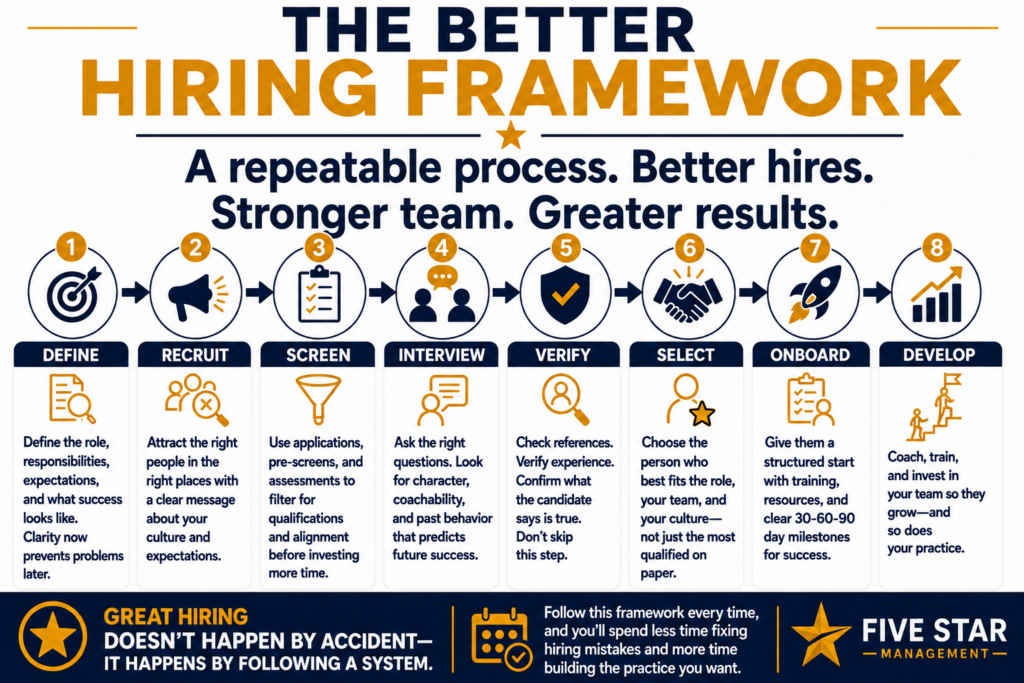
The Better Hiring Framework
Instead of treating hiring like an emergency response, build a repeatable system.
Think of the process as:
Define → Recruit → Screen → Interview → Verify → Select → Onboard → Develop
Each step protects the next.
Define the role before advertising it.
Screen before interviewing.
Interview for character and capability.
Verify before making an offer.
Onboard before expecting independence.
Develop before expecting leadership.
When those pieces work together, hiring becomes far more predictable.
And that’s when your team becomes a competitive advantage instead of a recurring source of stress.
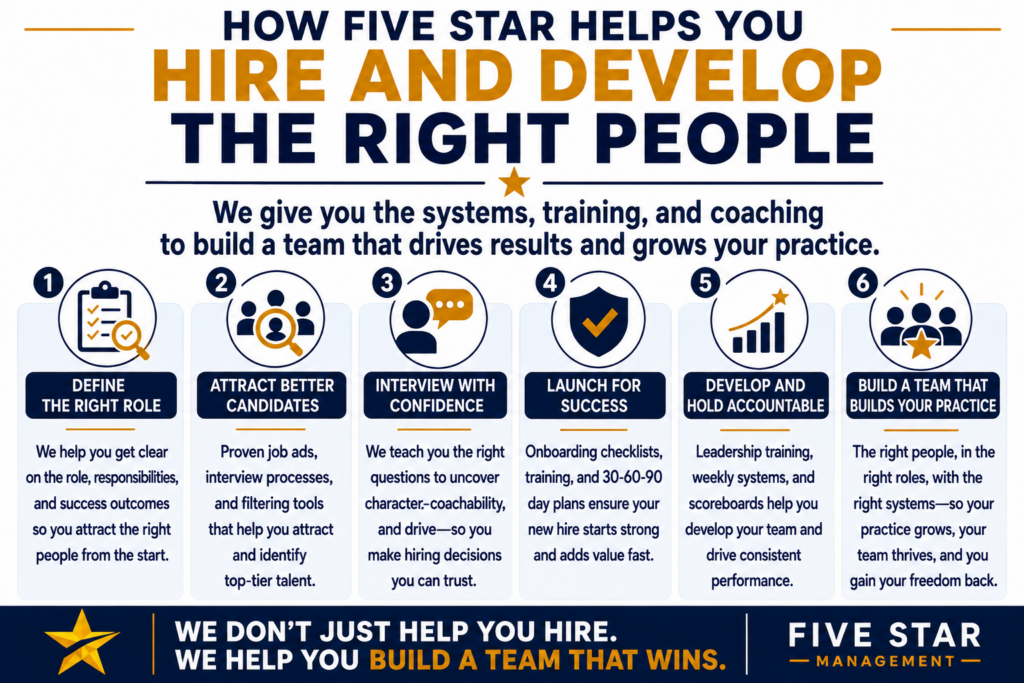
How Five Star Helps Chiropractors Build Better Teams
At Five Star Management, we know that practice growth eventually becomes people growth.
You can only do so much yourself.
At some point, your ability to build a larger, stronger practice depends on your ability to attract, select, develop, and lead great people.
That’s why our coaching helps chiropractic practice owners create stronger systems around:
- Hiring
- Onboarding
- Leadership
- Accountability
- Team development
- Associate success
- Practice culture
For practices building associate teams, our Win-Win Associate System provides a framework for creating associate relationships designed to benefit the owner, doctor, team, and patients.
And through leadership development programs like CDEP, we help owners develop leaders capable of carrying greater responsibility as the organization grows.
If you’re preparing to make an important hire—or you’re tired of repeating the cycle of hiring, training, losing people, and starting over—schedule a complimentary strategy session with Five Star Management.
Let’s build a team that can support where you want your practice to go next.
Final Thoughts
A bad hire can cost thousands.
But the bigger cost may be what that hire prevents your practice from becoming.
Hiring the right people creates leverage.
It creates capacity.
It protects culture.
It develops future leaders.
And it allows your practice to grow beyond what you can personally accomplish.
So don’t hire simply to fill a seat.
Know who you’re looking for.
Know what success looks like.
Protect your standards.
Build a real onboarding process.
And give the right people an opportunity to grow.
Because the goal isn’t just to hire someone who can do the job today.
It’s to build a team capable of helping you create the practice you want tomorrow.